
LOCATION: Russell County, Alabama; Columbus, GA; Girard, AL
PERIOD: 1850s-1960s
DRAMATIS PERSONAE: Roy Cooper (1794-1858); Mary O’Neill (1801-1826); Edith Carter (1799-1872); Frank Roy “Th’ Cunn’l” Cooper (1823-1865); Luther “Sonny Ray” Cooper (1827-1876); Lucas Keith Cooper (1887-1965); Henry Barbour (1848-1924); Charles Thomas Barbour (1933-1955).
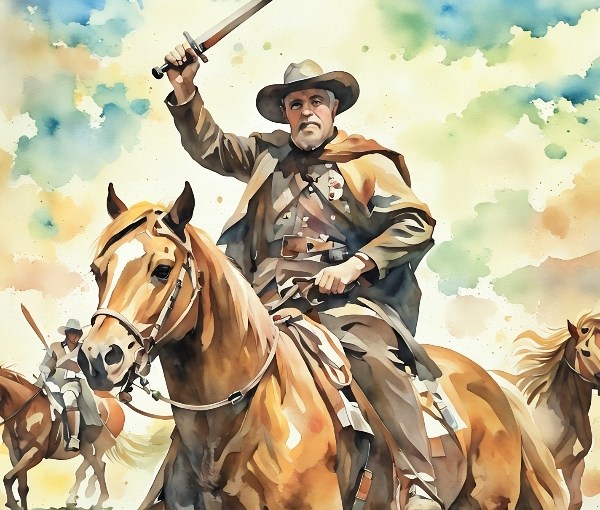
Henry Barbour was part Black and part Catawba Indian was brought as a slave to eastern Alabama by his owner Frank Roy “Th’ Cunn’l” Cooper. Cooper fought and died in the last battle of the War Between the States, which took place near the 14th Street Bridge across the Chattahoochee River on April 16th, 1865. The news of Lee’s surrender at Appomattox a week earlier had not reached Alabama yet.
Th’ Cunn’l was a contractor and builder, and Barbour was his labor foreman, constructing most of the first houses of Columbus, Georgia and Girard, Alabama. After Th ‘Cunn’l’s death, Barbour provided for his widow as long as she lived.
During Reconstruction, Barbour served in the Alabama legislature as a representative from Russell County. Over his former owner’s grave, Barbour erected a shaft with an inscription stating that the stone was placed by Henry Barbour in lasting remembrance of the love and gratitude he felt for his lost friend and former master.
Roy Cooper (1794-1858), Th’ Cunn’l’s father, had a second wife, Edith Carter (1799-1872), who he married after his first wife, Mary O’Neill (1801-1826), died giving birth to his second son, Lucas Neil Cooper (1826-1901). This second family would produce Frank’s half brother, Luther “Sonny Ray” Cooper (1827-1876).
“Sonny Ray” rode with Bedford Forrest, and together after the war, they were early members of the Ku Klux Klan (KKK), which was formed by six veterans of the Confederate Army in Pulaski, Tennessee, during the spring of 1866. Two years after Appomattox, Forrest was reincarnated as grand wizard of the Ku Klux Klan. As the Klan’s first national leader, he became the Lost Cause of the Confederacy’s avenging angel, galvanizing a loose collection of boyish secret social clubs into a reactionary instrument of terror.
But their activities were mostly limited to harassing Federal troops attempting to enforce the new laws of Reconstruction (1865-1877). Forrest also hoped to persuade black voters that returning to their pre-war state of bondage was in their best interest.
Because of the essentially ungovernability of the larger membership of the KKK, and a number of what Forrest thought of as counterproductive violent attacks and lynchings, he announced the dissolution of the organization, and officially left the group. The Klan remained mostly dormant until the early 1910s.
This second iteration of the Klan was the first to use cross burnings and standardized white-hooded robes. The KKK of the 1920s had a nationwide membership in the millions and reflected a cross-section of the native born white Protestant population. The third and current Klan formed in the mid 20th century, was largely a reaction to the growing civil rights movement. It used murder and bombings to achieve its aims.
Each generation of the Cooper family, after Lucas “Sonny Ray” Cooper were sympathetic to the Klan,imbibed it’s racist ideology, and were mostly white supremacists. It was Sonny Ray’s great-grandson, Lucas “Sonny Boy” Cooper (1935-1965), who would be among the mob that lynched Henry Barbour’s great-grandson, Charles Thomas Barbour (1933-1955) in 1955.
Ten years later, the narrator of this song, Lucas Keith Cooper (1887-1965), would confront Sonny Boy. They would fight, both dying from their wounds – 100 years to the day of the death of Frank Roy Cooper.
THE BALLAD OF CUNN’L COOPER
(F. D. Leone, Jr.)
My name is Lucas Cooper;
I died in 1965.
Hundred years from the day,
My grandpa Frank died.
Th’ Cunn’l was killed,
16th of April.
The last battle of the war,
A final betrayal.
Way down;
Way down.
Soldier fights a cause lost,
On bloody Southern ground.
Way down;
Way down.
All the rest is talk,
An empty sound; way down.
Henry Barbour was a slave;
Part Black, part Catawba Injun.
Worked for Th’ Cunn’l,
Supervising construction.
Provided for his widow,
Long as she was livin’.
Carved grandpa’s tombstone,
With a loving inscription.
Way down;
Way down.
Folks will surprise you,
Step out from the crowd.
Way down;
Way down.
Stand beside you,
On common ground; way down.
Grandpa had a half-brother,
Cut from a different cloth.
Th’ Cunn’l was a Christian;
Luther had no god or law.
That’s what he passed down,
Till it produced the one,
Who was in the mob that hanged,
Henry Barbour’s great-grandson.
Way down;
Way down.
Destiny foretold,
Around a neck a noose is wound.
Way down;
Way down.
History is a long road,
Twisting around; way down.
That fella, Sonny Boy Cooper,
Lived ’til 1965.
When he stumbled cross my path;
We fought; we died.
Sank like lead,
The die had been cast.
The past ain’t dead,
It ain’t even past.
Way down;
Way down.
Our stars crossed;
In an Alabama town.
Way down;
Way down.
Battles had been fought,
Been lost; been found; way down.
© 2025 Frank David Leone, Jr./Highway 80 Music (ASCAP). The songs and stories on the Highway 80 Stories website are works of fiction. Names, characters, businesses, places, events, locales, and incidents are either the products of the author’s imagination or used in a fictitious manner. Any resemblance to actual persons, living or dead, or actual events is purely coincidental.

 Highway 80 Stories