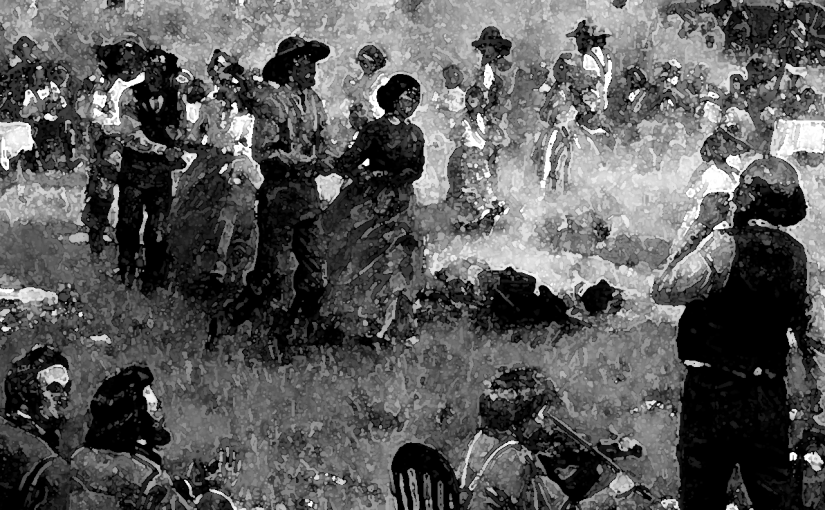
“The Langfords and the Littlejohns”


LOCATION: North Carolina Mountains
PERIOD: 1900s
DRAMATIS PERSONAE: George Littlejohn (1896-1944); Anse Littlejohn (1871-1961); Emily Langford (1900-1977); Elijah “Lige” Langford (1874-1925)


George Littlejohn, the “lone white sheep in a family of black,” was the son of Anse Littlejohn.  While his father, and brothers, were hard-nosed, severe and difficult to get along with North Carolinians, George was pretty much the opposite.  However, he was a strong individual, a quality which allowed him to defy his father and marry Emily Langford, the daughter of a strict Presbyterian family.

George and Emily left North Carolina and ended up in Mississippi, they were the great grandparents of Levi Hooper.


THE LANGFORDS AND THE LITTLEJOHNS
(F. D. Leone, Jr.)

The Littlejohns were ner-do-well
Soon as tell you hello as “go to hell”
The whole bunch was on’ry and mean
They’d fight for the least little thing
The Langfords on the other hand
Were a church-goin’, peace-lovin’ clan
When Emily turned sixteen
She was George Littlejohn’s dream

When George Littlejohn came to court
Lige Langford wouldn’t open his door
George stayed on the porch all night
Just a-singin’ in the yellow moonlight
Next mornin’ he was still there
Snorin’ in the rockin’ chair
Alma kicked him and said “come on in”
Emily hid a sly little grin

The Littlejohns were ner-do-well
Soon as tell you hello as “go to hell”
The whole bunch was on’ry and mean
They’d fight for the least little thing
The Langfords on the other hand
Were a church-goin’, peace-lovin’ clan
When Emily turned sixteen
She was George Littlejohn’s dream

Now George wasn’t like the rest
Emily brought out his best
The lone white sheep in a fam’ly of black
She made sure he kept comin’ back
At the weddin’ Lige stood next to Anse
They drank, laughed and shook hands
When Em’ly married George Littlejohn
The two fam’lies were joined into one
When Em’ly married George Littlejohn
Those two fam’lies became one

The Littlejohns were ner-do-well
Soon as tell you hello as “go to hell”
The whole bunch was on’ry and mean
They’d fight for the least little thing
The Langfords on the other hand
Were a church-goin’, peace-lovin’ clan
When Emily turned sixteen
She was George Littlejohn’s dream

© 2018 Frank David Leone, Jr./Highway 80 Music (ASCAP). The songs and stories on the Highway 80 Stories website are works of fiction. Names, characters, businesses, places, events, locales, and incidents are either the products of the author’s imagination or used in a fictitious manner. Any resemblance to actual persons, living or dead, or actual events is purely coincidental.

“Rosalie”


LOCATION: Mobile, Alabama
PERIOD: 1980s-90s
DRAMATIS PERSONAE: Rosalie Broussard (1967); Tullison “Tully” Tate (1965-1993)


Rosalie Broussard Tate has a history of running away from any relationship she is in.  This time she has run from her marriage leaving her husband Tully Tate and their twin girls at home.


ROSALIE
(F. D. Leone, Jr.)

In a cocktail lounge in Mobile
Just about closing time
Empty shot glass on her table
Rosalie shuts her eyes

Tully would always find her
Bring her home in the past
Rosalie looks around her
Guess he gave up at last

Anytime anyone loves her
Soon she’ll be gone
To the dim lights of a barroom
Where she feels she belongs
Mistrusting human kindness
She’d rather be alone
Telling herself she’s free
Rosalie, ah, Rosalie

She’d like to kick the habit
Always choosing to run
Since she was sixteen
It’s what she’s relied upon

There’s a devil lying to her
Whispering in her ear
She wants to ignore it, but
It’s the strongest voice she hears

Anytime anyone loves her
Soon she’ll be gone
To the dim lights of a barroom
Where she feels she belongs
Mistrusting human kindness
She’d rather be alone
Telling herself she’s free
Rosalie, ah, Rosalie

© 2018 Frank David Leone, Jr./Highway 80 Music (ASCAP). The songs and stories on the Highway 80 Stories website are works of fiction. Names, characters, businesses, places, events, locales, and incidents are either the products of the author’s imagination or used in a fictitious manner. Any resemblance to actual persons, living or dead, or actual events is purely coincidental.

“Rosa Parks”


LOCATION: Montgomery, Alabama
PERIOD: 1950s
DRAMATIS PERSONAE: Rosa Louise McCauley Parks (1913–2005)


Rosa Louise McCauley Parks (February 4, 1913 – October 24, 2005) was an American activist in the civil rights movement best known for her pivotal role in the Montgomery bus boycott. The United States Congress has honored her as “the first lady of civil rights” and “the mother of the freedom movement”. Parks became a NAACP activist in 1943, participating in several high-profile civil rights campaigns. On December 1, 1955, in Montgomery, Alabama, Parks rejected bus driver James F. Blake’s order to vacate a row of four seats in the “colored” section in favor of a White passenger, once the “White” section was filled.

Parks was not the first person to resist bus segregation, but the National Association for the Advancement of Colored People (NAACP) believed that she was the best candidate for seeing through a court challenge after her arrest for civil disobedience in violating Alabama segregation laws, and she helped inspire the Black community to boycott the Montgomery buses for over a year. The case became bogged down in the state courts, but the federal Montgomery bus lawsuit Browder v. Gayle resulted in a November 1956 decision that bus segregation is unconstitutional under the Equal Protection Clause of the 14th Amendment to the U.S. Constitution. (Wikipedia)


ROSA PARKS
(F. D. Leone, Jr.)

She was born in 1913, Jim Crow Alabama
Her mama was a teacher, her daddy slung a hammer
She couldn’t ride the bus to school ’cause she wasn’t white
A quiet girl, taught to be polite – Rosa Parks
1955 Montgomery city buses had two tiers
Whites sat up front and blacks in the rear
One day the seats for whites, they were all taken
If you thought they’d ride standin’ up you’d be mistaken – Rosa Parks

The driver told Rosa to give a white man her seat
But she was tired of giving in, jus’ sat ‘n’ grit her teeth
The police were called and they hauled Rosa in
She had broke the law, but the law was a sin – Rosa Parks

The whole community refused to ride the bus
Their boycott carried on for thirteen months
They drove their own cars along the same bus line
Picking up and making sure folks got to work on time – Rosa Parks
Rosa’s name is the one we know but there were many others
Preachers, treachers, fathers and mothers
The case made its way through the courts to decide
And when they did it was the day Jim Crow died – Rosa Parks

It took one woman who refused to be moved
And marches and sit-ins, before things improved
This battle has gone on 400 years and more
There are battles still to fight in this civil war – Rosa Parks

She was born in nineteen-thirteen, Jim Crow Alabama
Her mama was a teacher, her daddy slung a hammer
Rosa Parks, Rosa Parks, Rosa Parks

© 2022 Frank David Leone, Jr./Highway 80 Music (ASCAP). The songs and stories on the Highway 80 Stories website are works of fiction. Names, characters, businesses, places, events, locales, and incidents are either the products of the author’s imagination or used in a fictitious manner. Any resemblance to actual persons, living or dead, or actual events is purely coincidental. Image By Gene Herrick for the Associated Press; restored by Adam Cuerden – https://collections.si.edu/search/detail/edanmdm:npg_NPG.2013.76?q=record_ID%3Dnpg_NPG.2013.76, Public Domain, https://commons.wikimedia.org/w/index.php?curid=81795628

“Riding Shotgun in Phenix City”


LOCATION: Phenix City, Alabama
PERIOD: 2002
DRAMATIS PERSONAE: Josh Tate Campbell (1985); Sally Anderson(1985-2002)


Josh Tate Campbell (1985), Tully Tate’s nephew, the son of his sister Ruth, was born in 1985 in Phenix City, Alabama.  This song is a coming of age story, describing Josh’s first two loves: his girlfriend Sally Anderson and his car, a 1978 Chevelle.

Josh and Sally met in high school and were best friends which developed into their first experience with love.  As soon as he could Josh saved up and bought a 1978 Chevelle, which he worked on and got running.  With his new drivers license in hand he and Sally would go driving on Highway 80 outside of Phenix City.

Until the summer night that changed Josh’s life.


RIDING SHOTGUN IN PHENIX CITY
(F. D. Leone, Jr.)

Phenix City, Alabama
We were in high school
Talked like we were slick
Walked like we were cool

I got my drivers license
Summer of 2001
Bought a green ’78 Chevelle
You rode shotgun

Didn’t know how brief
Our time would be
That summer was sweet
You rode shotgun with me

We rolled the windows down
Laughin’ in the wind
I’ve never loved anyone
Like I loved you then

Never knew what hit us
80 at Evans Road
A little cross stands at that corner
The Chevelle was sold

Didn’t know how brief
Our time would be
That summer was sweet
You rode shotgun with me
That summer was sweet
You rode shotgun with me

Phenix City, Alabama
We were in high school

© 2020 Frank David Leone, Jr./Highway 80 Music (ASCAP). The songs and stories on the Highway 80 Stories website are works of fiction. Names, characters, businesses, places, events, locales, and incidents are either the products of the author’s imagination or used in a fictitious manner. Any resemblance to actual persons, living or dead, or actual events is purely coincidental.

“Lowndes County”


LOCATION: Lowndesboro, Alabama
PERIOD: 1933
DRAMATIS PERSONAE: Lamar Hooper (1907-1969); Lowndnes County Sheriff; Lowndes County General Sessions Court Judge; teenage girl at jail


This song takes place in 1933, during the depth of the Depression in North Alabama. Lamar Hooper, Levi Hooper’s grandfather, was born on Sand Mountain and when he was in his early 30s chose to go south to look for work. He walked to the nearest road and then put up his thumb hoping for a ride.

It wasn’t long before a truck picked him up and brought him all to way to Lowndes County in the central part of the state. However, that night he got into a little trouble in Lowndesboro, a small town on Highway 80.


LOWNDES COUNTY
(F. D. Leone, Jr.)

Sand Mountain’s where I’m from
Traveling South on my thumb
Until I heard a jail door slam
In Lowndes County, Alabam’

I’d just been there a week or two
What they said I done, I did not do
They picked me up Saturday night
Charged me for damage and a fight

I told them it was self-defense
What I said made no difference
They held me over for trial,
“Be a few days,” they smiled

The Judge was deaf to my plea
“Son, you look guilty to me”
Thirty dollars or thirty days
Up to you, it’s all the same”

“Thirty dollars I ain’t got
I might as well sit in jail and rot”
Just came south to look for work
Never thought things’d be worse

Teenage girl brought me a plate
Then sat and watched as I ate
A biscuit and slice of ham
She even gave me some strawberry jam

Slipped the fork back through the bars
Said she’d come around after dark
If I could get myself free
She just might run away with me

Sheriff came to check my cell door
Said, “One day done, 29 more
Get some rest tomorrow you’ll work”
I fingered that fork under my shirt

They call this place Alabam’
But Hell is surely where I am
I forgot why I chose to come
Never should’ve left Sand Mountain

Don’t know why I chose to come
Never should’ve left Sand Mountain

© 2020 Frank David Leone, Jr./Highway 80 Music (ASCAP). The songs and stories on the Highway 80 Stories website are works of fiction. Names, characters, businesses, places, events, locales, and incidents are either the products of the author’s imagination or used in a fictitious manner. Any resemblance to actual persons, living or dead, or actual events is purely coincidental.

“King Cotton”


LOCATION: Thomas William Monroe (1812-1909)
PERIOD: 1890s
DRAMATIS PERSONAE: Tullison Tate (1866-1938); Jessie “Crawford” (1828-1905); Thomas William Monroe (1812-1909); Celsie Monroe (1844-1936)


It’s July 1899 and Tullison Tate (1866-1938) is sitting in his wagon, loaded with cotton, in line waiting for it to be ginned.  The Monroe family has owned most of this Perry County, Alabama, town’s businesses including the gin. Tully’s grandmother was a slave from a neighboring plantation, Jessie “Crawford” (1828-1905), who was impregnated by Thomas William Monroe (1812-1909), producing a mixed blood daughter, Celsie in 1844, Tully’s mother.  Tully’s status in the community is as complicated as his blood.


KING COTTON
(F. D. Leone, Jr.)

Line of wagons filled with cotton
Moving up one by one
Line ends at Tommy, Jr.
Ol’ man Monroe’s son

Monroe owns the gin, an’ smith
The bank, an’ the store
It’s been a Monroe town
Since before The War

Heard ’em say cotton is king
Well, I ain’ seen one yet
The more I work, all it seems
The more I get in debt

Price of cotton keeps fallin’
Soon it won’t make sense to plant
Most are still plantin’ and pickin’
A few walked off their land

Sittin’ in a wagon of cotton
Won’t get ginned ’til ‘roun’ four
Tommy says what I got comin’
Less my bill at the store

Heard ’em say cotton is king …

They call me Monroe’s Tully
Makin’ sure I know my place
Tom Monroe is my granddaddy
But my grandma was a slave

© 2018 Frank David Leone, Jr./Highway 80 Music (ASCAP). The songs and stories on the Highway 80 Stories website are works of fiction. Names, characters, businesses, places, events, locales, and incidents are either the products of the author’s imagination or used in a fictitious manner. Any resemblance to actual persons, living or dead, or actual events is purely coincidental.

“Demopolis, Alabama”


LOCATION: Demopolis, Alabama; Shreveport, Louisiana
PERIOD: 2016-2018
DRAMATIS PERSONAE: James Matt Broussard (1985); Michael James “Sarge” Broussard (1948-2014); Rosalie Broussard (1969)


James Matt Broussard (1985) is the grandson of Michael James “Sarge” Broussard (1948-2014), whose daughter Rosalie Broussard (1969) gave birth to James when she was sixteen (see song “James“).

Even though Rosalie Broussard was from Vivian, Louisiana, she had James in Shreveport, where she lived initially after giving birth. Eventually she left James with her parents and went to Alabama with a guy she ended up marrying, Tully Tate.

Once James turned 18 he also moved to Shreveport.  This song describes a two-year period, from 2016 to 2018, when James lived in Demopolis, Alabama.  He was interested in Alabama since that was where he thought his mother was.  He had taken up with a woman in Shreveport who was from Demopolis and she convinced him to move to Alabama with her.

That relationship didn’t last, but James didn’t immediately leave Demopolis. Maybe, he had in the back of his mind that he might get back together with the woman. But once James realized that he didn’t even like the woman, he finally decides to leave Alabama and return to Shreveport.

James enjoyed shooting guns; something about shooting lifted his spirits. So, on his way out of town he stops at a pawn shop to see what kind of guns they had, but unbeknownst to James there was a robbery in progress. James instinctively tries to stop the holdup but the robber panics, takes a shot at James, missing by a wide margin.

That was enough for James, who runs to his truck and tears off on US 80 West to Shreveport. The robber also exits the pawn shop, ignorant of the fact that his getaway car has a bad fuel pump. He doesn’t get very far before it breaks down and he is apprehended without much trouble by a Marengo County Sheriff’s Deputy.


DEMOPOLIS, ALABAMA
(F. D. Leone, Jr.)

I was born in Shreveport, Louisiana
But for about the last two years now
Been living in Demopolis, Alabama
It ain’t never felt like home somehow

I came here on account of a woman
But we didn’t last too long
Stuck around, I guess, looking for something
Months ago I should’ve been gone

Gonna get my gun, get my gun
Wanna shoot some, shoot some
Buy some more, at the range
A pump shotgun, a thirty eight

There’s a market with a wooden Indian out front
An old man we called Shakespeare was the owner
It’s been there since the fifties, untouched
I put some pork rinds and a beer on the counter

Handed Shakespeare the cash for my provisions
I remarked that the Indian was a little weird
He said, “ain’t you ever heard of Hank Williams,
‘ Kaw-Liga’ was a pretty big hit ‘round here”

Gonna get my gun, get my gun
Wanna shoot some, shoot some
Gonna get my gun, change my mood
Wanna shoot some, improve my attitude

I’m sitting in my truck outside her house
She’s got a new boyfriend, from Alabama
I watch him take all her garbage out
Guess I’ll head on back to Louisiana

But before I do I stop at a pawn shop
A guy had a gun, “gimme all the cash,” he said
Without thinking I yell, “hey fella, stop”
He whirled around, threw a shot at at my head

Gonna get my gun, get my gun
Wanna shoot some, shoot some
Gonna get my gun, that’s what I’ll do
Put Demopolis, Alabama in my rear view

© 2020 Frank David Leone, Jr./Highway 80 Music (ASCAP). The songs and stories on the Highway 80 Stories website are works of fiction. Names, characters, businesses, places, events, locales, and incidents are either the products of the author’s imagination or used in a fictitious manner. Any resemblance to actual persons, living or dead, or actual events is purely coincidental.
“Crossin’ the Edmund Pettus Bridge”


LOCATION: Marengo County, Selma & Montgomery, Alabama
PERIOD: 1850s-1960s
DRAMATIS PERSONAE: Celsie Monroe (1844-1936); Jesse Harper (1850-1922); Joshua Tate (1828-1867); Tullison Monroe Tate (1866-1948); William Harper (1877-1945); Mason Harper (1905-1979); William Crawford Harper (1942-2001)


In 1844 Celsie Monroe was born into slavery; in 1865 she was freed. One hundred years later her great-grandson, Willie Harper, was one of those who joined the Selma March.

Celsie Crawford Monroe (1844-1936) was born into slavery but was freed by Will Monroe, a wealthy white planter and her father, in 1863 as a result of Abraham Lincoln’s Emancipation Proclamation.
Celsie’s mother, Jessie Crawford (1828-1905), was a slave from a neighboring plantation of whom Will Monroe had grown quite fond. Monroe made sure Jessie was provided for and also insisted that she be freed in 1863 by paying off her owner Carson Crawford.

Celsie was what was called a “yellow gal”, and quite beautiful. Once she was freed at age 19, Celsie began seeing a white man, Joshua Tate (1828-1867), and their relationship developed into a common law marriage, although the possibility of such a union was denied at the time.

The Tates were a wealthy Alabama family held in high regard and Joshua’s indiscretion was of course never openly acknowledged by the family and surrounding community, although everyone knew of it and the child it eventually produced.

Joshua was nominally a lawyer handling cotton trades and other mercantile business for the planters. But as was the custom for sons of his class, his hours were at his own instigation. Although he made a daily trip to town, he might only spend an hour or two in the afternoon in his office, often asleep on the leather couch sitting against the wall, next to the large hearth fire.

After the War, Republican “carpetbaggers” entered the former Confederacy and worked to overturn every vestige of slavery and the old ways at every turn; Alabama was no exception. These men were hated since they were seen as enemy outsiders, and interlopers and exploiters who added insult to the injury of losing the war. It was during this turbulent period that Joshua Tate was murdered in 1867 in his second floor office by a man with a three barreled derringer pistol, while Joshua was relaxing on the couch with a volume of Homer.

Some said the motivation behind the killing was Tate’s relationship with Celsie Monroe; others said he was killed because of his covert support of the Republicans. Still a few others said he was killed by a carpetbagger. However, no one was ever accused much less arrested and convicted of Josh Tate’s murder.

Tate lingered for two days before dying, leaving Celsie with a son, Tullison Monroe Tate (1866-1948). Tully Tate was one-quarter African-American, light-skinned and who would marry a white woman and whose descendants would all be considered white, Tully’s blood becoming less and less present with each successive generation.

In 1872 Celsie’s first official marriage was to a African-American man, Jesse Harper (1850-1922), and Celsie and Jesse enjoyed a long and happy union, raising four children, seven grandchildren, and many great-grandchildren. However, Celsie’s oldest child, Tully, was raised by his spinster Aunt Ruth, his father’s sister.

One of Celsie’s great-grandchildren, William Crawford Harper (1942-2001), marched from Selma to Montgomery in 1965. Willie Harper lived to see most of the Jim Crow laws reversed even as the stubborn stain of racism remained.


CROSSING THE EDMUND PETTUS BRIDGE
(F. D. Leone, Jr.)

Named for a Confederate general
Who has all but faded from history
That bridge is a landmark of a struggle
Where slave descendants took a step towards victory

It’s only fifty miles from Selma to Montgomery
But that’s not really how far it is
It’s been a hundred year long journey
Crossin’ the Edmund Pettus Bridge

Celsie Monroe was a slave woman
Her great-grandson was William Crawford Harper
He was just a few miles from her plantation
When he stood with the hundreds of other marchers

It’s only fifty miles from Selma to Montgomery
But that’s not really how far it is
It’s been a hundred year long journey
Crossin’ the Edmund Pettus Bridge

Four girls were bombed in Birmingham
“The eagle stirs her nest”
Jimmy Lee Jackson shot down in Marion
Willie Harper was on that bridge for justice

It’s only fifty miles from Selma to Montgomery
But that’s not really how far it is
It’s been a hundred year long journey
Crossin’ the Edmund Pettus Bridge

© 2018 Frank David Leone, Jr./Highway 80 Music (ASCAP). The songs and stories on the Highway 80 Stories website are works of fiction. Names, characters, businesses, places, events, locales, and incidents are either the products of the author’s imagination or used in a fictitious manner. Any resemblance to actual persons, living or dead, or actual events is purely coincidental.
Demopolis, Alabama

Demopolis is the largest city in Marengo County, in west-central Alabama. The population was 7,162 at the 2020 census.

The city lies at the confluence of the Black Warrior River and Tombigbee River. It is situated atop a cliff composed of the Demopolis Chalk Formation, known locally as White Bluff, on the east bank of the Tombigbee. It is at the center of Alabama’s Canebrake region and is also within the Black Belt region.

Demopolis was founded in the early 1800s after the fall of Napoleon’s empire. It was named by a group of French expatriates, a mix of exiled Bonapartists and other French refugees who had settled in the United States after the overthrow of the colonial government in Saint-Domingue by enslaved workers. Napoleon had sent troops there in a last attempt to regain control of the island, but they were defeated, largely by high mortality due to yellow fever.

The name, meaning in Greek “the People’s City” or “City of the People”, was chosen to honor the democratic ideals behind the endeavor. First settled in 1817, it is one of the oldest continuous settlements in the interior of Alabama. French colonists had founded Mobile on the coast in the early 18th century. Demopolis was incorporated on December 11, 1821. (From Wikipedia, the free encyclopedia, Creative Commons Attribution-ShareAlike License 4.0)

“Lamar and Katherine Fall in Love”

After Katherine pulled one of her disappearing acts, Lamar followed and found her in Tuscaloosa.  She’d been partying with a bunch of college kids, living life large. This was 1928, and for a couple of years, this was their life which was typical during the “Jazz Age.”

But since all good things must come to an end, so did this in October 1929, and The Depression.

Kathy and Lamar did what most young people do when trouble finds them: they went home, to Montgomery.  There Lamar went to work at his father’s mill, and Katherine settled into the life as wife and mother.


Location: Tuscaloosa, Montgomery, Alabama
Period: 1928-1931
Dramatis personae: Katherine George (1910); Lamar Hooper (1907-1969)


LAMAR AND KATHERINE FALL IN LOVE
(F. D. Leone, Jr.)

Lamar finally found Katherine;
On a barge, partyin’
Been goin’ for a couple of weeks;
It was nineteen and twenty eight;
Th’ height of the Jazz Age;
They hardly stop’d to eat or sleep.
Ain’ the way it’s spose to happen, but it did;
They fell in love.

Hung ‘roun Tuscaloosa awhile
Livin’ large, goin’ wild;
Drinkin’ too much, makin’ new friends.
Katherine led and Lamar tagged along,
Out every night dusk to dawn;
Burning their candle at both ends.
They were young, just a coupla kids;
When they fell in love.

You don’t choose,
The one who’ll break your heart;
All you can do,
Is play your little part.
Tha’s why they call it fallin’ when it does;
You’re in love.

Right about then the Depression hit,
These two kids hit the skids;
So they went back home to Magomry.
Lamar got a job at his daddy’s mill,
They lived in a little house on a hill;
Settled down and started a family.
Just the way it’s spose to happen, and it did;
They’re in love.
 
Lamar made a little bootleg shine,
But didn’t drink at all this time;
Katherine was famous for her fig preserves.
She called him Pop, he called her Mother;
Had one child after another,
After three Kath still had her curves.
They were young, but no longer kids;
And they were in love.
 
You don’t choose,
The one who’ll break your heart;
All you can do,
Is play your little part.
Tha’s why they call it fallin’ when it does;
You’re in love.

© 2023 Frank David Leone, Jr./Highway 80 Music (ASCAP). The songs and stories on the Highway 80 Stories website are works of fiction. Names, characters, businesses, places, events, locales, and incidents are either the products of the author’s imagination or used in a fictitious manner. Any resemblance to actual persons, living or dead, or actual events is purely coincidental.