James Lamar Halladay (1973)

James “Jamie” Lamar Halladay was born in Monroe, Louisiana, in 1973.  His father was a musician, guitar player, Frank Halladay, who played in a series of bands, traveling Texas, Louisiana and eventually Nashville.  By the time Jamie was four, Frank Halladay stopped living with the family, which also included Jamie’s younger sister, Sadie, although not out of their lives altogether.  He would show up on birthdays and Christmas, when he could (see song “The Laughing Man at the Door“).

James Charles Halladay (1913-1995), Jamie Halladay’s grandfather, was a fighter pilot who served with distinction in the Army Air Corps during WWII. He learned to fly as a crop dusting pilot for the Huff Daland Dusters, as part of the eradication of the boll weevil. This company, moved from Macon Georgia to Monroe Louisiana, in 1925 but Charlie didn’t hire on until 1933, but stayed with the company as it became a regional commercial carrier, which eventually became Delta Airlines.

Hi son Frank showed a talent for music early on and learned to play the guitar listening to the Grand Ole Opry and especially Hank Williams when he was still pretty small. While in high school he started a band with some of his friends and they got pretty good. Good enough to become the backup band for Webb Pierce and played on the Louisiana Hayride.

It while he was playing with Webb Pierce that Frank met the woman who was to eventually become his wife and Jamie’s mother, Lee Ann Lucas. But while Frank and Lee Ann were in love and did get married, the itinerant lifestyle of a musician did not make for a stable home life and the marriage failed. Frank tried to see his kids as much as he could, but was not a regular presence in their lives.

Nevertheless, he did have an impact on Jamie’s life.

On his twelfth birthday, Frank gave Jamie a guitar and taught him a few chords, but that was just the start for Jamie. He eventually got good enough to move to Nashville and get some gigs there playing behind country stars. He ended up breaking into the studio scene and became a member of the “A list” players, i.e. first call musicians for recording sessions.

It was while he was living in Nashville, around 2003, that Jamie began visiting a bar, McLemore’s and became friends with the owner Jake McLemore (see song “McLemore’s“).

© 2019 Frank David Leone, Jr./Highway 80 Music (ASCAP). The songs and stories on the Highway 80 Stories website are works of fiction. Names, characters, businesses, places, events, locales, and incidents are either the products of the author’s imagination or used in a fictitious manner. Any resemblance to actual persons, living or dead, or actual events is purely coincidental.
Cole Lucas Broussard (1946-1965)

Cole Lucas “Luke” Broussard was the older brother of Mike Broussard, and both were born in Vivian, Louisiana; Luke two years older than Mike. Luke and Mike were descendants of Confederate soldier Coleman Broussard (1842-1910).

Although they were born in Vivian their father moved the family moved to the “big city” of Shreveport in 1953, and one of the first things their father did was buy a new car, a Studebaker Champion.

Studebaker

As soon as he could, Luke learned to drive that car and he would drive around Shreveport, often taking his younger brother Mike along. Coming from Vivian, Shreveport offered what seemed to them a world of exciting things to do, and Luke introduced most of them to Mike (see song “Shreveport, 1963“).

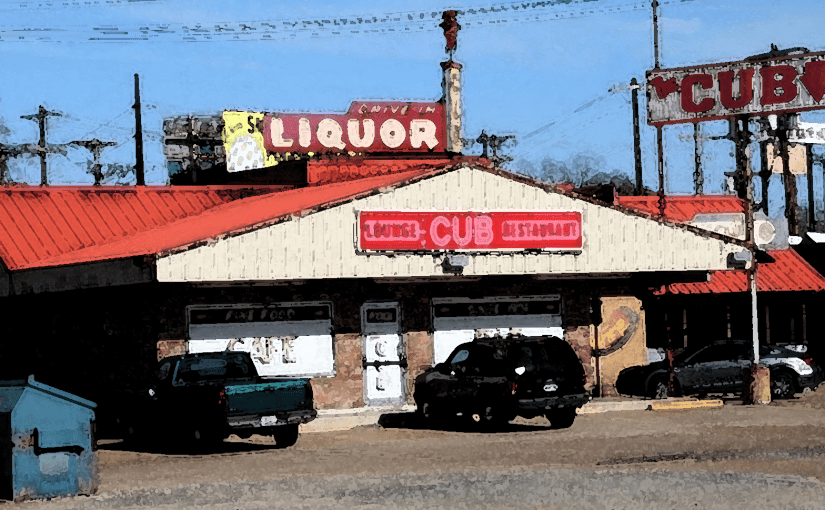
Things like going to the Cub drive-through liquor store and buying some whiskey which they’d put in a Coke. I guess the Cub’s management figured if you were old enough to drive, then you were old enough to drink.  However, in Shreveport in 1963, a sixteen year old was old enough to drive.

Luke and Mike would also cross the Red River and go to the Bossier strip because of all the bars and clubs.  Places like the Orbit Lounge, the Kickapoo, the Shindig, Sak’s Whisk-A-Go-Go, and many offered exotic dancers.  During the ’50s and ’60s it was a little Las Vegas.

One of the milder things they’d do was play pool, their favorite game was “cutthroat”.  Cutthroat involves three players who each divide up the balls 1-5, 6-10, 11-15 and the first to sink the other two player’s balls, while keeping his on the table, wins.  They got pretty good at hustling guys from Barksdale Air Force base, who never seemed to catch on to the fact that Mike and Luke were brothers, playing two against one.

They also loved eating the local foods, onion rings at the Kokomo, Strawn’s strawberry icebox pie and Southern Maid donuts.

If they had nothing else to do they would park out at the airport and watch the planes take off and land, and if they were really bored they’d drive to Longview, Texas, late at night.  Mike loved it when out of nowhere they’d see the Eastman chemical refinery all lit up like a magical city, reflected in the reservoir water.

Both Luke and Mike served in Vietnam, Luke received his induction notice shortly after turning eighteen.  He had been dating a girl, Cherie Shnexnaidre, but they had not married yet.  Just before reporting Luke and Cherie visited a justice of the peace and tied the knot. Cherie had gotten pregnant and they wanted to be married when she gave birth.  A son, Cody Cole, was born in 1965 just before Cherie got the telegram informing her of Luke’s death.

Mike was also drafted two years later, but he came back unharmed and lived a long life back in Vivian where he operated a Texaco gas station and repair shop. Mike took up the role of surrogate father to Cody Cole and later, when Cody was around sixteen, hired him to work at the filling station (see the song “Sarge“).

Mike never forgot those Shreveport summers and that was how he chose to remember his big brother Luke.

© 2018 Frank David Leone. The songs and stories on the Highway 80 Stories website are works of fiction. Names, characters, businesses, places, events, locales, and incidents are either the products of the author’s imagination or used in a fictitious manner. Any resemblance to actual persons, living or dead, or actual events is purely coincidental.

“My Pocketknife”

It took a couple of years longer than in other towns, but The Great Depression finally hit Oil City, Louisiana in 1932.  The price of oil plummeted and work ground to a stop.  They capped the wells and hauled the rigs away, to wait for better times.  In 1934, out of all other options, Lee Allen McLemore and his thirteen year old son Charlie hit the road looking for work, and like many others head west to California.

MY POCKETKNIFE
(F.D. Leone, Jr.)

Charlie and his father crawl up the embankment
Hidden by the bend they crouch and wait
The train’ll have to slow down maybe just enough
With any luck they’ll grab that freight

Charlie and his father left Oil City at dawn
Somethin’ called The Depression had arrived
Work was for the takin’ out in California
Pickin’ cotton under sunny skies

Long as I have my pocketknife
I’ll be alright, be alright
I can make it through the coldest night
Long as I have my pocketknife

Charlie and his father join a migrant army
Ride the rails with tramps an’ hoboes
Tent camps were jungles, danger everywhere
Do your best to hang on to your coat

Charlie and his father dodge a railroad bull
Hidin’ in the tender ’til he’s gone
A man was crumpled in the corner, frozen overnight
It’s a damp and cold L.A. dawn

Long as I have my pocketknife …

© 2018 Frank David Leone, Jr./Highway 80 Music (ASCAP). The songs and stories on the Highway 80 Stories website are works of fiction. Names, characters, businesses, places, events, locales, and incidents are either the products of the author’s imagination or used in a fictitious manner. Any resemblance to actual persons, living or dead, or actual events is purely coincidental.

Lee Allen McLemore (1903-1965)

Lee Allen McLemore was the son of a oil strike wild-catter and the father of a multi-national corporation executive. His life bridged the wildest years of the oil boom, it’s crash during the Depression and then the economic surge after the Second World War.

His father was Jacob Mac McLemore and his son was Charlie McLemore.

Lee Allen might be seen as having been over-shadowed by both of these other men but he was a capable and resilient individual who made it possible for both his father and his son to realize their dreams.

His life was cut short by a oil rig accident, he died at the age of 62 when a over-pressurized well exploded.

Charles Taylor “Charlie” McLemore (1921-2001)

Jake McLemore’s father was Charles Taylor “Charlie” McLemore.

Charlie grew up during the depression, traveling with his father, Lee Allen, on trains, with other hobos, with the putative goal of finding work. When the crash hit the oil industry, it took longer than for most other industries, but eventually the bottom fell out of the oil business in 1932. The wells were capped and the rigs hauled away, leaving the men who had depended upon the work stranded in small oil patch towns with no other opportunities for work. Many of them joined the large numbers of itinerant men riding the rails. Some looked for work but many had given up and made do as best they could.

But when we think of hobos riding in boxcars we don’t usually think of children doing the same thing. But when families had no money, little food and nothing on the horizon, they simply sent their children away to fend for themselves, as best they could.

“At the height of the Depression, as many as a million teenagers traveled the rails looking for work and community, moving in vagabond packs and living in hobo jungles, finding both charity and brutality in the broken-back cities of America. They crowded the cars and hid down in the tenders where the coal and water were stored; they squeezed between cars and clung atop their bucking roofs. In 1932, about 75 percent of the nearly six hundred thousand transients on the Southern Pacific line through Texas, New Mexico, and Arizona were under the age of twenty-five.”

“Fathers, and sometimes sons, stayed in the network of “jungles” along the route, tucked amid the timber and hidden from view. Each camp had its own division of labor—one person went into town to find a potato for soup while another brought salt or an extra spoon. Pots and pans hung from tree branches; crude shelters were made from cardboard or tin scrap and sometimes built up in the trees. Pocketknives were like gold in the jungles. Blades were “hired out” in exchange for soap or a bowl of stew. In a pinch, a knife could be traded for a pair of shoes or sold for cash. Men cooked possums and jackrabbits caught in snares along the brush lines and traded their hides for food.” (Mealer, Bryan. The Kings of Big Spring: God, Oil, and One Family’s Search for the American Dream. 2018.)

This was the kind of life Charlie McLemore lived during his childhood.

Charlie and his father worked picking cotton in California for a few weeks and also fruit when they could. They managed to work just enough to feed themselves, as well as, put a little aside. Eventually they got back to Oil City just as things were starting to come back.

By the time World War II started, and a need for oil exploded, Charlie was in his late teens. His father got work immediately at a refinery and from then on, the Lee McLemore family did okay.

Charlie went into the oil business as well, but oil was not the only resource product that supported the Oil City economy. Natural gas was even more abundant and Charlie got a job at United Gas Corporation, headquartered in Shreveport, Louisiana, and moved his family there in 1960 a year after Jake was born.

Charlie worked at United Gas and survived the hostile takeover by Pennzoil in 1968, and became part of the management of Pennzoil United, Inc. He did pretty well, well enough to send his son Jake to Vanderbilt University in Nashville.

Retiring at the age of 70 in 1991, Charlie lived long enough to see Jake get married and have children.  Charles Taylor McLemore died in 2001 at the age of 80 from a heart attack a few months before 9/11, and several years before his grandson Lee’s death in 2004 in Iraq.

Despite surviving the Great Depression by riding the rails with his father, he was among the generation that experienced the economic boom after WWII.  Charlie McLemore saw nothing in his lifetime that undermined his faith in the American Dream.  A dream he lived out to the fullest.

Levi Motts (1845-1864)

Levi Motts (1845-1864).  Young confederate soldier in love with Ruby Robison.  He fights and dies in Battle of Mansfield, April 8, 1964.

Ancestors:  Randall Motts (1752- 1821); Lucas Motts (1797-1875); Luther Motts (1820-1871).

Randall Motts was an Englishman who came to the Colonies in 1782, entering first at Pennsylvania and then making his way across the mountains into Alabama.  He amassed twelve sections of land planted for cotton and became quite wealthy.  His son Lucas, always one for adventure and not a timid young man, headed west and settled in North Louisiana.  There he found a land ideal for growing cotton and created his own large plantation.  Lucas was Levi’s grandfather.

Lucas’s son, Luther Motts, Levi’s father, took over the day-today operations of his father’s cotton farm and managed it extremely well.  Levi grew up in a house of plenty, and took it completely for granted.  Happy to live off his father’s largess and not one to get his hands dirty, much less calloused, Levi spent his time playing cards, drinking and visiting the growing number of brothels in the new town of Shreveport.

Levi was not like like his father who balanced his somewhat reckless ambition with disciplined hard work.  Levi saw the South’s secession and march towards war as an adventure that he would not miss. Levi as was true for most of the young men of his generation, never thought of war as anything but a short term, almost harmless, righteous fight filled with excitement.  Having grown up reading the novels of Walter Scott, Levi imagined himself as one of those Scottish heroes embarking upon the opportunity of a lifetime to prove his mettle as a man standing up against oppression.  So it came as no surprise to his father and grandfather that as soon as the canons fired upon Fort Sumter, Levi volunteered in 1862 to fight in the Rebel cause.

Mustering out of Monroe, Louisiana Levi and his cousin Coleman Broussard  joined up with in Colonel Henry Gray’s brigade, the Louisiana Gray’s.  It did not take them long to find their way to the burgeoning red light district of Shreveport. There Levi met and took up with one of the young sporting girls there, Ruby Robison.  Cole was also smitten and Ruby seeing Levi for what he was, a rake and leaky vessel for her to place her future, encouraged Cole in his romantic dreams.  They were a inseparable trio, the two kinsmen and the beautiful and fragile young whore hedging her bets, so to speak.

Despite Coleman’s obvious romantic aspirations, Ruby couldn’t deny her stronger feelings for Levi.  Defying the conventions of the time she and Levi made plans for marriage as soon as the war was over.  However, the Louisiana Grays were called up to confront the Union troops already marching towards Louisiana after conquering Vicksburg.  Gray’s brigade is one of the units in Gen. Robert Taylor’s army tasked with stopping the Trans-Mississippi Campaign of Nathaniel Bank’s invading force at Mansfield.

While the Battle of Mansfield was a Confederate victory, Levi Motts was one of only about a hundred Southern men who died there on April 8, 1864.  When he went into battle, Levi knew that Ruby was pregnant with their child. This child, a girl Ruby named Pearl, is born in late December of 1864. Because of her illegitimate status Pearl chose to use the name Robison for most of her life (see songs “Levi Motts is My Name” and “Fannin Street“).

Coleman returned to Shreveport and Ruby alone.  She and Cole both loved Levi, and bonded over their shared loss and their prior closeness matured into kind of a love of their own.  Coleman would raise Levi’s daughter and he and Ruby would have more kids of their own.  But Cole never forgot he was her second choice and would never excite her heart the way Levi had.

Lucas Motts lived to bury both his son and grandson and watching as the Mott family fortunes are destroyed by the war and Reconstruction.

“Levi Motts Is My Name”

LEVI MOTTS IS MY NAME
(F.D. Leone, Jr.)

Levi Motts is my name
Come from Northwest Louisiana
I joined up with Colonel Gray
He said be ready to march today
Don’t know when I’ll be back again
If this war will ever end

Ruby Robison is my gal
Keeps a room down in the bottoms
We talked of gettin’ out of there
Make a new life anywhere
Don’t know when I’ll be back again
If this war will ever end

Ruby wrote me a letter
We were waitin’ outside Mansfield
Wrote there’s a baby on the way
We fought the Yankees April Eighth
Don’t know when I’ll be back again
If this war will ever end

Levi Motts is my name
Come from Northwest Louisiana
Lead ball went through my neck
That afternoon I bled to death
Don’t know when I’ll be back again
If this war will ever end

© 2017 Frank David Leone, Jr./Highway 80 Music (ASCAP). The songs and stories on the Highway 80 Stories website are works of fiction. Names, characters, businesses, places, events, locales, and incidents are either the products of the author’s imagination or used in a fictitious manner. Any resemblance to actual persons, living or dead, or actual events is purely coincidental.
The Battle of Mansfield

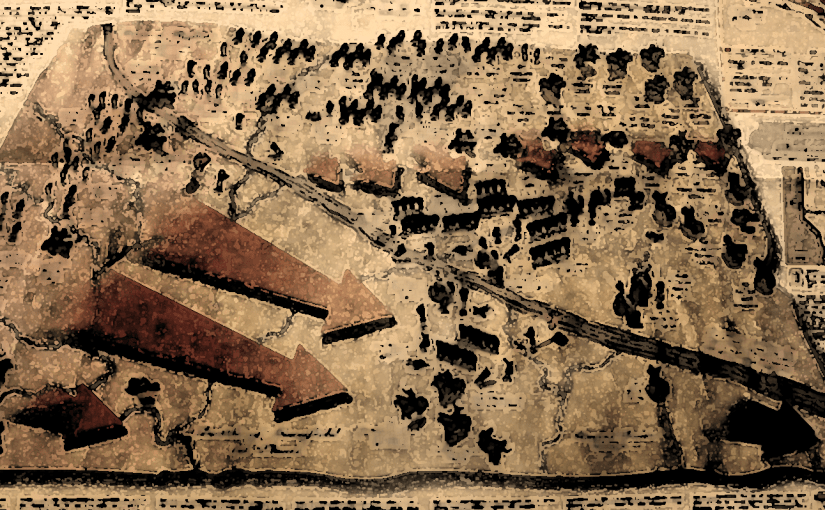
The Red River campaign of Union General Nathaniel Banks grinds to a halt when Confederate General Richard Taylor routs Banks’ army at Mansfield, Louisiana.

Gray and Taylor

The Red River campaign, which had begun a month earlier, was an attempt by the Union to invade Confederate Texas from Shreveport, Louisiana. Banks, accompanied by a flotilla on the Red River, would move northwest across the state and rendezvous at Shreveport with a force under General Frederick Steele moving from Little Rock, Arkansas.

The slow-moving Banks approached Mansfield and opted to take a shorter road to Shreveport than one that ran along the Red River. Not only was the road narrow, it was far away from the gun support offered by the Union flotilla on the river. Banks’ troops ran into Taylor’s force and a skirmish erupted. At 4 p.m., Taylor ordered an all-out assault on the Yankees. The Rebels eventually broke the Union lines, sending the Federals in a disorganized retreat. The Yankees fell back three miles before reinforcements stopped the Confederate advance.

Banks suffered 113 men killed, 581 wounded, and 1,541 missing, while Taylor had about 1,500 total casualties. But Banks was now in retreat, and the Red River campaign was failing. Taylor attacked again the next day, but this time Banks’ men held the Confederates at bay. Banks was unnerved, though, and he began to retreat back down the Red River without penetrating into Texas.

Ruby Robison (1845-1933)

Ruby Robison (1845-1933).  Young prostitute on Fannin Street; has daughter, Pearl, with Confederate soldier Levi Motts.  After learning that Levi is killed at the Battle of Mansfield in April, 1864, Ruby marries his cousin Coleman Broussard and has four other children.

Ruby came to Shreveport during the Civil War, perhaps with Union troops up the Red River from New Orleans following the occupation of that city. Born in Ireland in 1845, her family may have been among the large numbers of Irish immigrants who sought refuge in America during the potato famines of the mid-nineteenth century.  She most likely resorted to prostitution as a means of survival.

Ruby had a room in one of the dozens of brothels in downtown Shreveport area around Fannin Street, but her life took an unexpected turn when she met Levi Motts.  Ruby and Levi began to have serious feelings for each other and Levi swore that he would find a way to get her out of the life she’d known as a prostitute.  But the war got in the way, sending Levi off to fight and die in the Battle of Mansfield (see songs, “Fannin Street” and “Levi Motts is My Name“).

Ruby had let Levi know of her pregnancy and she gave birth to a daughter in 1865, whom she named Pearl.  Levi’s cousin, Coleman Broussard chose to marry Ruby and they had four children together.  Their first son, Lucas was the great-grandfather of Mike “Sarge” Broussard.

Ruby lived to the ripe old age of 88, living to see not only her daughter grow up, get married and have children of her own, but well into the lives of her great-grandchildren.

Fannin Street, Shreveport

(Information taken from Wikipedia)

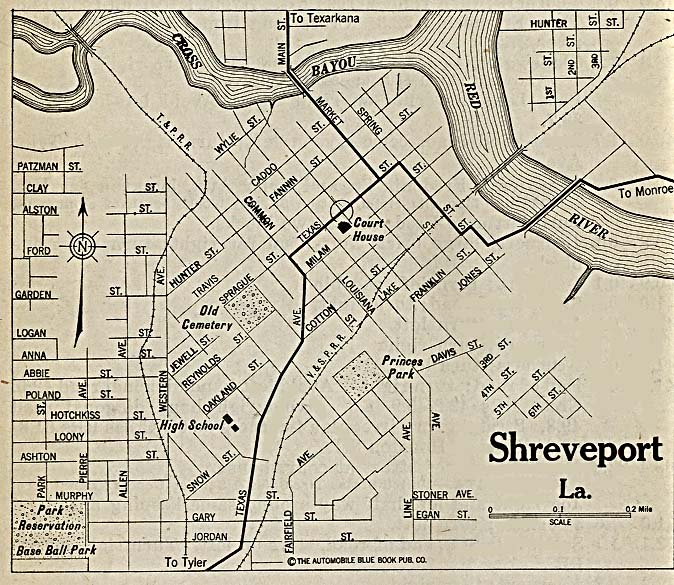
Fannin Street in downtown Shreveport, Louisiana, was the center of activity in the tenderloin district known as St. Paul’s Bottoms.

A Shreveport city ordinance of December 1871 addressed the issue of prostitution in an attempt to keep it away from the public sphere. In “An Ordinance Relating to and to Regulate Lewd Women,” the council stated clearly that it “shall not be lawful for any woman or girl who is known to be a lewd person to stand upon the sidewalk in front of the premises occupied by her.” The ordinance also stated that “no woman or girl who is notoriously known to be a lewd person shall be found to be strolling in any street, sidewalk, market house or alley, or drinking in any coffey [sic] house or saloon after 8: 00 p.m. at night.”

Before the creation of a segregated red-light district, prostitution thrived on the riverfront of Shreveport in an area known as “the Batture” (or riverbank) located near the docks. Large brothels operated in the riverfront area from the earliest days of the city’s growth in the 1830s. By the time the Shreveport City Council established a legal district for prostitution in an area of the city known as St. Paul’s Bottoms, named for nearby St. Paul’s Methodist Church, the world’s second oldest profession had prospered for decades.

Fannin red-light Shreveport,_1920

This was a low-lying area bordered by selectively chosen streets, as well as the Texas & Pacific Railway tracks.  The location did not represent the city’s best real estate, and the low-lying “bottoms” were far enough removed from the river to lack the benefit of breezes in the summer. Furthermore, the land was muddy and collected water, providing a prime breeding spot for mosquitoes. However, in response to the city ordinance, prostitutes, madams and pimps all began the process of relocating their businesses.

At its peak, Shreveport’s red-light district had over one hundred registered brothels.  The region primarily attracted white clientele for white prostitutes, although there were areas in the district that featured black or “mulatto” girls, including the Octoroon Club on Fannin Street that advertised such girls from the New Orleans area.

The typical rate for a “trick” was three dollars, a price that seems to have been fixed among those brothels attracting more prominent white clientele.  However, there were many small-scale operators in shotgun houses who charged less than the going rate.  Probably first used as low-cost housing for the rapid influx of workers into the city following the Civil War, the “shotgun house” was another important staple characteristic of the St. Paul’s Bottoms area.