“Fannin Street”


LOCATION: Shreveport, Louisiana: St. Paul’s Bottoms
PERIOD: 1860s
DRAMATIS PERSONAE: Ruby Robison (1845-1933); Levi Motts (1845-1864); Coleman Broussard (1842-1910); Pearl Robison (1864-1936); Lucas Broussard (1866-1934)


Ruby Robison (1845-1933), young prostitute on Fannin Street; has daughter, Pearl, with Confederate soldier Levi Motts. After learning that Levi is killed at the Battle of Mansfield in April, 1864, Ruby marries his cousin Coleman Broussard and has four other children.

Ruby came to Shreveport during the Civil War, perhaps with Union troops up the Red River from New Orleans following the occupation of that city. Born in Ireland in 1845, her family may have been among the large numbers of Irish immigrants who sought refuge in America during the potato famines of the mid-nineteenth century. She most likely resorted to prostitution as a means of survival.

Ruby had a room in one of the dozens of brothels in downtown Shreveport area around Fannin Street, but her life took an unexpected turn when she met Levi Motts. Ruby and Levi began to have serious feelings for each other and Levi swore that he would find a way to get her out of the life she’d known as a prostitute. But the war got in the way, sending Levi off to fight and die in the Battle of Mansfield (see songs, “Fannin Street” and “Levi Motts is My Name“).

Ruby had let Levi know of her pregnancy and she gave birth to a daughter in 1865, whom she named Pearl. Levi’s cousin, Coleman Broussard chose to marry Ruby and they had four children together. Their first son, Lucas was the great-grandfather of Mike “Sarge” Broussard.

Ruby lived to age of 88, living to see not only her daughter grow up, get married, and have children of her own, but well into the lives of her great-grandchildren.


FANNIN STREET
(F. D. Leone, Jr.)

On Fannin Street, Fannin Street
There’s a room upstairs for the men she meets
She’s not theirs and never was,
Just what she does
On Fannin Street

There was one boy, fine and sweet
Not like the rest of Fannin Street
The only one she ever loved
In the room above
Fannin Street

On Fannin Street, Fannin Street
There’s a room upstairs for the men she meets
She’s not theirs and never was,
Just what she does
On Fannin Street

The boy he said he’d take her away
From the life she led one day
He left for Mansfield to the restless beat
Of Marching feet
In columns of grey

On Fannin Street, Fannin Street
There’s a room upstairs for the men she meets
She’s not theirs and never was,
Just what she does
On Fannin Street

In her room alone Ruby Robison
Heard that the Rebels had won
She went to Mansfield but there she cried
For the baby inside
And the boy who was gone

On Fannin Street, Fannin Street
There’s a room upstairs for the men she meets
She’s not theirs and never was,
Just what she does
On Fannin Street

© 2017 Frank David Leone, Jr./Highway 80 Music (ASCAP). The songs and stories on the Highway 80 Stories website are works of fiction. Names, characters, businesses, places, events, locales, and incidents are either the products of the author’s imagination or used in a fictitious manner. Any resemblance to actual persons, living or dead, or actual events is purely coincidental.
Love and Loss During the Gold Rush

The Ballad of Black Jack Kelley and Spooner Magee


Location: North Central Louisiana
Period: 1849
Dramatis personae: “Black Jack” Kelley; Spooner Magee; the Stranger.

Jack Kelley (1824-1886) married into the Magee family, marrying Margaret Magee (1824-1896) in 1841. Jack and her brother, Spooner Magee (1826-1902), became best friends and would often go hunting together as well as drinking and getting into a variety of mishaps and adventures.

On the night this song describes, Jack and Spooner were at a local watering hole when Jack offers Spooner the idea of going out to California, this was 1849 when the gold rush was the rage. However, Jack proposed that they not try their luck at gold prospecting, instead to open a general mercantile storefront and sell necessaries to those with a greedier nature. Jack thought it more reliably lucrative, as he says, “fleecing the suckers.”

But while this discussion was taking place, of which Spooner remained unconvinced of the venture, a stranger interrupted them and the night took a somewhat violent and unfortunate detour.

Jack and Spoon never did make it out to California. In fact, the idea was never broached again.


A Day In The Life of Spooner Magee


Location: Northwestern Louisiana, between Monroe and Shreveport.
Period: 1879
Dramatis personae: Spooner Magee (1826-1886); Sally Ann Gray (1863-1954); Jack Kelley (1824-1869).

It’s been ten years since Jack Kelley, Spooner’s brother-in-law and best friend, died. They had shared many adventures and good times, and Spooner missed him sorely. Jack had married Spooner’s sister Margaret, and entered the Magee family as a second son. He and Spooner quickly became great running buddies. But Jack’s nature was more searching, seeking new experiences and driven by an urge to break out of the confines of rural Northwestern Louisiana. As Spooner said, “Oh, he was a rascal for sure.”

This adventurous urge is best typified by Jack’s brainstorm during the Gold Rush for he and Spooner to go out to California and set up a store to sell necessaries to the miners. A plan which was thwarted by an encounter with a sheriff’s deputy in a bar. But, Jack had planted the idea into Spooner’s brain to go out west, and Spooner never really gave up on that dream.

This song describes Spooner, late in life, reminiscing about old times with his best friend, Black Jack Kelley, and still dreaming of California.

The song takes place over the course of one day in 1879 with Spooner in the bar, the Faded Rose, talking to the bartender, Sally Ann Gray. Spooner is trying to convince her to make this far-fetched trip to California until, finally, she decides to do it.

At the end, they made it to the Pacific Ocean.


Sally Ann


Location: San Francisco, California, Monroe, Louisiana
Period: 1886-1954
Dramatis personae: Sam “Spooner” Magee (1826-1886); Sally Ann Gray (1863-1954); Sam “Teaspoon” Magee (1862-1946); Henry Olson Magee (1853-1932).


You wouldn’t know it from her name, but Sally Ann Gray was full-bloodied Sicilian. Her father’s family had anglicized their Italian name of Graziano to Gray upon first emigrating to England in the 17th century, which was quite common. Her mother and father entered America at the port of New Orleans in 1859 shortly after they were married in Cefalu, a town on the northern coast of Sicily.

Sally inherited the immigrant dream of carving out a better life and dreamed of escaping the suffocating small town in northwestern Louisiana where the family ended up, and going west. A common ambition, but in her case, one supplied to her by an older friend of her father’s who filled her head with fancy images of San Francisco.


L’Maison d’Amour


Location: San Francisco
Period: 1879-1886
Dramatis personae: Sally Ann Gray; patrons of brothel.


After Sally Ann and Spooner made it out to San Francisco, Spooner went back to Louisiana after a month or so, but Sally Ann stayed behind.

Initially she got work in a bar/brothel as a bartender, something she had been back home.  The madam, Marie LaBlanc, another Louisiana transplant, took Sally under her wing, and eventually gave her more and more responsibilities until Sally Ann was essentially her second in command.  While she did do some work as a prostitute, early on, over time she maneuvered herself more and more into management and took over upon Marie’s death, who had been killed by an obsessively jealous patron.

Sally spent seven years in San Francisco, and this song describes a typical night in which she verbally spars with a regular customer, who, while she fends of his advances, she acknowledges that he is certainly not the worst kind of man who visits the “house of love”.


Aftermath


 Location: San Francisco, California, Monroe, Louisiana
Period: 1886-1954
Dramatis personae: Sam “Spooner” Magee (1826-1886); Sally Ann Gray (1863-1954); Sam “Teaspoon” Magee (1862-1946); Henry Olson Magee (1853-1932).

Sally Ann Gray had been in San Francisco, the madam of a brothel, for the last seven years, when she gets the news that Spooner Magee has died. Spooner and Sally had come out to California in 1879 on a lark, and Sally just stayed. She comes back home to Louisiana for his funeral, and reconnects with Sam “Teaspoon” Magee, Spooner’s youngest son, whom she knew all through her childhood and high school years.

Sally and Teaspoon end up getting married, having six children, and happily living out their lives in this part of Louisiana. Teaspoon never asked about her life in California, and wouldn’t care in any event.


“L’Maison d’Amour”

Location: San Francisco
Period: 1879-1886
Dramatis personae: Sally Ann Gray; patrons of brothel.


After Sally Ann and Spooner made it out to San Francisco, Spooner went back to Louisiana after a month or so, but Sally Ann stayed behind.

Initially she got work in a bar/brothel as a bartender, something she had been back home.  The madam, Marie LaBlanc, another Louisiana transplant, took Sally under her wing, and eventually gave her more and more responsibilities until Sally Ann was essentially her second in command.  While she did do some work as a prostitute, early on, over time she maneuvered herself more and more into management and took over upon Marie’s death, who had been killed by an obsessively jealous patron.

Sally spent seven years in San Francisco, and this song describes a typical night in which she verbally spars with a regular customer, who, while she fends of his advances, she acknowledges that he is certainly not the worst kind of man who visits the “house of love”.


L’MAISON D’AMOUR
(F. D. Leone, Jr.)

“Sally gal
Come over here
Sit in my lap
Whisper in my ear.
You know I love you,
Like a daughter;
Not like those other fellas,
Who don’t treat you like they oughta.”

“Harvey, get on,
You ol’ pervert;
You don’ smell good,
An ‘ need to change your shirt.
“Sally gal,
You used t’ be so prim ‘n’ proper;
You were as green,
As a grasshopper.”

“Didn’t take you long,
Before you learned th’ ropes;
Now you give us crusty buzzards,
Th’ straight dope;
Sally gal,
Come on ‘n’ sit in my lap.
Aw now, girl,
Don’t look at me like that.”

Next mornin’ now;
Outside a soft grey drizzle.
Sally is wonderin’,
How a dream can fizzle.
No time for that, no, no no;
No second or third thoughts.
Sally don’ waste time,
Dwellin’ on what she lost.

One by one,
Her girls come downstairs,
As usual, complainin’;
Sally silently swears.
She’s still young ‘n’ pretty,
But not a girl no more.
She’s th’ madam now:
L’maison d’amour.

Well, ol’ Harvey,
He ain’ so bad,
Better’n most of ’em;
He makes her laugh.
“Mary, ya’ll get started, and
Wash your coffee cups.
Get yourselves together, b’fore
They start showin’ up.”


CREDITS:
David Leone: guitar, vocal
Tammy Rogers: fiddle

Related songs in chronological order:
“Ballad of Black Jack Kelley and Spooner Magee”
“Sally Ann”
“A Day in the Life of Spooner Magee”
“L’Maison d’Amour”
“Aftermath”

© 2023 Frank David Leone, Jr./Highway 80 Music (ASCAP). The songs and stories on the Highway 80 Stories website are works of fiction. Names, characters, businesses, places, events, locales, and incidents are either the products of the author’s imagination or used in a fictitious manner. Any resemblance to actual persons, living or dead, or actual events is purely coincidental.
Ruby Robison (1845-1933)

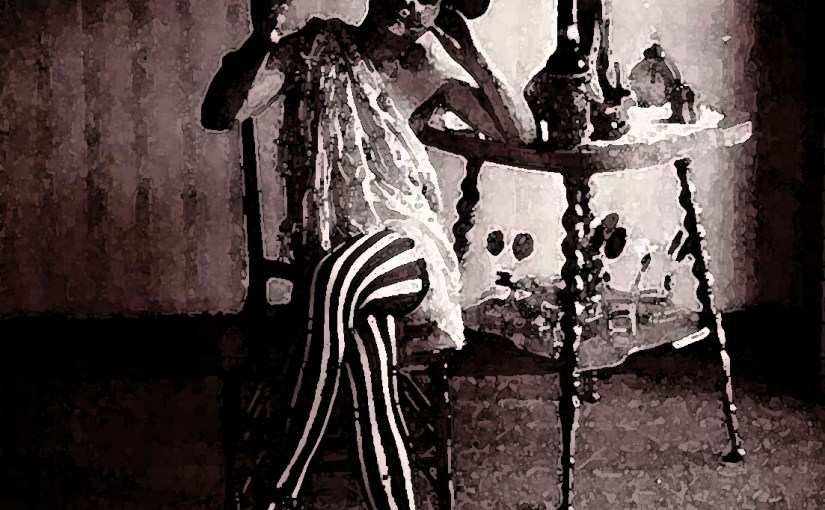
Ruby Robison (1845-1933).  Young prostitute on Fannin Street; has daughter, Pearl, with Confederate soldier Levi Motts.  After learning that Levi is killed at the Battle of Mansfield in April, 1864, Ruby marries his cousin Coleman Broussard and has four other children.

Ruby came to Shreveport during the Civil War, perhaps with Union troops up the Red River from New Orleans following the occupation of that city. Born in Ireland in 1845, her family may have been among the large numbers of Irish immigrants who sought refuge in America during the potato famines of the mid-nineteenth century.  She most likely resorted to prostitution as a means of survival.

Ruby had a room in one of the dozens of brothels in downtown Shreveport area around Fannin Street, but her life took an unexpected turn when she met Levi Motts.  Ruby and Levi began to have serious feelings for each other and Levi swore that he would find a way to get her out of the life she’d known as a prostitute.  But the war got in the way, sending Levi off to fight and die in the Battle of Mansfield (see songs, “Fannin Street” and “Levi Motts is My Name“).

Ruby had let Levi know of her pregnancy and she gave birth to a daughter in 1865, whom she named Pearl.  Levi’s cousin, Coleman Broussard chose to marry Ruby and they had four children together.  Their first son, Lucas was the great-grandfather of Mike “Sarge” Broussard.

Ruby lived to the ripe old age of 88, living to see not only her daughter grow up, get married and have children of her own, but well into the lives of her great-grandchildren.

Fannin Street, Shreveport

(Information taken from Wikipedia)

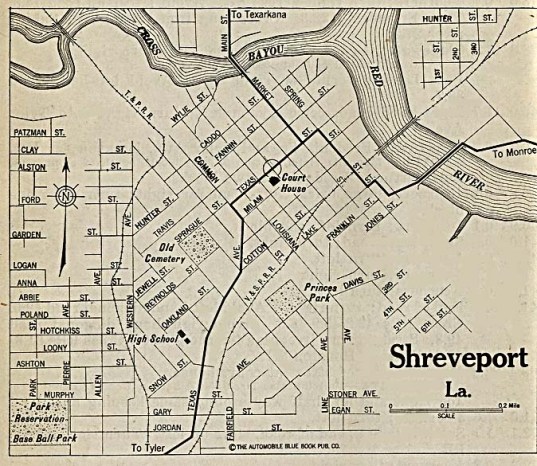
Fannin Street in downtown Shreveport, Louisiana, was the center of activity in the tenderloin district known as St. Paul’s Bottoms.

A Shreveport city ordinance of December 1871 addressed the issue of prostitution in an attempt to keep it away from the public sphere. In “An Ordinance Relating to and to Regulate Lewd Women,” the council stated clearly that it “shall not be lawful for any woman or girl who is known to be a lewd person to stand upon the sidewalk in front of the premises occupied by her.” The ordinance also stated that “no woman or girl who is notoriously known to be a lewd person shall be found to be strolling in any street, sidewalk, market house or alley, or drinking in any coffey [sic] house or saloon after 8: 00 p.m. at night.”

Before the creation of a segregated red-light district, prostitution thrived on the riverfront of Shreveport in an area known as “the Batture” (or riverbank) located near the docks. Large brothels operated in the riverfront area from the earliest days of the city’s growth in the 1830s. By the time the Shreveport City Council established a legal district for prostitution in an area of the city known as St. Paul’s Bottoms, named for nearby St. Paul’s Methodist Church, the world’s second oldest profession had prospered for decades.

Fannin red-light Shreveport,_1920

This was a low-lying area bordered by selectively chosen streets, as well as the Texas & Pacific Railway tracks.  The location did not represent the city’s best real estate, and the low-lying “bottoms” were far enough removed from the river to lack the benefit of breezes in the summer. Furthermore, the land was muddy and collected water, providing a prime breeding spot for mosquitoes. However, in response to the city ordinance, prostitutes, madams and pimps all began the process of relocating their businesses.

At its peak, Shreveport’s red-light district had over one hundred registered brothels.  The region primarily attracted white clientele for white prostitutes, although there were areas in the district that featured black or “mulatto” girls, including the Octoroon Club on Fannin Street that advertised such girls from the New Orleans area.

The typical rate for a “trick” was three dollars, a price that seems to have been fixed among those brothels attracting more prominent white clientele.  However, there were many small-scale operators in shotgun houses who charged less than the going rate.  Probably first used as low-cost housing for the rapid influx of workers into the city following the Civil War, the “shotgun house” was another important staple characteristic of the St. Paul’s Bottoms area.