“The Ballad of Sam McLemore”


LOCATION: West Texas
PERIOD: 1870s
DRAMATIS PERSONAE: Sam Summers McLemore (1852-1878); Sally McCune Cummings (1854-1912); Jacob “Mac” McLemore (1879-1977)


Sam Summers McLemore (1852-1878) lived a violent and short life as an outlaw and gunfighter in Texas.  His father fought and died in the Civil War, leaving Sam at age 12 without much direction.  He occupied his time by practicing drawing and shooting the pistol that he inherited from his father.

At age 18 he was part of a cattle drive, and when some of the wranglers went into town, he was called out for cheating at cards.  He wasn’t cheating but had to defend his honor and killed his first man.  From then on, he found himself having to kill more men who challenged him (see song “The Ballad of Sam McLemore“).

Being a gunfighter was never clearly articulated in his mind, but his life took on a momentum of its own, with him being thrust in the position of defending himself from those who wished to make their own reputations.  For the better part of a decade he lived this kind of life, before taking up with a young prostitute, Sally McCune, rooming with her in the saloon/brothel in West Texas where she worked.

His last fight took place in the dusty street outside this saloon, when he was outgunned by a younger gunslinger and died on that street, age 26.  He did not know it at the time but Sally was carrying his child, Jacob Mac McLemore.

Sally would joke that since her father, a hard shell Baptist minister, was named Horace it was only natural that she took to whorin’.  But once she had the boy, she swore that she’d get out of that life and raise him up right.  And this she did, eventually owning and operating a boarding house in Fort Worth.  This is where Jacob grew up, until he turned 15 and took off for Corsicana when he heard about the oil strike there in 1894.


THE BALLAD OF SAM MCLEMORE
(F. D. Leone, Jr.)

He can’t say how it started
One day he killed a man
It was in self defense
Still they called him the devil’s hand
 
That one became ten
Songs were sung in saloons
He couldn’t hang up his gun
There was always something to prove
 
No wife no home no one that he could trust
A gunslinger can’t outrun his fame
He’s called out, draws and falls down in the dust
Shot by a boy who wants to make a name
 
At first it was thrilling
He was fast as the wind
Those who challenged him
Wouldn’t challenge no one again
 
Then he was older, they were bolder
And knew he wasn’t as fast
He was still tough but all bluff
A shadow of his past
 
No wife no home no one that he could trust
A gunslinger can’t outrun his fame
He’s called out, draws and falls down in the dust
Shot by a boy who wants to make a name

© 2018 Frank David Leone, Jr./Highway 80 Music (ASCAP). The songs and stories on the Highway 80 Stories website are works of fiction. Names, characters, businesses, places, events, locales, and incidents are either the products of the author’s imagination or used in a fictitious manner. Any resemblance to actual persons, living or dead, or actual events is purely coincidental.

“Missouri”


LOCATION: Texarkana, Texas
PERIOD: 1930s
DRAMATIS PERSONAE: Levi Lester Motts (1909-1999); Julia Taylor (1909-1931); Joshua Taylor (1877-1945)


During the 1920s and ’30s the boll weevil devastated the cotton crop in several Southern states along the Highway 80 corridor.  Many farmers gave up and left their farms since the weevil appeared to be impervious to all attempts to drive it out or kill it off.  Ironically the thing that finally caused the weevil to move on, was a widespread drought in 1930, which farmers did not see as much of a savior.  After the drought the Great Depression caused the remaining farmers who had managed to survive the weevil, as well as the drought, to be threatened yet again with economic collapse.

The West offered a virgin land, a territory full of promise.  The allure was irresistible for some men who uprooted themselves and often their entire families to try their luck “out West”.

Levi Luther Motts’ great-uncle was Levi Motts (1843-1864).


MISSOURI
(F. D. Leone, Jr.)

There’s land in Missouri
I’ve heard tell it’s rich and dark
Ain’ nothin’ for me ’round here
I’d like to make a brand new start

Boll weevil killed my cotton
What drove him off was a drought
I’ve had enough of Texarkana
I’m thinkin’ hard of movin’ out

To Missouri – I’ll head west
Where a man can start fresh
I won’t rest until I’ve left
To Missouri I’m bound

Ol’ man Taylor thinks I’m lazy
Says soon it’s bound to rain
I should stick it out and make a crop
No matter where I go it’ll be the same

Since my Julie took sick and died
I’ve got no reason to stay
Texarkana is for Taylor
As for me, I’ll move away

To Missouri – I’ll head west
Where a man can start fresh
I won’t rest until I’ve left
To Missouri I’m bound

© 2019 Frank David Leone, Jr./Highway 80 Music (ASCAP). The songs and stories on the Highway 80 Stories website are works of fiction. Names, characters, businesses, places, events, locales, and incidents are either the products of the author’s imagination or used in a fictitious manner. Any resemblance to actual persons, living or dead, or actual events is purely coincidental.

“Go West”


LOCATION: Big Spring, Texas
PERIOD: 1903
DRAMATIS PERSONAE: John Henry Hardin (1878-1949); “Henry Adams Hardin (1926-2015); John Farley Hardin (1927-2020)


Homer and Virgil Hardin were distant relatives of Louanne Bowden, on her mama’s grandma’s side.   They typified a certain mindset among the American pioneers: ruthless independence and no need for civilization. For a while, the kind of life they desired could still be found by leaving the settled towns and cities and going further west.


GO WEST
(F. D. Leone, Jr.)

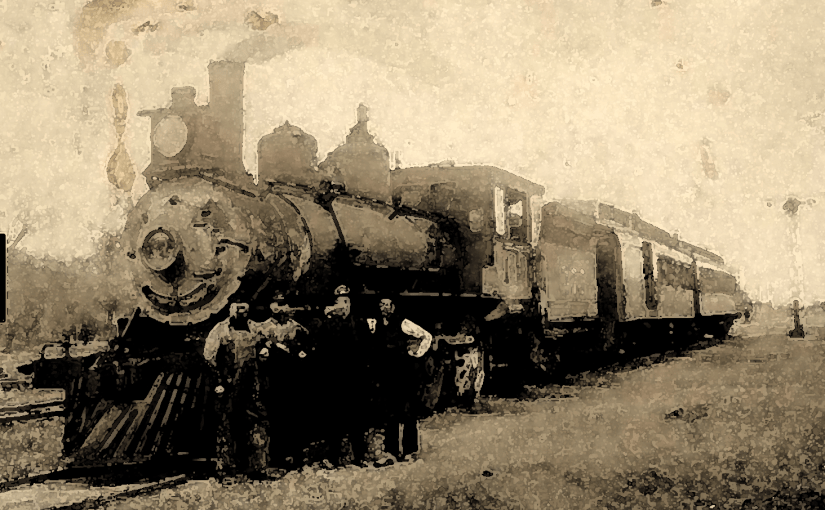
John Henry Hardin was an engineer
Railroading for the T&P
He had a good wife and two ornery sons
This would’ve been about nineteen and aught-three

The Hardins come from North Carolina
Alabama, then Texas in eighteen-seventy-nine
They would move on about every ten years
Leaving progress: the lawyers and the bankers behind

And go west, hoping to stay free
Even if it meant a harder life
Go west, hanging on to liberty
Life ain’t worth living otherwise

Homer and Virgil were John Henry’s sons
They were dyed-in-the-wool true Hardins, them two
Stuck there in Big Spring, standing at the tracks
Staring and waiting for the coal train to blow through

Each had a nickel in his pocket
Earned that mornin’ from chopping two cords of wood
When they were younger they’d put ’em on the track
But they been saving their nickels to get out for good

And go west, hoping to stay free
Even if it meant a harder life
Go west, hanging on to liberty
Life ain’t worth living otherwise

© 2019 Frank David Leone, Jr./Highway 80 Music (ASCAP). The songs and stories on the Highway 80 Stories website are works of fiction. Names, characters, businesses, places, events, locales, and incidents are either the products of the author’s imagination or used in a fictitious manner. Any resemblance to actual persons, living or dead, or actual events is purely coincidental.