“One Time Too Many”


LOCATION: Vicksburg, Mississippi
PERIOD: 1985-2004
DRAMATIS PERSONAE: Louanne Murray Bowden (1967); Ronnie Raney (1962-2004)


In a disastrous act of rebellion from her upper crust background, Louanne Bowden began dating and ultimately married Ronnie Raney whom sehe met while attending the University of Mississippi in Oxford.

The Raney family under the leadership of matriarch Molly Motts Raney transitioned from bootlegging moonshine whiskey to distributing marijuana, pills and eventually funding methamphetamine labs. Ronnie was the second oldest son, acting as his mother’s right hand operations manager, his older brother Lonnie was sheriff of Warren County, offering protection for the entire enterprise.

After suffering years of Ronnie drunken abuse, Louanne and finding no relief from the corrupt legal system in Warren County, took matters into her own hands and shot Ronnie with a deer rifle as he sat at the kitchen table eating a slice of her homemade peach pie.

Although she knew she was justified in killing him, she fatalistically accepted her conviction of murder and the twenty year sentence that went with it. Only much later was she vindicated and released for time served.


ONE TIME TOO MANY
(F. D. Leone, Jr.)

She’d like to fix up her dinette
Yellow wallpaper with nosegays
A hard wood floor would do the trick
Those stains’ll take more than paint
 
A buzzer spoils this daydream
Lights out and the bars clang shut
It’ll have to wait twenty years
This cell is where she’ll stay put
 
She’d had enough
Taken too much
He treated her rough one time too many
She did the crime
She’ll do the time
Regrets? No, she don’t have any
 
She brought him his beer and a slice of pie
Then shot him with his deer gun
It was worth it just to see him surprised
Once he realized just what she’d done
 
She’d had enough
Taken too much
He treated her rough one time too many
She did the crime
She’ll do the time
Regrets? No, she don’t have any
 
His brother was sheriff of Warren County
There was no doubt the fix was in
A jury of his peers showed no mercy
But if she could she’d do it again
 
She’d had enough
Taken too much
He treated her rough one time too many
She did the crime
She’ll do the time
Regrets? No, she don’t have any

© 2017 Frank David Leone, Jr./Highway 80 Music (ASCAP). The songs and stories on the Highway 80 Stories website are works of fiction. Names, characters, businesses, places, events, locales, and incidents are either the products of the author’s imagination or used in a fictitious manner. Any resemblance to actual persons, living or dead, or actual events is purely coincidental.

Lonnie Raney (1958-2006)

Lonnie Raney (1958-2006).  Oldest son of Vernon and Molly Raney; brother of Ronnie and Ginny Raney.  Elected sheriff of Warren County (Vicksburg, county seat) and is generally a well-liked but corrupted law enforcement officer.  One of his prime responsibilities was protecting his mother and brother in the pursuit of their marijuana growing and drug business.

Although sister-in-law Louanne Borden Raney murders his brother Ronnie, and is convicted of second degree murder (see song, “One Time Too Many“), she later refuses cut a deal in an DEA investigation into the Raney family criminal activities and instead warns Lonnie of the investigation.

In 2006 Lonnie is killed in a shootout while attempting to protect his mother and the drug business when the DEA comes to serve warrants for their arrest.

Warren County, Mississippi

(Information taken from Wikipedia)

Warren County is a county located in the U.S. state of Mississippi. As of the 2010 census, the population was 48,773.  Its county seat is Vicksburg.[2] Created by legislative act of 22 December 1809, Warren County is named for American Revolutionary War officer Joseph Warren.

Part of the Mississippi Delta and the historic cotton culture, Warren County is included in the Vicksburg, MS Micropolitan Statistical Area, which is also included in the Jackson-Vicksburg-Brookhaven, MS Combined Statistical Area.

“When Louanne Met Lucy in Prison”


LOCATION: Mississippi Penitentiary for Women, Rankin County, MIssissippi
PERIOD: 2015
DRAMATIS PERSONAE: Lucy Bess Cooper (1980-2015); Louanne Murray Bowden (1967)


Louanne Bowden was sent to the Mississippi Penitentiary for Women after being convicted of murdering her husband, Ronnie Raney (see song, “One Time Too Many“). Prison was an unlikely place for someone of Louanne’s background to end up, but there she was (see song, “Louanne in Vicksburg“). The fact that she killed Ronnie as a result of his constant physical abuse did not mitigate the verdict. Only years later would her case be reviewed and she would be released for time served when the charge was changed from murder to justifiable homicide (see song “A Waxahachie Funeral“).

However, while Louanne was serving her twenty year sentence Lucy Cooper was also sent to this prison on an 18 month sentence for distribution of controlled substance, marijuana. Although Lucy put up a brash and strong front, she was in fact a fragile woman, unable to cope with life behind bars. Shortly before being considered and most likely to be released on parole, a little shy of 12 months into her sentence, Lucy succumbed to depression and killed herself with an heroin overdose (see also song, “Levi and Lucy“).


WHEN LOUANNE MET LUCY IN PRISON
(F. D. Leone, Jr.)

When Louanne met Lucy in prison
Lou was halfway through her twenty
For killin’ Ronnie Raney
Who hit her once too many
Lucy would talk all about Levi
In words tender and soft
It was old friends and old sins
Got Lucy caught

Ain’t that how it is sometimes?
You’re on the verge of change
Life sends you the same ol’ same

They gave Lucy eighteen months
Easy time for most but for Lucy hard
Day by day she faded away
Behind stone walls and steel bars
Louanne tried to keep an eye on Lucy
Easy in there to come to harm
August night when they found her
Needle was still in Lucy’s arm

Ain’t that how it is sometimes …

Louanne got word to Levi
Said it best she knew how
Lucy only had six weeks left
She ain’ never gettin’ out
Levi read that letter and then
Put it in his dresser drawer
Got drunk in Vicksburg went a little further
Did a little more

© 2017 Frank David Leone, Jr./Highway 80 Music (ASCAP). The songs and stories on the Highway 80 Stories website are works of fiction. Names, characters, businesses, places, events, locales, and incidents are either the products of the author’s imagination or used in a fictitious manner. Any resemblance to actual persons, living or dead, or actual events is purely coincidental.

Parchman Farm (Mississippi State Penitentiary)

(Information taken from Wikipedia)

Mississippi State Penitentiary (MSP), also known as Parchman Farm, is a prison farm, the oldest prison, and the only maximum security prison for men in the state of Mississippi.

Begun with four stockades in 1901, the Mississippi Department of Corrections facility was constructed largely by state prisoners. It is located on about 28 square miles (73 km2) in unincorporated Sunflower County, in the Mississippi Delta region.

It has beds for 4,840 inmates. Inmates work on the prison farm and in manufacturing workshops. It holds male offenders classified at all custody levels—A and B custody (minimum and medium security) and C and D custody (maximum security). It also houses the male death row—all male offenders sentenced to death in Mississippi are held in MSP’s Unit 29—and the state execution chamber.

Female prisoners are not usually assigned to MSP; Central Mississippi Correctional Facility (CMFC), also the location of the female death row, is the only state prison in Mississippi designated as a place for female prisoners.

CMCF opened in January 1986 with a capacity of 667 prisoners. CMCF was the first prison facility of the Mississippi Department of Corrections outside of the Mississippi State Penitentiary (MSP) in Sunflower County. Upon the opening of CMCF, female prisoners were transferred from MSP to CMCF; previously women were held in MSP Camp 25.

“Levi After Lucy”


LOCATION: Mississippi: Vicksburg, Greenwood, Greenville
PERIOD: 2015-16
DRAMATIS PERSONAE: Levi Hooper (1973); Lucy Cooper (1980-2015)In the aftermath of Lucy


Cooper‘s either accidental overdose or intentional suicide while incarcerated in the Louisiana Prison for Women, Levi Hooper went on something of a bender. Levi was not normally a drinker, but he felt despondent over Lucy’s death and did the only thing he knew how in order to deal with the set of emotions he felt: anger, shock, frustration.

Lucy had not done any drugs or much drinking for weeks prior to being arrested. That arrest was in itself was another case of bad timing: someone she thought was a friend flipped when arrested and gave Lucy up as his dealer (see song, “Levi and Lucy“. The reason Levi did not wish to believe that Lucy had committed suicide was because often when a former user has not done any narcotics for a while, if they relapse at their last dosage, their body cannot tolerate what it once did.

In any event, Lucy had been in the process of turning her life around at the time of her arrest, and her death while serving a relatively short sentence, 18 months, was hard for Levi to take (see songs, “Ready for Change” and “When Louanne Met Lucy in Prison“).

His binge begins in bars around Vicksburg, then he hits the road, to Greenwood, and Greenville, ending up at a small Catholic church in Lake Providence, Louisiana. Levi does not wish to be rude to the priest, he is simply exhausted both mentally and physically, and after this experience, Levi goes back home, devotes himself once again to helping his mother and begin to pick up the pieces of his life.


LEVI AFTER LUCY
(F. D. Leone, Jr.)

Levi staggered up the stone church steps
A slice of moon hung above a wooden cross
Inside the door he stared at a concrete font
Then walked down the aisle, drunk and lost

He eased himself into a pew and sat
Musty scent of incense hung in the air
Worn leather knee-benches underfoot
Levi tried to find the words of a prayer

Vicksburg, Greenwood, Greenville
Gone down many roads, travelin’ still
Pavement, gravel, then dirt
But what he’s lookin’ for ain’t in this church

His head sank to his chest; he slept
A priest shook him; he struggled to his feet
The priest asked him, “Do I know ye?”
“No,” Levi said. “You don’ know me.”

Vicksburg, Greenwood, Greenville …

“Please, Lord, please keep me still
From sinkin’ lower an’ blowin’ away
I’ll straighten out I swear I will
Least that’s how I feel today”

Priest looked him over and said
“Were you waiting to see me?”
Woman was dustin’ the altar with a rag
“No, sir, I just fell asleep.”

Vicksburg, Greenwood, Greenville …

© 2018 Frank David Leone, Jr./Highway 80 Music (ASCAP). The songs and stories on the Highway 80 Stories website are works of fiction. Names, characters, businesses, places, events, locales, and incidents are either the products of the author’s imagination or used in a fictitious manner. Any resemblance to actual persons, living or dead, or actual events is purely coincidental.

Nellie Phelps (1855-1922)

Eleanor “Nellie” Davis (1923-2007) was Louanne Bowden’s paternal grandmother.  She was named Eleanor and called Nellie for her own great-grandmother, Nellie Phelps (1855-1922).  Nellie Phelps had died the year prior to Louanne’s grandmother’s birth.

The Phelps family had come from England to America in the 1690s, the first Phelps born in Pennsylvania was William Phelps (1721).  From Pennsylvania the family went to Tennessee and began farming.  Nellie Phelps had two brothers, Burch and Jethro (“Jed”).  Their parents, were another William Phelps (1834-1872) and his wife Martha Massey (1835-1862).  Martha died when Nellie was eight, probably from some kind of “heart sickness” after Burch, their oldest, had died from a fever.  She had never been happy on the frontier anyway, and just went to bed one day and never got up.

Nellie and her brother Jed were left with their father to tend to the farm, which they did for nearly a decade before William, too, got sick with consumption.  He died when Nellie was 17 and Jed only sixteen (see song “I Didn’t Know What Else to Do”).  When Nellie got married the next year to Robert Abbott, they and Jed all went to Texas where the Abbotts had a nice sized ranch.

Nellie lived a long life in Texas, but Jed died young, only 32, as a Texas Ranger in the Indian wars.

Waxahachie, Texas

(Information taken from Wikipedia)

Waxahachie was founded in August 1850 as the seat of the newly established Ellis County on a donated tract of land given by early settler Emory W. Rogers, a native of Lawrence County, Alabama, who migrated to Texas in 1839. It was incorporated on April 28, 1871, and in 1875 the state legislature granted investors the right to operate a rail line from Waxahachie Tap Railroad to Garrett, Texas, which greatly increased the population of Waxahachie.

From 1902 to 1942, Waxahachie was the 2nd home of Trinity University, which was a Presbyterian-affiliated institution founded in 1869. Then-Trinity’s main administration and classroom building is today the Farmer Administration Building of Southwestern Assemblies of God University. Trinity’s present-day location is San Antonio.

Waxahachie was the home of Constance Maddox Haynes (1928-2015), Louanne Borden‘s maternal grandmother, and the only member of her extended family to which she had a special closeness. Louanne’s release from prison coincided with Constance Haynes’s funeral in Waxahachie.

In the mid-1980s Waxahachie became popular with the movie industry.

The majority of Tender Mercies, a 1983 film about a country western singer, was filmed in Waxahachie. The 1984 film Places in the Heart starring Sally Field was also filmed in Waxahachie. The 1985 film The Trip to Bountiful starring Geraldine Page was also filmed in Waxahachie.

“A Waxahachie Funeral”


LOCATION: Whitfield MIssissippi; Waxahachie, Texas
PERIOD: 2015
DRAMATIS PERSONAE: Louanne Murray Bowden (1967); Constance Maddox Haynes (1913-2015, 102); Helen Haynes Murray (1947)


While at CMCF, Louanne developed an exemplary record of good behavior including mentoring several other young female prisoners. For example, about half way through her sentence, a young woman, Lucy Cooper, was sent to CMCF on a drug charge, given eighteen months. Lucy was a funny, bright, and street smart but fragile woman who simply could not do the time for her crime. Despite being taken under Louanne’s wing, Lucy became increasingly more and more despondent, eventually suiciding from an overdose – within weeks of her release (see song, “When Louanne Met Lucy in Prison“).

Not long after this tragedy Louanne’s case was reviewed by a judge who ruled that hers was a case of justified homicide and her sentence was commuted to time served. These events coincided with the death of her grandmother in 2015, when she was released after serving about 60% of her original sentence. She returned to Texas for her grandmother’s funeral and remained there with her mother, to live once again in Highland Park, however, now in somewhat reduced grandeur.


A Waxahachie Funeral
(F. D. Leone, Jr.)

A call from that charity lawyer,
Words like “justifiable homicide”.
She heard him say the phrase “time served”;
Then a thirty hour Greyhound ride.
Twelve years in, Louanne walked out of prison;
In a blue dress and a brand new pair of shoes.
Destination: a Waxahachie funeral;
Her grandma dead at a hunderd ‘n’ two.

Standin’ with her people among weathered stones;
Stiff new shoes powdered with red dirt.
Back home to witness a tough ol’ Texas woman,
Laid into a plot of Texas earth.

Her daddy died five years before;
That was a funeral Louanne had to miss.
It’s just her and her Neiman Marcus mother,
Left behind to make some sense of this.
They climb inside a shiny black Lincoln;
Go back to that big old empty house.
Their polite Highland Park friends,
Don’t know how to talk to her now.

Standin’ with her people among weathered stones;
Stiff new shoes powdered with red dirt.
Back home to witness a tough ol’ Texas woman,
Laid into a plot of Texas earth.

Louanne and momma sit in the kitchen;
Mute and surrounded by their ghosts.
They stare across a walnut table;
A cup of coffee and a slice of melba toast.
Louanne remembers another August;
That magic summer when she turned eighteen.
When her life seemed so full of promise;
Magnolias and September dreams.

Standin’ with her people among weathered stones;
Stiff new shoes powdered with red dirt.
Back home to witness a tough ol’ Texas woman,
Laid into a plot of Texas earth.

© 2018 Frank David Leone, Jr./Highway 80 Music (ASCAP). The songs and stories on the Highway 80 Stories website are works of fiction. Names, characters, businesses, places, events, locales, and incidents are either the products of the author’s imagination or used in a fictitious manner. Any resemblance to actual persons, living or dead, or actual events is purely coincidental.

Jake McLemore (1959- )

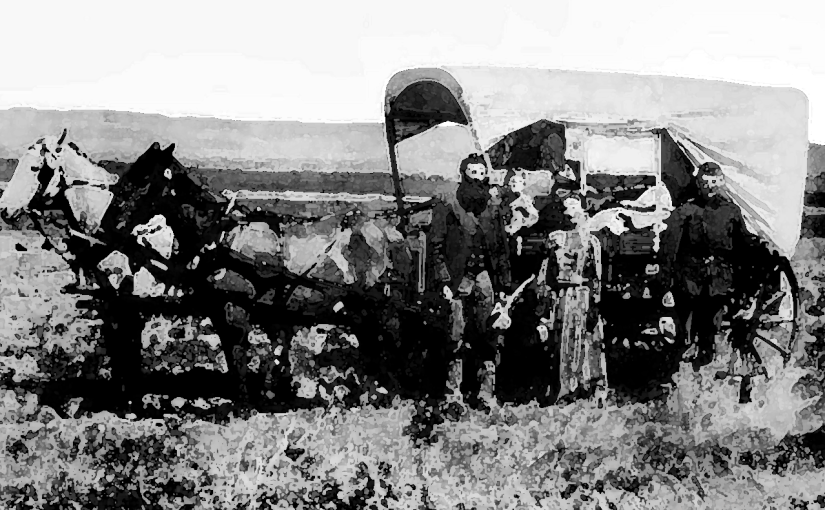
An American historian in the 19th century described the frontier vanguard in the following words:

“Thus the backwoodsmen lived on the clearings they had hewed out of the everlasting forest; a grim, stern people, strong and simple, powerful for good and evil, swayed by gusts of stormy passion, the love of freedom rooted in their hearts’ core. Their lives were harsh and narrow; they gained their bread by their blood and sweat, in the unending struggle with the wild ruggedness of nature. They suffered terrible injuries at the hands of the red men, and on their foes they waged a terrible warfare in return. They were relentless, revengeful, suspicious, knowing neither ruth nor pity; they were also upright, resolute, and fearless, loyal to their friends, and devoted to their country. In spite of their many failings, they were of all men the best fitted to conquer the wilderness and hold it against all comers.

The Anglo-American 18th-century frontier, like that of the Spanish, was one of war. The word “Texan” was not yet part of the English language. But in the bloody hills of Kentucky and on the middle border of Tennessee the type of man was already made. ”

These were the McLemores who left Tennessee for Texas.

Owen McLemore was born in 1791 in Tennessee and married Anabel March in 1812.  Together they worked a sustenance farm in Tennessee and began to build a family in East Tennessee, seeing their first son Jacob McLemore come into the world on Christmas Day 1818.  Anabel gave birth to six other sons before dying during childbirth 1832 at which time, Owen took his six surviving sons to West Texas (see songs, “Blinkin’ Back a Tear” and “My Anabel“).

Jacob “Christmas” McLemore, as he was known his entire life, was Jake McLemore’s great-great-great-grandfather. There was another Jacob McLemore, “Christmas” McLemore’s grandson, Jacob Mac McLemore (1879-1977), who first got oil fever when he was 15 running off to the 1894 oil strike in Corsicana. Next was Oil City in 1906, where made a killing, lost it, made and lost other fortunes before ultimately dying at the ripe old age of 98 without a cent to his name, but rich in memories which was all he handed down to his great-grandson and namesake, Jake McLemore.

Jake McLemore’s father, Charlie McLemore, was small businessman at the J.M. Guffey Petroleum Company of Oil City, Louisiana where Jake was born in 1959 and where he spent his early life. Charlie moved the family to Shreveport in 1968 after he got a job at United Gas Corporation. Shreveport would be Jake’s home until he graduated high school, and went to Vanderbilt University in Nashville, Tennessee.

Jake decided to stay in Nashville after graduating from Vandy with a degree in Business Administration. After investing in several businesses, he came to own a bar, which he had won in a poker game. He promptly changed the name and settled down as proprietor of McLemore’s Bar in 1985 (see song, “McLemore’s“).

By that time Jake had already married and had a son, Lee, in 1983. But Jake’s happiness and home were shattered when his wife, Amelia, was killed in a car accident when a drunk driver ran a red light, leaving Jake to raise his son alone. Soon after graduating from high school, Lee McLemore enlisted in the army and was deployed to Iraq.

But before he left for Iraq, in July 2003, Lee’s girlfriend Ellen Brewer gave birth to a son whom they named Charles after his grandfather Charlie McLemore. Lee and Ellen secretly married shortly before Lee shipped out for Iraq that December. Jake knew nothing of this son and lost touch with Ellen Brewer. It was only much later that, largely out of curiosity, Charles looked Jake up and established contact.

On March 31, 2004, five U.S. soldiers were killed by a large IED on a road a few miles outside of Fallujah, one of the soldiers who died that day was Lee McLemore.

Jake kept the bar going for several years after Lee died but ended up selling it in 2007 and bought some land outside of Shreveport, Louisiana not far from Oil City. He had fond memories of fishing on Caddo Lake with his father and settled into that kind of life again.

It didn’t take long for Jake to become bored with retirement, and he bought a diner in Shreveport where Pearl Robison happened to enter one day in January 2010 (see song, “Pearl + Jake“). For five years Jake and Pearl had a turbulent romantic relationship, before Pearl took to the road again (see song “Hit the Road“), heading west on U.S. 80, leaving Jake heart broken at 56 (see songs, “The River and Jake” and “The Red River Flows“).

Unbeknownst to him Pearl was pregnant when she left, and gave birth to a daughter, Sadie Jo Robison. Pearl initially had no intention of letting Jake know about this child, but she eventually did tell Jake (see song “Terrell“), however, nearly two years after she had left Shreveport. Jake immediately proposed to Pearl, and they got married and moved back to Shreveport to raise Sadie Jo together.

Jake hired someone to run the diner and went back to a life of fishing and shooting the breeze with his friend Mike Broussard and other men from the area. Then one day in 2016 his grandson, Charles, walked into his life.

Jake is currently living with Pearl and Sadie Jo outside Shreveport, Louisiana, and maintaining a close relationship with Charles, helping him to grow into a sturdy young man in the long line of McLemore men.