“Demopolis, Alabama”


LOCATION: Demopolis, Alabama; Shreveport, Louisiana
PERIOD: 2016-2018
DRAMATIS PERSONAE: James Matt Broussard (1985); Michael James “Sarge” Broussard (1948-2014); Rosalie Broussard (1969)


James Matt Broussard (1985) is the grandson of Michael James “Sarge” Broussard (1948-2014), whose daughter Rosalie Broussard (1969) gave birth to James when she was sixteen (see song “James“).

Even though Rosalie Broussard was from Vivian, Louisiana, she had James in Shreveport, where she lived initially after giving birth. Eventually she left James with her parents and went to Alabama with a guy she ended up marrying, Tully Tate.

Once James turned 18 he also moved to Shreveport.  This song describes a two-year period, from 2016 to 2018, when James lived in Demopolis, Alabama.  He was interested in Alabama since that was where he thought his mother was.  He had taken up with a woman in Shreveport who was from Demopolis and she convinced him to move to Alabama with her.

That relationship didn’t last, but James didn’t immediately leave Demopolis. Maybe, he had in the back of his mind that he might get back together with the woman. But once James realized that he didn’t even like the woman, he finally decides to leave Alabama and return to Shreveport.

James enjoyed shooting guns; something about shooting lifted his spirits. So, on his way out of town he stops at a pawn shop to see what kind of guns they had, but unbeknownst to James there was a robbery in progress. James instinctively tries to stop the holdup but the robber panics, takes a shot at James, missing by a wide margin.

That was enough for James, who runs to his truck and tears off on US 80 West to Shreveport. The robber also exits the pawn shop, ignorant of the fact that his getaway car has a bad fuel pump. He doesn’t get very far before it breaks down and he is apprehended without much trouble by a Marengo County Sheriff’s Deputy.


DEMOPOLIS, ALABAMA
(F. D. Leone, Jr.)

I was born in Shreveport, Louisiana
But for about the last two years now
Been living in Demopolis, Alabama
It ain’t never felt like home somehow

I came here on account of a woman
But we didn’t last too long
Stuck around, I guess, looking for something
Months ago I should’ve been gone

Gonna get my gun, get my gun
Wanna shoot some, shoot some
Buy some more, at the range
A pump shotgun, a thirty eight

There’s a market with a wooden Indian out front
An old man we called Shakespeare was the owner
It’s been there since the fifties, untouched
I put some pork rinds and a beer on the counter

Handed Shakespeare the cash for my provisions
I remarked that the Indian was a little weird
He said, “ain’t you ever heard of Hank Williams,
‘ Kaw-Liga’ was a pretty big hit ‘round here”

Gonna get my gun, get my gun
Wanna shoot some, shoot some
Gonna get my gun, change my mood
Wanna shoot some, improve my attitude

I’m sitting in my truck outside her house
She’s got a new boyfriend, from Alabama
I watch him take all her garbage out
Guess I’ll head on back to Louisiana

But before I do I stop at a pawn shop
A guy had a gun, “gimme all the cash,” he said
Without thinking I yell, “hey fella, stop”
He whirled around, threw a shot at at my head

Gonna get my gun, get my gun
Wanna shoot some, shoot some
Gonna get my gun, that’s what I’ll do
Put Demopolis, Alabama in my rear view

© 2020 Frank David Leone, Jr./Highway 80 Music (ASCAP). The songs and stories on the Highway 80 Stories website are works of fiction. Names, characters, businesses, places, events, locales, and incidents are either the products of the author’s imagination or used in a fictitious manner. Any resemblance to actual persons, living or dead, or actual events is purely coincidental.

“Crossin’ the Edmund Pettus Bridge”


LOCATION: Marengo County, Selma & Montgomery, Alabama
PERIOD: 1850s-1960s
DRAMATIS PERSONAE: Celsie Monroe (1844-1936); Jesse Harper (1850-1922); Joshua Tate (1828-1867); Tullison Monroe Tate (1866-1948); William Harper (1877-1945); Mason Harper (1905-1979); William Crawford Harper (1942-2001)


In 1844 Celsie Monroe was born into slavery; in 1865 she was freed. One hundred years later her great-grandson, Willie Harper, was one of those who joined the Selma March.

Celsie Crawford Monroe (1844-1936) was born into slavery but was freed by Will Monroe, a wealthy white planter and her father, in 1863 as a result of Abraham Lincoln’s Emancipation Proclamation.
Celsie’s mother, Jessie Crawford (1828-1905), was a slave from a neighboring plantation of whom Will Monroe had grown quite fond. Monroe made sure Jessie was provided for and also insisted that she be freed in 1863 by paying off her owner Carson Crawford.

Celsie was what was called a “yellow gal”, and quite beautiful. Once she was freed at age 19, Celsie began seeing a white man, Joshua Tate (1828-1867), and their relationship developed into a common law marriage, although the possibility of such a union was denied at the time.

The Tates were a wealthy Alabama family held in high regard and Joshua’s indiscretion was of course never openly acknowledged by the family and surrounding community, although everyone knew of it and the child it eventually produced.

Joshua was nominally a lawyer handling cotton trades and other mercantile business for the planters. But as was the custom for sons of his class, his hours were at his own instigation. Although he made a daily trip to town, he might only spend an hour or two in the afternoon in his office, often asleep on the leather couch sitting against the wall, next to the large hearth fire.

After the War, Republican “carpetbaggers” entered the former Confederacy and worked to overturn every vestige of slavery and the old ways at every turn; Alabama was no exception. These men were hated since they were seen as enemy outsiders, and interlopers and exploiters who added insult to the injury of losing the war. It was during this turbulent period that Joshua Tate was murdered in 1867 in his second floor office by a man with a three barreled derringer pistol, while Joshua was relaxing on the couch with a volume of Homer.

Some said the motivation behind the killing was Tate’s relationship with Celsie Monroe; others said he was killed because of his covert support of the Republicans. Still a few others said he was killed by a carpetbagger. However, no one was ever accused much less arrested and convicted of Josh Tate’s murder.

Tate lingered for two days before dying, leaving Celsie with a son, Tullison Monroe Tate (1866-1948). Tully Tate was one-quarter African-American, light-skinned and who would marry a white woman and whose descendants would all be considered white, Tully’s blood becoming less and less present with each successive generation.

In 1872 Celsie’s first official marriage was to a African-American man, Jesse Harper (1850-1922), and Celsie and Jesse enjoyed a long and happy union, raising four children, seven grandchildren, and many great-grandchildren. However, Celsie’s oldest child, Tully, was raised by his spinster Aunt Ruth, his father’s sister.

One of Celsie’s great-grandchildren, William Crawford Harper (1942-2001), marched from Selma to Montgomery in 1965. Willie Harper lived to see most of the Jim Crow laws reversed even as the stubborn stain of racism remained.


CROSSING THE EDMUND PETTUS BRIDGE
(F. D. Leone, Jr.)

Named for a Confederate general
Who has all but faded from history
That bridge is a landmark of a struggle
Where slave descendants took a step towards victory

It’s only fifty miles from Selma to Montgomery
But that’s not really how far it is
It’s been a hundred year long journey
Crossin’ the Edmund Pettus Bridge

Celsie Monroe was a slave woman
Her great-grandson was William Crawford Harper
He was just a few miles from her plantation
When he stood with the hundreds of other marchers

It’s only fifty miles from Selma to Montgomery
But that’s not really how far it is
It’s been a hundred year long journey
Crossin’ the Edmund Pettus Bridge

Four girls were bombed in Birmingham
“The eagle stirs her nest”
Jimmy Lee Jackson shot down in Marion
Willie Harper was on that bridge for justice

It’s only fifty miles from Selma to Montgomery
But that’s not really how far it is
It’s been a hundred year long journey
Crossin’ the Edmund Pettus Bridge

© 2018 Frank David Leone, Jr./Highway 80 Music (ASCAP). The songs and stories on the Highway 80 Stories website are works of fiction. Names, characters, businesses, places, events, locales, and incidents are either the products of the author’s imagination or used in a fictitious manner. Any resemblance to actual persons, living or dead, or actual events is purely coincidental.

“Robert Dodge”


LOCATION: Plantation in Albemarle, Virginia,  Clarksdale and Friars Point,Mississippi; Memphis, Tennessee; New Orleans, Louisiana; Chicago, Illinois; Detroit, Michigan
PERIOD: 1841-1932
DRAMATIS PERSONAE: Robert Dodge (1884-1932); Charles Dodge (1841-1912); Winnie Mason (1845-1930)


Of the approximately twelve million Africans brought to the Americas, as few as 350,000 came directly to the territories that would become the United States.  Virtually all of those slaves were brought to the East Coast, primarily to Virginia and the Carolinas.  Among them were the ancestors of Winnie Mason (1845-1930) and Charles Dodge (1841-1912), whose ancestors had been given their freedom prior to the Civil War.  Charles and Winnie moved from Virginia to Mississippi as free persons of color.

Winnie had given birth to nine children, but only five survived to adulthood.  Robert Dodge (1884-1932) was the youngest and last to leave home.  The events of this song took place roughly from 1880 to 1920.

Free blacks in the South were not uncommon.  In 1810, there had been over 100,000 free black persons there, and by 1860 more free blacks lived in the South (261,918) than in the North (226,152).  Forty percent were mulattoes, and for the most part they had been released from slavery through manumission (formal acts of emancipation by their slave-owners). That had been the case for the Dodge family, whose mixed-blood ancestor had fought in the Revolution and been granted his freedom as a result.

After receiving their freedom former slaves often moved from the upper to the deep South, as did the Dodges who went from Virginia to Mississippi. For the most part, such movement was instigated by the possibility of money to be made in the Lower South’s cotton industry.

Robert Dodge was not like his father, who was a hard worker and entrepreneur. While Robert was blessed with musical talent he was cursed with a lack of discipline and need for instant gratification. He never settled in any town long because of his wanderlust and wherever he went trouble was not far behind.

Robert was one of many songsters who traveled around Mississippi singing and playing for house parties in what were called jukes or juke joints.


ROBERT DODGE
(F. D. Leone, Jr.)

Robert was born on a plantation
Charlie Dodge’s youngest son
The Dodges lived in Albemarle
Six generations before Charles

A Dodge had fought with Washington
That’s how their freedom was won
Charles left Virginia for Mississip’
He’d heard there was cotton to pick

Charles was good with his hands
He set up a blacksmith stand
Put his money in a crockery pot
Saved enough to buy his own spot

In the year nineteen-aught-one
Robert wanted his own freedom
He didn’t like plantation work
Picking cotton made his hands hurt

He got a guitar by trading his shoes
Started making money playing blues
He was known in all the juke joints
From Clarksdale to Friars Point

When he was living in Greenville
Took up with a gal named Lit’l Lil
Til her husband found them both in bed
And he hit Lit’l Lil upside the head

He came at Robert with a knife
Robert ran for his life
Shouting, “I don’t mean a thing to her
I’m just a poor songster”

He ran to Memphis on his bare feet
Found a hoodoo shop on Beale Street
A conjure woman sitting at a boiling pot
Said her brew would bring him luck

She gave him a bag made of jute
Filled with graveyard clay and snakeroot
Added some cat’s teeth and colored glass
Would make him play his guitar fast

He found his way to New Orleans
His fingers flew across his guitar strings
There was a train would take him North
To Chicago and Detroit

Robert was born on a plantation
Charlie Dodge’s youngest son
The Dodges lived in Albemarle
Six generations before Charles

© 2020 Frank David Leone, Jr./Highway 80 Music (ASCAP). The songs and stories on the Highway 80 Stories website are works of fiction. Names, characters, businesses, places, events, locales, and incidents are either the products of the author’s imagination or used in a fictitious manner. Any resemblance to actual persons, living or dead, or actual events is purely coincidental.
“Nathaniel Knox Was An Ulster Man”


LOCATION: Ulster, Ireland; Carolinas, America; Meridian, Mississippi
PERIOD: 1621-1905
DRAMATIS PERSONAE:
Tristan Knox (1621); Nathaniel Knox (1722) ; Jeremiah Knox (1774-1864); Matthew Knox (1833)


NATHANIEL KNOX WAS AN ULSTER MAN
(F. D. Leone, Jr.)

Nathaniel Knox was an Ulster man
A staunch Presbyterian
Sold his labor for a six week voyage
With a wife and two small boys

Traced his line to 1621
To his great-great-grandad Tristan
They came to Ulster from County Galloway
Nathaniel Knox sailed away

It was a small thing that he took
A list of names in a holy book
Every Knox that’ll come along
Will write more names of his own

Nathaniel Knox went to Carolina
Took his grandson Jeremiah
Who was the first Knox American-born
In seventeen seventy-four

It was a small thing that he took
A list of names in a holy book
Every Knox that’ll come along
Will write more names of his own

It ain’t rained for six weeks now
Jeremiah watched his fields turn brown
One minute he’s cooking molasses from sugar cane
Then everything he’s built goes up flames

Matthew Knox was Jeremiah’s grandson
He left Carolina for Meridian
Mississippi soil is rich and dark
Matthew Knox has an Ulster heart

It was a small thing that he took
A list of names in a holy book
Every Knox that’ll come along
Will write more names of his own

© 2018 Frank David Leone, Jr./Highway 80 Music (ASCAP). The songs and stories on the Highway 80 Stories website are works of fiction. Names, characters, businesses, places, events, locales, and incidents are either the products of the author’s imagination or used in a fictitious manner. Any resemblance to actual persons, living or dead, or actual events is purely coincidental.

“Miss Lucy Keith”


LOCATION: Vicksburg, MIssissippi
PERIOD: 1853-1925
DRAMATIS PERSONAE: Lucy Calhoun Keith (1864-1919); Cowan “Dusty” Cooper (1853-1925)


During the latter half of the 19th century shaped note singing became very popular. Singing schools were found all though the South, and singing conventions would be held for three days at a time, or even as long as a week. These events were part of what has been called The Great Awakening in which revivals or camp meetings were held where, along with the preaching, much singing would take place.

This song is about the great-great-grandparents of Lucy Cooper (1980-2015), Cowan “Dusty” Cooper (1843-1925) and Lucy Calhoun Keith (1859-1919). They were an unlikely match since Cowan was a ne’er-do-well and more than 15 years older, while Miss Lucy Keith was a dignified young lady, the heir to her father’s banking fortune. But they happened to meet at an opportune moment.

Because Lucy was a somewhat intimidating lady, suitors had never succeeded in winning her hand, and by now seven years had elapsed since she had attained marriageable age. At the same time, it was 1885, Cowan Cooper had become dissatisfied with his life as an itinerant gambler and con-man and was ripe for change.

After becoming aware of Miss Lucy Keith, and seeing that she was strikingly beautiful, and destined to become rich, Cowan began to make himself available wherever she might be, including one of these camp meetings. Although at first his motives might not have been exactly honorable, that changed rather quickly.

They officially met at a group singing event held by the river in Vicksburg, Mississippi. As he joined in the singing, Cowan felt himself being born again and from then on he and Lucy Keith began courting seriously. Cowan grew into a proper gentleman and eventually met with the approval of Old Man Keith, who took him on at the bank.

Cowan and Lucy married, raised three children, and lived happily together for 32 years.


MISS LUCY KEITH
(F. D. Leone, Jr.)

I buried Lucy yesterday
After thirty-two years together
But I am getting ahead of myself
I mean to tell you how I met her

My name is Cowan Cooper
Been a grifter my whole life
I was making a pretty good living
With cards and dice

I come from Jackson, Mississippi
Born in 1843
But I cared nothing about
Preserving the Union or slavery

While other boys fought and died
I bought myself out of the war
Dealt poker in a Vicksburg saloon
And lived with a whore

I met Lucy in 1885
By then the war was twenty years gone
I was tired of the gambler’s life
But it’s all I’d ever known

Miss Lucy Keith was the talk of Vicksburg
Her flashing green eyes and long red hair
They said she can look right through you
Made you feel like you weren’t even there

I was intrigued by this young lady
And would appear wherever she went
Until one night I found myself
At a camp meeting, under a tent

Now I was raised up in the church
But learned more songs in less sacred places
There was a feeling in that tent
A light radiated from all the faces

I sat down next to Miss Lucy Keith
She kindly indicated to me the hymn
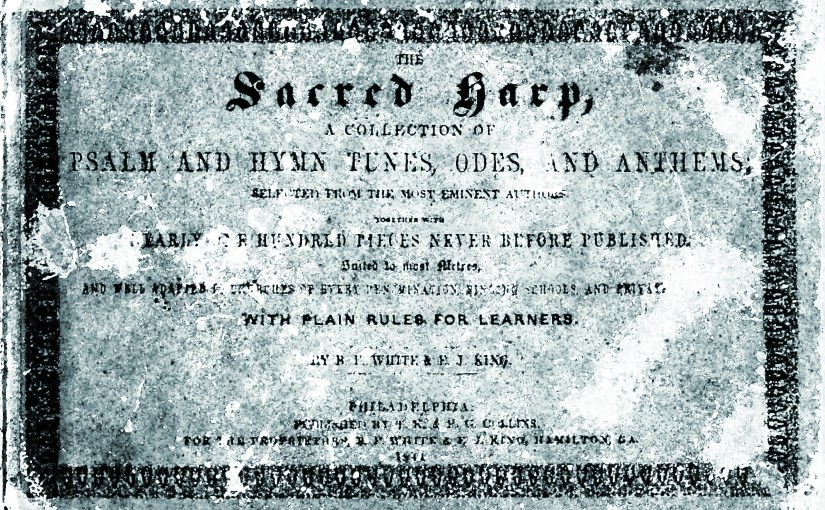
We shared a Sacred Harp
Leaned in close and sang “Jerusalem”

I can’t explain what came over me
The singing mixed with Miss Lucy Keith’s perfume
From the fragile scent of lilac
I felt myself rising up in the room

In the weeks after that night
I was often seen with Miss Lucy Keith
My former friends couldn’t understand
And stared at me with disbelief

I threw away my cards and dice
Having no use anymore for them
A wretch such as I had been saved
When Lucy Keith and I sang “Jerusalem”

So now you’ve heard my story
And it’s all I have to tell
I walked away that old hymn book
Somewhere, it’s sitting on my shelf

Those shaped notes may be old-fashioned
I hope there’s still some power left in them
Save your old Sacred Harps
My life was changed when I sang “Jerusalem”

© 2020 Frank David Leone, Jr./Highway 80 Music (ASCAP). The songs and stories on the Highway 80 Stories website are works of fiction. Names, characters, businesses, places, events, locales, and incidents are either the products of the author’s imagination or used in a fictitious manner. Any resemblance to actual persons, living or dead, or actual events is purely coincidental.
“I Start Each Day With Coffee”

LOCATION: Jackson, MIssissippi
PERIOD: 2023
DRAMATIS PERSONAE: Levi Hooper (1973); Lucy Cooper (1980-2015)


Outside of Jackson, Mississippi, fall of 2022. Levi Hooper, approaching his fifitieth birthday, lives alone and is satisfied with his solitary life.  But thoughts of Lucy Cooper still haunt the corners of his mind.


I START EACH DAY WITH COFFEE
(F. D. Leone, Jr.)

I start each day with coffee
At night a double shot of rye
In between I do my best 
To just get by
A masterpiece is the sunrise
The golden moon is poetry
I love livin’ in this cabin
It’s got everything I need
 
Each day may seem the same
But they are infinitely not
Tiny ripples on the surface
Reflect the hand of God
 
I love the first days of October
The crisp clean air of fall
Kicking through a drift of dry leaves
Firdaa nights high school football
I’ll chop a little oak and ash
For burning in my stove
Hunt and fish in the evening
Down in my cedar grove
 
Each day may seem the same
But they’re infinitely not
Tiny ripples on the surface
Reflect the hand of God
 
Sometimes I think of Lucy
Those memories still are mine
After all these years
There’s still feelings I can’t define 
I start each day with coffee
At night a double shot of rye
In between I do my best 
To just get by

© 2022 Frank David Leone, Jr./Highway 80 Music (ASCAP). The songs and stories on the Highway 80 Stories website are works of fiction. Names, characters, businesses, places, events, locales, and incidents are either the products of the author’s imagination or used in a fictitious manner. Any resemblance to actual persons, living or dead, or actual events is purely coincidental.

“Lucy’s Grandma On Her Mama’s Side”


LOCATION: Raleigh, North Carolina; Mississippi
PERIOD: 1920s-30s
DRAMATIS PERSONAE: Millie Carson Sparks (1899-1985); Bessie Carson Grant (1932- ); Lucy Bess Cooper (1980-2015)


The May 24, 1935 Roanoke Times headline read: Woman Pilot of Whiskey Cars Is Placed On Stand. Millie Carson Sparks testified on May 23 for a half hour. “So great was the interest with which her appearance has been awaited that it served to overshadow a full day of varied testimony . . .” The experience was a disappointing one for most, including Anderson, who saw his hopes of a great mountain heroine die with her appearance on the witness stand. “Mrs. Carson, whose name became so widely known here in the palmy [sic] days of the bootleggers during Prohibition, appeared minus the diamond that once gleamed in her teeth. She was dressed in a white outfit with hat and shoes to match, the dress having brown ruffled sleeves and collar gathered in front with a large cameo pin.

Mildred “Millie” Sparks was a tall, thin and sophisticated young woman whose appearance and mien belied her Southwestern Virginia upbringing. Sparks had originally married a big-shot bootlegger and soon became the principal driver for the operation, driving pilot cars as the caravans of booze careened and smashed their way through the hills of rural towns and into the conduits of the major cities, becoming a celebrity in the process. They said Sparks had movie-star looks and diamonds set in her teeth.

The woman she presented to the world gave no indication of the kind of upbringing she experienced as a girl.

She would have been out of bed at dawn. Summers came on the mountain farm then winters. From the time she was six or seven, she went, for a few months each winter, to a mountain school.

From the time when she was tall enough to stand up to the stove she got up and got the breakfast. In the winter there were corn bread and hot hog meat, and in the summer there were greens. Then she had to clean up the dishes and sweep out the house. She said that the house had no floor. There was just the hard earth, clay she said, made hard and even shiny by much tramping of bare and unwashed feet. To sweep out the house with a homemade broom her father had made, to wash the dishes – mend and wash her father’s clothes.

To school for a few months each winter, for four or five years – to learn anyway to read and write. Spring, summer, fall, and winter. There were plenty of creeping crawling things. “We had lice and bedbugs,” she said. She thought, when she was a child, they were companions every one had.

When she was sixteen she decided she could take no more of the life of back-breaking work and ran off to Raleigh and found work in one of the textile mills. Eventually she met the men involved in the bootlegging and married one.

No one around called the thing “bootlegging.” That might as well have been a foreign word. “You mean blockadin’, sir? What blockades?” Nobody ever said “moonshine” either. White Lightning. White Mule. Moon. Stump Whiskey. Mountain Dew. Squirrel Whiskey. Fire Water.

She had a little girl, Bessie, and chose to retire from her husband’s business, which was becoming increasingly dangerous and unprofitable by the early ’30s. It wasn’t long before the Feds shut down the entire enterprise, culminating with the longest trial in state history. She died 50 years after giving testimony in that trial at the age of 86.


LUCY’S GRANDMA ON HER MAMA’S SIDE
(F. D. Leone, Jr.)

Lucy’s grandma on her momma’s side
Was still around when Lucy died
Bessie Grant was born in the Depression
Had a hard life but was full of fun
Lucy was her favorite one
They never told her Lucy died in prison

Bessie’s momma was a blockader
Revenuers could never fade her
When she drove her fast pilot car
Millie Sparks had a diamond in her teeth
Ever’ thing she did was for keeps
Wore a camel coat; smoked a cigar

A long line of strong women
Tough as nails every one
They were here before this land was named
None of ’em was ever tamed
There ain’ ’nuff time to tell what all they done

Lucy’s momma Mae had a juke joint
Over by Friar’s Point
Where the all the old blues men played
Lucy’s daddy Frank burned it down
Bragged he was tired of her runnin’ around
‘Til he met the business end of a .38

A long line of strong women
Tough as nails every one
They were here before this land was named
None of ’em was ever tamed
There ain’ ’nuff time to tell what all they done

Maybe you heard about Lucy’s end
But six months after she went in
She had a baby, a little boy
They took the child and sent him off
Did it all without a second thought
Momma Mae found him, raised him up as McCoy

A long line of strong women
Tough as nails every one
They were here before this land was named
None of ’em was ever tamed
There ain’ ’nuff time to tell what all they done

© 2018 Frank David Leone, Jr./Highway 80 Music (ASCAP). The songs and stories on the Highway 80 Stories website are works of fiction. Names, characters, businesses, places, events, locales, and incidents are either the products of the author’s imagination or used in a fictitious manner. Any resemblance to actual persons, living or dead, or actual events is purely coincidental.
“Down 80 East”


LOCATION: Vicksburg, Mississippi
PERIOD: 2015
DRAMATIS PERSONAE: Levi Hooper (1973); Lucy Cooper (1980-2015)


Upon hearing of Lucy Cooper‘s death while in prison, Levi Hooper went on a bender. Getting in his truck and driving through Mississippi: Greenwood, Greenville, Vicksburg and even into Louisiana. He drank until drunk in small bars along the way (see songs, “When Louanne Met Lucy in Prison” and “Levi After Lucy“).

This behavior was certainly unusual for Levi, normally a down-to-earth, church-going man who spent much of his spare time helping his mother, Mildred Motts Hooper, with her house and business. She had turned her home into a thrift shop a year after her husband passed on (see song, “Mildred’s House of Values“).

This drinking road trip only lasted a little over a week, but it was enough for Levi’s mother, to become concerned. So it was with relief that he finally came home, and things returned to normal without Levi offering up any explanation as to the reason for his absence.


DOWN 80 EAST
(F. D. Leone, Jr.)

Levi woke up on the wrong side of the road
Sitting on the side of 80 East
Last thing he remembered was stumbling out that old church
Pressing a wrinkled twenty on the priest

Time to go back, runnin’ wild has run its course
He can’t run away from the grief
He needs a shave, a strong cup of coffee
Time to go back, down 80 East

He don’t understand why Lucy did what she did
She was so close to getting her parole
But this drinking and running has gone on long enough
What he’s looking for ain’t down this road

Time to go back, runnin’ wild has run its course
He can’t run away from the grief
He needs a shave, a strong cup of coffee
Time to go back, down 80 East

All along Levi thought it too good to be true
Doubted he and Lucy would last
But it looked like she was headed in the right direction
In the end she just ran out of gas

Time to go back, runnin’ wild has run its course
He can’t run away from the grief
He needs a shave, a strong cup of coffee
Time to go back, down 80 East

© 2019 Frank David Leone, Jr./Highway 80 Music (ASCAP). The songs and stories on the Highway 80 Stories website are works of fiction. Names, characters, businesses, places, events, locales, and incidents are either the products of the author’s imagination or used in a fictitious manner. Any resemblance to actual persons, living or dead, or actual events is purely coincidental.

“Sadie Jo”


LOCATION: Terrell, Texas, Shreveport, Louisiana
PERIOD: 2015-2019
DRAMATIS PERSONAE: Jacob “Jake” Tyler McLemore (1959); Pearl Boone Robison (1973); Sadie Jo Robison McLemore (2015)


It didn’t take long for Jake to become bored with retirement, and he bought a diner in Shreveport where Pearl Robison happened to enter one day in January 2010 (see song, “Pearl and Jake”). For five years Jake and Pearl had a turbulent romantic relationship,  before Pearl took to the road again (see song “Hit the Road”), heading west on U.S. 80, leaving Jake heartbroken at 56  (see songs, “The River and Jake” and “The Red River Flows”).

Unbeknownst to him Pearl was pregnant when she left, and gave birth to a daughter, Sadie Jo Robison.  Pearl initially had no intention of letting Jake know about this child, but she eventually did tell Jake (see song “Terrell”), however, nearly two years after she had left Shreveport.  Jake immediately proposed to Pearl, and they got married and moved back to Shreveport to raise Sadie Jo together.


SADIE JO
(F. D. Leone, Jr.)

Sadie Jo, I love you so
For the rest of my days, I’ll keep you safe,
Watching you grow
Your mama, Pearl, and my baby girl
Everything is brand new since you
Entered my world

Lost my first wife
To a damn drunk
He blew through a light
In a rusted out truck

I lost my son
In a pointless war
What your mama done, she gave me a someone
To love once more

Sadie Jo, I love you so
For the rest of my days, I’ll keep you safe,
Watching you grow
Your mama, Pearl, and my baby girl
Everything is brand new since you
Entered my world

I’m a tough old cob
To be a new daddy now
Wanna do a better job
This time around

A new baby and wife
Were not in my plans
I thank God every night for blessing my life
With this second chance

Sadie Jo, I love you so
For the rest of my days, I’ll keep you safe,
Watching you grow
Your mama, Pearl, and my baby girl
Everything is brand new since you
Entered my world

© 2019 Frank David Leone, Jr./Highway 80 Music (ASCAP). The songs and stories on the Highway 80 Stories website are works of fiction. Names, characters, businesses, places, events, locales, and incidents are either the products of the author’s imagination or used in a fictitious manner. Any resemblance to actual persons, living or dead, or actual events is purely coincidental.

“The Ballad of Sam McLemore”


LOCATION: West Texas
PERIOD: 1870s
DRAMATIS PERSONAE: Sam Summers McLemore (1852-1878); Sally McCune Cummings (1854-1912); Jacob “Mac” McLemore (1879-1977)


Sam Summers McLemore (1852-1878) lived a violent and short life as an outlaw and gunfighter in Texas.  His father fought and died in the Civil War, leaving Sam at age 12 without much direction.  He occupied his time by practicing drawing and shooting the pistol that he inherited from his father.

At age 18 he was part of a cattle drive, and when some of the wranglers went into town, he was called out for cheating at cards.  He wasn’t cheating but had to defend his honor and killed his first man.  From then on, he found himself having to kill more men who challenged him (see song “The Ballad of Sam McLemore“).

Being a gunfighter was never clearly articulated in his mind, but his life took on a momentum of its own, with him being thrust in the position of defending himself from those who wished to make their own reputations.  For the better part of a decade he lived this kind of life, before taking up with a young prostitute, Sally McCune, rooming with her in the saloon/brothel in West Texas where she worked.

His last fight took place in the dusty street outside this saloon, when he was outgunned by a younger gunslinger and died on that street, age 26.  He did not know it at the time but Sally was carrying his child, Jacob Mac McLemore.

Sally would joke that since her father, a hard shell Baptist minister, was named Horace it was only natural that she took to whorin’.  But once she had the boy, she swore that she’d get out of that life and raise him up right.  And this she did, eventually owning and operating a boarding house in Fort Worth.  This is where Jacob grew up, until he turned 15 and took off for Corsicana when he heard about the oil strike there in 1894.


THE BALLAD OF SAM MCLEMORE
(F. D. Leone, Jr.)

He can’t say how it started
One day he killed a man
It was in self defense
Still they called him the devil’s hand
 
That one became ten
Songs were sung in saloons
He couldn’t hang up his gun
There was always something to prove
 
No wife no home no one that he could trust
A gunslinger can’t outrun his fame
He’s called out, draws and falls down in the dust
Shot by a boy who wants to make a name
 
At first it was thrilling
He was fast as the wind
Those who challenged him
Wouldn’t challenge no one again
 
Then he was older, they were bolder
And knew he wasn’t as fast
He was still tough but all bluff
A shadow of his past
 
No wife no home no one that he could trust
A gunslinger can’t outrun his fame
He’s called out, draws and falls down in the dust
Shot by a boy who wants to make a name

© 2018 Frank David Leone, Jr./Highway 80 Music (ASCAP). The songs and stories on the Highway 80 Stories website are works of fiction. Names, characters, businesses, places, events, locales, and incidents are either the products of the author’s imagination or used in a fictitious manner. Any resemblance to actual persons, living or dead, or actual events is purely coincidental.