“Wanna Go to Jackson?”


LOCATION: Montgomery, Alabama; Jackson, Mississippi.
PERIOD: 1932-1933
DRAMATIS PERSONAE: Lamar Hooper (1907-1969); Katherine George (1910-1994);  Donald Motts (1909); Marjy Littlejohn (1911-1982); twins, Leon & Mary Hooper (1932); Mildred Motts (1934-2014).


Lamar and Katherine had been in Montgomery a little over a year, when Lamar gets a hankering to move. Kath was pregnant at the time, and told him, she’d move with him, but not until this baby was born and they were ready to travel.

When asked, Lamar informs her that their destination was Jackson, Mississippi. When asked why, he says he heard it was nice.

In Jackson the Hoopers meet the Motts and they become great friends, and eventually Leon Hooper marries Mildred Motts, bringing these two families officially together.


WANNA GO TO JACKSON?
(F. D. Leone, Jr.)

“Lemme ask you somthin’, Mama,
Are you happy in Magomry?
What would’ya think if we moved?”
“‘Magomry’s home; move where?”
“Jackson, M’sippy”
“Why there? I’m confused.”
“Someone said it was nice, and I thought,
Things jus’ might improve.”
 
“Well, that’s fine, Lamar,
When were you thinking we’d start?”
“Right now, if you ain’ busy?”
“Lamar, I’m kinda far along;
Cain’ we wait ’til this baby’s born?”
“Why sure, Kath, don’t get in a tizzy;
But as soon as y’all can travel,
I wanna go t’ Jackson, M’sippy.”
 
But it wasn’t just one baby,
In Katherine’s belly’;
It was twins tha’ she was havin’.
She named ’em Leon and Mary,
For her mama and daddy;
All the while, Lamar was packin’.
He put ’em in the car,
They all went down the highway to Jackson.

They rented a clapboard house,
5402 Highland;
An’ met the couple at 5401.
Donald and Marjy Motts,
And their daughter Mildred;
Who, one day, would marry Leon.
Friday they’d get together, an’
Play Moon and 7-Up fo fun.
 
Kath brought her fig preserves,
Some Fritos and Dr. Pepper;
Marjy’d serve pimento cheese on rye.
The guys would drink Jax beer,
Maybe a highball or two;
Sometimes Lamar got a little high.
Then he’d stand at the hearth, and
Sing Jimmie Rodgers all night.
 
Don got Lamar on at the oilfield,
They all became good friends;
Sairdy night they’d go out on Flowood Road.
Hot dogs ‘n’ fruit jar whiskey,
Live music at speakeasies;
They were in hog heaven, an’ it show’d.
The Motts and the Hoopers,
Never moved and together they grew old.

© 2023 Frank David Leone, Jr./Highway 80 Music (ASCAP). The songs and stories on the Highway 80 Stories website are works of fiction. Names, characters, businesses, places, events, locales, and incidents are either the products of the author’s imagination or used in a fictitious manner. Any resemblance to actual persons, living or dead, or actual events is purely coincidental.
“Tuscaloosa”

Location: Montgomery County, Alabama; Tuscaloosa.
Period: 1928-1931
Dramatis personae: Lamar Hooper (1907-1969); Katherine George (1910)


Lamar Hooper grew up on a farm in Montgomery County Alabama, but was a restless teenager who left home at 15 and went to the “big city” of Montgomery (see song “Magomery“). After a few years he met a young lady, Katherine George, and they began dating. But Katherine was also restless, and she would often take off for parts unknown.

This song is about one of her escapades in Tuscaloosa, where life was a bit more exciting, what with the college there and plenty of young folk, who were living the life in the Jazz Age.

Lamar would dutifully trail after Katherine.

Lamar and Katherine hung around Tuscaloosa, where their romance blossomed and they fell deeply in love. Eventually they would would return to Montgomery and their more conventional lifestyle. These little adventures would cease once the Depression hit, when merely surviving took all their energies and attention.

They married in 1931, and had three children, the oldest, Leon Hooper (1933-1975) was the father of Levi Hooper (1973) (more of whom can be learned about in several other Highway 80 songs: “Levi & Lucy“; Levi After Lucy).

By the time Leon was born Lamar and Katherine had relocated to Jackson, Mississippi, in the constant pursuit of employment and a better life.


TUSCALOOSA
(F. D. Leone, Jr.)

8th of May,
Katherine fled,
Tuscaloosa.
I coulda stayed,
Hit the road instead;
Tuscaloosa.
A place, a time,
The scene of a crime;
It all remains,
In my head;
Tuscaloosa.

Keep my pride
Hidden away;
Thought I knew her.
Dawn sky;
Iron grey,
Tuscaloosa.
I wonder if Katherine was,
Ever, really, in love?
Overnight,
Frost on the clay;
Tuscaloosa.

Downhill;
A road alone,
Don’ wanna lose her.
Whippoorwill’s
Lonesome song;
Tuscaloosa.
Sun’s going down,
Another dirt road town.
I’ll drive until,
She’s too far gone;
Tuscaloosa.

White line,
Leads to a door;
Straight to her.
City sign,
Ten miles more;
Tuscaloosa.
An ashtray was left,
Full of lipstick tipped cigarettes;
In our two-lane
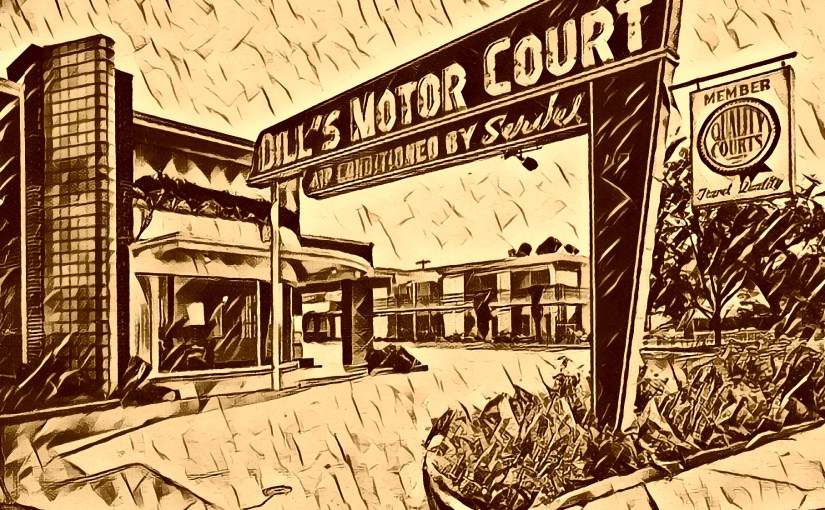
Motel court;
Tuscaloosa.

© 2023 Frank David Leone, Jr./Highway 80 Music (ASCAP). The songs and stories on the Highway 80 Stories website are works of fiction. Names, characters, businesses, places, events, locales, and incidents are either the products of the author’s imagination or used in a fictitious manner. Any resemblance to actual persons, living or dead, or actual events is purely coincidental.
“James”

Rosalie Broussard found herself pregnant a week after turning sixteen (see song “Jenny or James“).  Though her boyfriend wanted her to have an abortion, and even offered her the money, she refused, because Rosalie had a naive understanding about what having a baby really meant, and also because she just didn’t like the idea.  However, she eventually realized she couldn’t handle the responsibility and when James was three she handed him over to her father and his second wife, MaeAnn.

When Rosalie was twenty she left Vivian, Louisiana and married Tully Tate, a man she met while waitressing at a truck stop.  They had twin girls and lived in Mobile, Alabama.  But Rosalie never could make peace with domestic life and would run off from time to time, each time Tully would find and bring her back home (see song “What Tully’s Done“).  But eventually he grew tired of chasing after his runaway wife and Rosalie finally left that family as well (see song “Rosalie“).

Mike and MaeAnn dearly loved James since they saw that his mother had not shown him the natural love of a mother.  But James still felt an emptiness which was only relieved when he played catch with his grandpa.

JAMES
(F.D. Leone, Jr.)

James was Wednesday’s child, full of woe
His mama left when he was just three years old
Rosalie was only sixteen when she had him
Left him with her parents; he was raised by them

James grew up wondering if he’d done something wrong
That made his mama leave him at his grandpa’s home
His father was a shadow, a name that wasn’t said
But Mike and MaeAnn did their best

When James played catch with Mike
For a little while everything seemed alright
A peaceful feeling settled in with the dimming light
On those summer days when James played catch with Mike

He overheard bits and pieces about his mama’s life
She was living in Mobile, a truck driver’s wife
At Christmas she might visit but wouldn’t stay too long
Gave James some toy he’d long ago outgrown

MaeAnn said he had twin sisters in Mobile
James really hoped that they had a better deal
But soon Rosalie would run off from them too
It seemed that’s all his mama was cut out to do

When James played catch with Mike
For a little while everything seemed alright
A peaceful feeling settled in with the dimming light
On those summer days when James played catch with Mike

© 2019 Frank David Leone, Jr./Highway 80 Music (ASCAP). The songs and stories on the Highway 80 Stories website are works of fiction. Names, characters, businesses, places, events, locales, and incidents are either the products of the author’s imagination or used in a fictitious manner. Any resemblance to actual persons, living or dead, or actual events is purely coincidental.

William Crawford Harper (1942-2001)

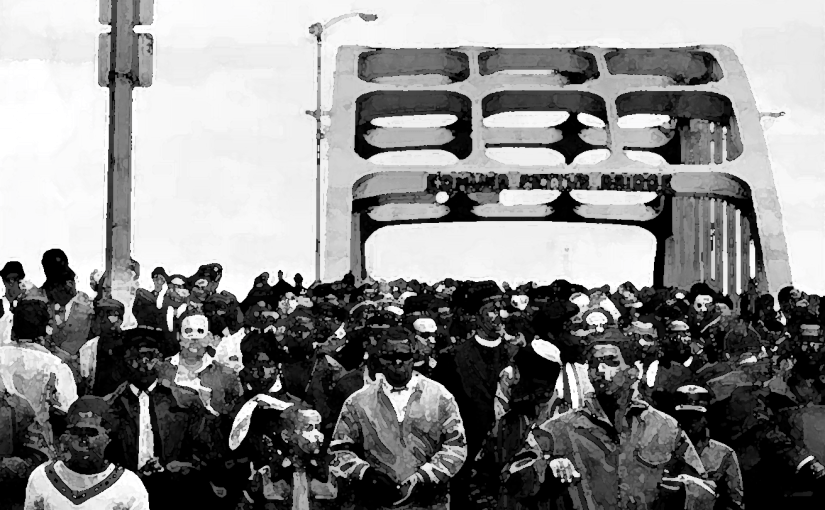
William Crawford Harper was the great-grandson of a woman born into slavery, Celsie Crawford Monroe (1844-1936 ).   Willie Harper would grow up just a few miles from the former plantation where Celsie lived,  however he would join one of the landmark events of the civil rights era, the march from Selma to Montgomery (see song “Crossin’ the Edmund Pettus Bridge“).

William served in the Marines during the Vietnam War but came home and used his training to start an electronics business.  He married Corinne Morgan and they had one son, Morgan Harper. Morgan married Rosa Blanton, and they had three children, including one son Crawford Harper (1987).

Willie Harper always knew that his great-grandmother, Celsie, was half-white, and had given birth to a son Tully Tate in 1866 from her common law marriage to a white man, Joshua Tate.  Tully Tate married the illegitimate daughter (Pearl Robison) of a Louisiana prostitute (Ruby Robison) and Confederate soldier (Levi Motts) (see songs “Levi Motts is My Name” and “Fannin Street“).

The Harpers had lost track of the Tate side of the family.  But Willie Harper’s grandson, Crawford Harper, would end up coming into to contact with descendants from the white side of the family, Vernon and Donald Raney, in Meridian Mississippi, which is just across the state line from Demopolis, Alabama, where Crawford was living in 2007.

Unfortunately the Raneys were not exactly upstanding individuals.  Their family had  been involved in making moonshine, bootlegging and later drug distribution ever since Lonsom Raney established his copper pot still in the early 19th century in north Georgia.  Later members of the family moved to Mississippi (see songs “Lonsom Raney 1828” and “’57 Fleetwood to Memphis“).

Crawford and the Raney brothers would join up for a period of time which would have greatly disturbed Willie Harper, who had tried to instill only the highest values in his children and grandchildren.  However, Willie never lived to see how his grandson turned out, dying in 2001 from a heart attack.

© 2018 Frank David Leone, Jr./Highway 80 Music (ASCAP). The songs and stories on the Highway 80 Stories website are works of fiction. Names, characters, businesses, places, events, locales, and incidents are either the products of the author’s imagination or used in a fictitious manner. Any resemblance to actual persons, living or dead, or actual events is purely coincidental.

Celsie Crawford Monroe (1844-1936)

Celsie Crawford Monroe (1844-1936) was born into slavery but was freed by Will Monroe, a wealthy white planter and her father, in 1863 as a result of Abraham Lincoln’s Emancipation Proclamation.

Celsie’s mother, Jessie Crawford (1828-1905), was a slave from a neighboring plantation of whom Will Monroe had grown quite fond. Monroe made sure Jessie was provided for and also insisted that she be freed in 1863 by paying off her owner Carson Crawford.

Celsie was what was called a “yellow gal”, and quite beautiful.  Once she was freed at age 19, Celsie began seeing a white man, Joshua Tate (1828-1867), and their relationship developed into a common law marriage, although the possibility of such a union was denied at the time.

The Tates were a wealthy Alabama family held in high regard and Joshua’s indiscretion was of course never openly acknowledged by the family and surrounding community, although everyone knew of it and the child it eventually produced.

Joshua was nominally a lawyer handling cotton trades and other mercantile business for the planters. But as was the custom for sons of his class, his hours were at his own instigation. Although he made a daily trip to town, he might only spend an hour or two in the afternoon in his office, often asleep on the leather couch sitting against the wall, next to the large hearth fire.

After the War, Republican “carpetbaggers” entered the former Confederacy and worked to overturn every vestige of slavery and the old ways at every turn; Alabama was no exception.  These men were hated since they were seen as enemy outsiders, and interlopers and exploiters who added insult to the injury of losing the war.  It was during this turbulent period that Joshua Tate was murdered in 1867 in his second floor office by a man with a three barreled derringer pistol, while Joshua was relaxing on the couch with a volume of Homer.

Some said the motivation behind the killing was Tate’s relationship with Celsie Monroe; others said he was killed because of his covert support of the Republicans.  Still a few others said he was killed by a carpetbagger.  However, no one was ever accused much less arrested and convicted of Josh Tate’s murder.

Tate lingered for two days before dying, leaving Celsie with a son, Tullison Monroe Tate (1866-1948). Tully Tate was one-quarter African-American, light-skinned and who would marry a white woman and whose descendants would all be considered white, Tully’s blood becoming less and less present with each successive generation.

In 1872 Celsie’s first official marriage was to a African-American man, Jesse Harper (1850-1922), and Celsie and Jesse enjoyed a long and happy union, raising four children, seven grandchildren, and many great-grandchildren. However, Celsie’s oldest child, Tully, was raised by his spinster Aunt Ruth, his father’s sister.

One of Celsie’s great-grandchildren, William Crawford Harper (1942-2001), marched from Selma to Montgomery in 1965 (see song “Crossin’ the Edmund Pettus Bridge“). Willie Harper lived to see most of the Jim Crow laws reversed even as the stubborn stain of racism remained.

© 2018 Frank David Leone. The songs and stories on the Highway 80 Stories website are works of fiction. Names, characters, businesses, places, events, locales, and incidents are either the products of the author’s imagination or used in a fictitious manner. Any resemblance to actual persons, living or dead, or actual events is purely coincidental.
Tullison Monroe Tate (1866-1948)

Tullison Monroe “Tully”Tate was the direct descendant of the major landowner and planter of Perry County Alabama, Thomas William Monroe but was not considered an heir because he was an illegitimate offspring.  Tully was just another cotton sharecropper, on his grandfather’s land with no more status than any other black farmer  in Alabama around the turn of the 20th century.  The reason he was not acknowledged as a true Monroe heir was not simply because he was born outside of marriage, but more importantly, because his grandmother was a slave whom Will Monroe had impregnated in 1844.  The result of this miscegenation was Tully’s mother Celsie Monroe.

Celsie was briefly married to a white man, Joshua Tate, and Tully was their only child before separating. Josh Tate was unusual for that time, he was sympathetic to the plight of negroes and his marriage to Celsie was one of love.  After the war the years of Reconstruction were hardly less violent than the war itself. Joshua Tate wished to see the local political power elites toppled and sought to help the Republican elect suitable progressive candidates, including whenever possible negro men.  And he was shot down in 1867 at one of these elections when he confronted a mob that was attempting to control who was allowed to vote.

Tully was a cotton farmer whose status within the community was complicated by the fact of his heritage, which everyone knew, calling him Monroe’s Tully (see song “King Cotton“). After leaving Tully’s father, Celsie would go on to marry Mingo Harper, also a former slave, and they would have four other children, two of whom would play a not insignificant role in the civil rights struggles of the 1950s and ’60s.

Tully Tate would marry Pearl Robison, the daughter of Ruby Robison and Levi Motts resulting in the birth of Hazel Tate.  Hazel would in turn marry Virgil Raney, descendant of Lonsom Raney producing a son, Vernon Raney, husband of Molly Motts. This created the complicated reality that Tullison Monroe Tate’s mixed blood ran through the various strands of the Tate, Raney, Motts and Robison families.

Almost exactly one century later there would be another Tully Tate, the son of a country singer in Louisiana.

Levi Hooper (1973- )

In Levi’s mother’s mind he was named for her ancestor who died in the Civil War.  However, the name Levi was also an old Hooper family name, and Leon Hooper, Levi’s father, chose to name his son after his grandfather who had died the year Levi was born.

Levi Hooper was a descendant of two old Southern families: the Hoopers came into North Carolina in the early 18th century and then migrated to Alabama in the mid-19th century.  The Mott family was an old Louisianan family going back to the 1750s.

Jackson, Mississippi, was where Levi was raised and he never moved away.  His daddy was a welder and made a good living but died just before Levi turned two.  After that Levi’s mother turned the family home into a thrift shop (see song,”Mildred’s House of Values“) putting price tags on everything from lamps and vases to the furniture.

Levi eventually got his own place and met his neighbor from across the street, Lucy Cooper, and began a kind of courtship (see song, “Levi + Lucy“).  Lucy Cooper was nothing like Levi, she was rebellious and wild whereas Levi was mild-mannered, a church -going man.  But Lucy was strangely attracted to Levi’s wholesome quality and made a real effort at cleaning up her life and trying her best to change.

But as this kind of thing is never really easy, Lucy had trouble straightening out and one thing led to another and she was arrested and sent to the penitentiary to serve eighteen months on a drug charge.

Levi visited her often and told her was waiting for her, but Lucy could not take prison life and ended up overdosing shortly before being released.  Lucy’s death, coupled with the passing of his mother the year before, was too much for Levi.  He started down a dark path of drinking and driving all through the western Mississippi/eastern Louisiana area (see song, “Levi After Lucy“).

He would not break out of this self-destructive behavior until he learned from Lucy’s mother, Mae Cooper, that before she died Lucy had given birth to Levi’s son whom Mae was raising and had named McCoy (see song “Lucy’s Grandma“).

Opelika, Alabama

 (Information taken from Wikipedia)

Opelika is a city in and the county seat of Lee County in the east central part of the State of Alabama. It is a principal city of the Auburn-Opelika Metropolitan Area. According to the 2013 Census Estimate, the population of Opelika was 28,635.

The first white settlers in the area now known as Opelika arrived in the late 1830s and established a community called Lebanon. After the removal of the native Creek (Muscogee) peoples by federal troops in 1836-37, the area became known as “Opelika.” This word taken from the Muskogee language means “large swamp”. Settlement was sporadic until the late 1840s, when the railroad reached the town. This stimulated development of Opelika as a commercial center.

In 1848, the Montgomery & West Point Railroad Company extended a rail line from Montgomery, Alabama to Opelika, and in 1851 completed a connection to West Point, Georgia, thus connecting Opelika with Atlanta, Georgia. This line was the only direct rail route between New Orleans and the Eastern Seaboard. It rapidly became one of the primary trade lines for shipments of raw cotton from Southern plantations to the North. The Montgomery & West Point was soon joined by a rail connection to Columbus, Georgia in 1855, and a connection to Birmingham, Alabama in 1869. Almost overnight, Opelika became a regional hub for commerce.

Soon after the end of the Civil War, the Alabama state legislature created a new county out of parts of Macon, Russell, Chambers, and Tallapoosa counties to be named after Confederate general Robert E. Lee. In 1866, citizens of the new “Lee County” voted Opelika as the county seat. The town was technically unincorporated after having its charter revoked for abetting the rebellion against the United States.

After Opelika received a new charter the town nearly doubled in size between 1870 and 1900. During this time, Opelika began to gain a reputation as a wild, lawless town. Soon after receiving the new charter, city officials attempted to scam outside investors by issuing fake railroad bonds. For this, the town’s charter was revoked again in 1872, and the town was administered as a police district by the state legislature for the following year.

Opelika’s downtown was packed with saloons catering to railroad workers and other men. Frequent gunfire in the street by intoxicated patrons resulted in railroads directing their passengers to duck beneath the windows when their trains passed through the town.

In 1882, two factions claimed to rule the city government, one known as the “Bar room” headed by Mayor Dunbar, a saloon keeper, and another known as the “Citizens”. There was a riot in late November–December of that year, in which a dozen men were wounded. In the end a couple were killed. The Citizens had claimed control of the city via the elections, but Dunbar refused to give up. After continued violence, the state legislature revoked the city’s charter and the governor sent in the militia to restore order. The legislature appointed five commissioners to manage the city, a situation that continued until 1899. That year the legislature restored the city’s charter.

In 1900, local investors founded the Opelika Cotton Mill as the first textile plant in the city, employing 125. The city was located on the Fall Line of the Piedmont, where factories were established to take advantage of water power. Attempts to expand the textile industry in Opelika continued for the next three decades. In 1925 city officials used a $62,500 bribe to induce executives of the Pepperell Manufacturing Co. (now WestPoint Home) to construct a large mill just outside the city limits.  From 1930 to 1970, Opelika continued industrialization, becoming a regional economic powerhouse.

Between the late 1970s and 2005, non-agricultural employment in the Auburn-Opelika,  grew at a slow and steady pace. Of the goods-producing industries, the metropolitan area has experienced the most change in manufacturing, which peaked in employment in the late 1980s. As many jobs moved offshore, employment declined. But this trend appears to be changing, as the number of manufacturing jobs has risen steadily since 2002.