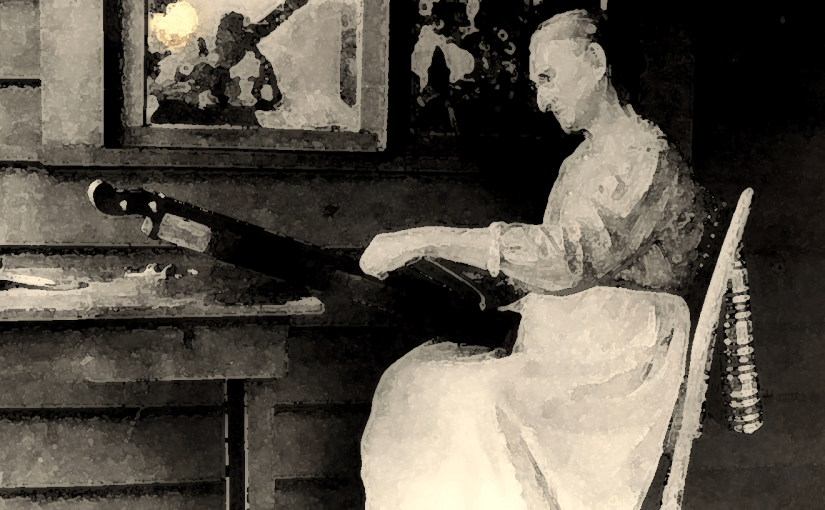
Alma Prescott Langford (1875-1958)

Alma Prescott Langford was the daughter of a minister and the granddaughter of a Cherokee chief.  Alma was a serious woman, but would display uncommon compassion given the right circumstances.  Those circumstances arose concerning her daughter Emily Langford.

Her maternal grandfather was a Cherokee chief, Franklin Largo, who married a white woman, Hilary Cosgrove, and helped her operate the general store her father started.  The Prescotts were a Calvinist Presbyterian family whose men were often called to preach.

People said she got the “Italian” look from the Indian side. It’s true she had her  grandpa’a’s black eyes and prominent cheek bones but she got her mama’s fair skin and height.

When George Littlejohn came to court her daughter Emily, it was Alma who softened up Lige Langford enough to allow the match to proceed.  She had a keen understanding about love cropping up in places that a straight-laced Calvinist community frowned upon (see song “The Langfords and the Littlejohns“).

Emily Langford (1900-1977)

langfords-and-littlejohns-family-tree-e1526455149929.jpg

Emily Lankford was the sweet daughter of Elijah Langford a strict religious man who raised her to certainly not fall in love and marry someone like George Littlejohn. At least he didn’t think he wanted George Littlejohn in his family.  But as it turned out George was a good husband to Emily and became someone Lize liked and respected.

The Littlejohns were a family of hell-raisers and Lize Langford wanted nothing to do with them.  However, George was not cut out of the same cloth, and Emily saw him for who he really was.  George had a good singing voice and the story goes that when Lize Langford would not let him in his house to see Emily, George stayed outside on the porch and sang all night.  He usually accompanying himself on a handmade dulcimer.

George and Emily left North Carolina and moved to Mississippi, their daughter Marjy Littlejohn was Levi Hooper’s maternal grandmother.

Anse Littlejohn (1871-1961)

Anse Littlejohn was Levi Hooper’s great-great-grandfather on his mother’s side.  Anse was the patriarch of a family of ner-do-wells.  His son George, however, fell in love with Emily Langford, one of the children from a church going family.  When George and Emily married these two families merged, softening the Littlejohns but also undercutting the piety of the Langfords.

George Littlejohn (1896-1944)

George Littlejohn, the “lone white sheep in a family of black,” was the son of Anse Littlejohn.  While his father, and brothers, were hard-nosed, severe and difficult to get along with North Carolinians, George was pretty much the opposite.  However, he was a strong individual, a quality which allowed him to defy his father and marry Emily Langford, the daughter of a strict Presbyterian family.

George and Emily left North Carolina and ended up in Mississippi, they were the great grandparents of Levi Hooper.

“Levi and Lucy”


LOCATION: Jackson, Mississippi
PERIOD: 2012-2015
DRAMATIS PERSONAE: Levi Hooper (1973); Lucy Bess Cooper (1980-2015)


The romance of Levi Hooper and Lucy Cooper was an unlikely union; absolutely, an attraction of opposites.

They met while living across the street from one another in Jackson, Mississippi.   Lucy was a hell-raising rebel and Levi was a church-going, salt-of-the-earth young man.  Lucy was attracted to Levi mainly because he was nothing like the people she’d been involved with up to then, and Lucy had grown tired of her life and was ripe for a change.

Levi was attracted to Lucy because, well, for one thing, she was a very sexy lady, but more importantly he intuitively felt that she wanted more out of life than her drinking, drugging and wild partying.

Theirs was a true love which they both felt strongly, but a love that was destined to be cut off far too early, its potential left unfulfilled.


LEVY AND LUCY
(F.D. Leone, Jr.)

Lucy Cooper cussed the hammer that struck her thumb
Sent it sailing to kingdom come
Grabbed a whiskey bottle and marched out to her front porch
Found a roach and lit it with a butane torch

Levi Hooper watched from across the street
Wonderin’ how they might come to meet
He strolled out real slow looked in his mailbox
Lucy called out,”hey, hotshot”

Love can’t be controlled
Can’t be foretold
If you can explain it
It ain’ it

Love can’t be fenced
Or convinced
If you can explain it
It ain’ it

Every Sunday Levi would stop by on his way to church
Look at his feet with each of Lucy’s cuss words
Levi hoped she might want to come with him sometime
But he tried to push that thought out of his mind

Lucy had no luck at tryin’ to settle down
Her old friends always kept coming around
Lucy got busted they sent her to the prison farm
Where she put that stuff all up her arm

Love can’t be controlled
Can’t be foretold
If you can explain it
It ain’ it

Love can’t be fenced
Or convinced
If you can explain it
It ain’ it

© 2018 Frank David Leone, Jr./Highway 80 Music (ASCAP). The songs and stories on the Highway 80 Stories website are works of fiction. Names, characters, businesses, places, events, locales, and incidents are either the products of the author’s imagination or used in a fictitious manner. Any resemblance to actual persons, living or dead, or actual events is purely coincidental.

“Levi After Lucy”


LOCATION: Mississippi: Vicksburg, Greenwood, Greenville
PERIOD: 2015-16
DRAMATIS PERSONAE: Levi Hooper (1973); Lucy Cooper (1980-2015)In the aftermath of Lucy


Cooper‘s either accidental overdose or intentional suicide while incarcerated in the Louisiana Prison for Women, Levi Hooper went on something of a bender. Levi was not normally a drinker, but he felt despondent over Lucy’s death and did the only thing he knew how in order to deal with the set of emotions he felt: anger, shock, frustration.

Lucy had not done any drugs or much drinking for weeks prior to being arrested. That arrest was in itself was another case of bad timing: someone she thought was a friend flipped when arrested and gave Lucy up as his dealer (see song, “Levi and Lucy“. The reason Levi did not wish to believe that Lucy had committed suicide was because often when a former user has not done any narcotics for a while, if they relapse at their last dosage, their body cannot tolerate what it once did.

In any event, Lucy had been in the process of turning her life around at the time of her arrest, and her death while serving a relatively short sentence, 18 months, was hard for Levi to take (see songs, “Ready for Change” and “When Louanne Met Lucy in Prison“).

His binge begins in bars around Vicksburg, then he hits the road, to Greenwood, and Greenville, ending up at a small Catholic church in Lake Providence, Louisiana. Levi does not wish to be rude to the priest, he is simply exhausted both mentally and physically, and after this experience, Levi goes back home, devotes himself once again to helping his mother and begin to pick up the pieces of his life.


LEVI AFTER LUCY
(F. D. Leone, Jr.)

Levi staggered up the stone church steps
A slice of moon hung above a wooden cross
Inside the door he stared at a concrete font
Then walked down the aisle, drunk and lost

He eased himself into a pew and sat
Musty scent of incense hung in the air
Worn leather knee-benches underfoot
Levi tried to find the words of a prayer

Vicksburg, Greenwood, Greenville
Gone down many roads, travelin’ still
Pavement, gravel, then dirt
But what he’s lookin’ for ain’t in this church

His head sank to his chest; he slept
A priest shook him; he struggled to his feet
The priest asked him, “Do I know ye?”
“No,” Levi said. “You don’ know me.”

Vicksburg, Greenwood, Greenville …

“Please, Lord, please keep me still
From sinkin’ lower an’ blowin’ away
I’ll straighten out I swear I will
Least that’s how I feel today”

Priest looked him over and said
“Were you waiting to see me?”
Woman was dustin’ the altar with a rag
“No, sir, I just fell asleep.”

Vicksburg, Greenwood, Greenville …

© 2018 Frank David Leone, Jr./Highway 80 Music (ASCAP). The songs and stories on the Highway 80 Stories website are works of fiction. Names, characters, businesses, places, events, locales, and incidents are either the products of the author’s imagination or used in a fictitious manner. Any resemblance to actual persons, living or dead, or actual events is purely coincidental.