“Barrow”


LOCATION: Texas and Louisiana
PERIOD: 1931-1934
DRAMATIS PERSONAE: Bonnie Elizabeth Parker (1910-1934); Clyde Chestnut “Champion” Barrow (1909–1934)


Clyde Barrow and Bonnie Parker captured the imagination of Depression era America. Although their actual success at crime was a far cry from the myth, people were starving to be distracted from the dire reality of the dust bowl and economic devastation.

For about three years, 1931-1934, the “Barrow Gang” traveled Texas, Oklahoma and Missouri attempting to rob banks but more often small grocery stores or filling stations. Clyde was blamed for murders he didn’t commit. Criminal masterminds they were not, but the newspapers built them up into larger-than-life characters; publishing photographs of the couple that had been found at an abandoned hideout.

The portrayal in the press of Bonnie and Clyde was sometimes at odds with the reality of their life on the road, especially for Bonnie Parker. She was present at 100 or more felonies during the two years that she was Barrow’s companion, although she was not the cigar-smoking, machine gun-wielding killer depicted in the newspapers, newsreels, and pulp detective magazines of the day.

In May 1934 Frank Hamer, a legendary Texas Ranger, assembled a well-armed posse around Gibsland, Louisiana on Louisiana SR 154, not far from US 80, and they put over a hundred slugs into their bodies, bringing an end to their short but exciting run.


BARROW
(F. D. Leone, Jr.)

He grew up a poor boy in Texas
A little smarter than the rest, and restless
He looked around and didn’t see no justice
The cards were stacked against a poor man
Told himself he’d not be poor again

She had honey golden hair and was so cute
Got away with anything she’d do
Loved the movies and said she’d be in one too
The dreams of a poor girl ain’t free
But nothin’ could dent her belief

He stole cars and robbed grocery stores
Then bigger crimes that could not be ignored
Killed a lawman, when they sent him down he swore
They’d never take him alive again
He’d die before he went back to the pen

When she met him she sure liked his flash
For a time they ran wild and fast
But even they knew it couldn’t last
A Texas Ranger was on their trail
Said he’d chase ‘em all the way to hell

Blamed for crimes they didn’t even commit
Magazines and newsreels reported it
Didn’t matter if the facts didn’t fit
That Ranger was closin’ in
There was just one way it could end

1934 saw widespread trouble
Folks started rooting for the fugitive couple
The Law staked ’em out with a lot of muscle
They never really had a chance
Those bullets sure made ’em dance

© 20195 Frank David Leone, Jr./Highway 80 Music (ASCAP). The songs and stories on the Highway 80 Stories website are works of fiction. Names, characters, businesses, places, events, locales, and incidents are either the products of the author’s imagination or used in a fictitious manner. Any resemblance to actual persons, living or dead, or actual events is purely coincidental.
“Feel Like Dirt”


LOCATION: Midland, Texas; Conyers, Georgia
PERIOD: 1981
DRAMATIS PERSONAE: Ruby Jones Robison (1955) ; Darrel Haynes (1951)


Ruby Jones Robison (1955) is Pearl Robison’s aunt, her father’s sister. Ruby met Darrel Haynes (1951) at Texas Tech in Lubbock, TX, and they were quickly married settling into a house in Midland in 1977 where Darrel had gotten a job at Baker Oil right out of college.

They were happy for a few years, but when they lost their first child, a girl, it broke the marriage up. Ruby was 32 in 1981 when she decided to leave Darrell and go back to Conyers, Georgia, her hometown.


FEEL LIKE DIRT
(F. D. Leone, Jr.)

She got on the Greyhound with her suitcase
And her little patent leather bag
Had two Cokes, a package of peanuts,
And a fifth of Ancient Age
 
She nursed that bottle all across Texas,
But she was sober when she crossed the Georgia line, in fact
Lord, she cried those first few weeks
But she didn’t look back; couldn’t look back
 
It was either kill the man or leave
Killin’ was more trouble than he was worth
Gettin’ on that bus was a relief
First time in a long time she didn’t feel like dirt
 
She left everything in the house
And nothing of herself behind
Dropped her keys on the kitchen table
Along with the reason why
 
It was a matchbook she’d found in his jeans
There was a heart with a phone number inside
All those loads of laundry
The dreams she compromised
 
It was either kill the man or leave
Killin’ was more trouble than he was worth
Gettin’ on that bus was a relief
First time in a long time she didn’t feel like dirt
 
She got on the Greyhound with her suitcase
And her little patent leather bag
Had two Cokes, a package of peanuts,
And a fifth of Ancient Age

© 2018 Frank David Leone, Jr./Highway 80 Music (ASCAP). The songs and stories on the Highway 80 Stories website are works of fiction. Names, characters, businesses, places, events, locales, and incidents are either the products of the author’s imagination or used in a fictitious manner. Any resemblance to actual persons, living or dead, or actual events is purely coincidental.

“Missouri”


LOCATION: Texarkana, Texas
PERIOD: 1930s
DRAMATIS PERSONAE: Levi Lester Motts (1909-1999); Julia Taylor (1909-1931); Joshua Taylor (1877-1945)


During the 1920s and ’30s the boll weevil devastated the cotton crop in several Southern states along the Highway 80 corridor.  Many farmers gave up and left their farms since the weevil appeared to be impervious to all attempts to drive it out or kill it off.  Ironically the thing that finally caused the weevil to move on, was a widespread drought in 1930, which farmers did not see as much of a savior.  After the drought the Great Depression caused the remaining farmers who had managed to survive the weevil, as well as the drought, to be threatened yet again with economic collapse.

The West offered a virgin land, a territory full of promise.  The allure was irresistible for some men who uprooted themselves and often their entire families to try their luck “out West”.

Levi Luther Motts’ great-uncle was Levi Motts (1843-1864).


MISSOURI
(F. D. Leone, Jr.)

There’s land in Missouri
I’ve heard tell it’s rich and dark
Ain’ nothin’ for me ’round here
I’d like to make a brand new start

Boll weevil killed my cotton
What drove him off was a drought
I’ve had enough of Texarkana
I’m thinkin’ hard of movin’ out

To Missouri – I’ll head west
Where a man can start fresh
I won’t rest until I’ve left
To Missouri I’m bound

Ol’ man Taylor thinks I’m lazy
Says soon it’s bound to rain
I should stick it out and make a crop
No matter where I go it’ll be the same

Since my Julie took sick and died
I’ve got no reason to stay
Texarkana is for Taylor
As for me, I’ll move away

To Missouri – I’ll head west
Where a man can start fresh
I won’t rest until I’ve left
To Missouri I’m bound

© 2019 Frank David Leone, Jr./Highway 80 Music (ASCAP). The songs and stories on the Highway 80 Stories website are works of fiction. Names, characters, businesses, places, events, locales, and incidents are either the products of the author’s imagination or used in a fictitious manner. Any resemblance to actual persons, living or dead, or actual events is purely coincidental.

“Between Here and Gone”


LOCATION: Macon, Georgia
PERIOD: January, 2010
DRAMATIS PERSONAE: Pearl Boone Robison (1973)


Pearl Robison comes from a fractured family line going back before the Civil War, and her life has carved a jagged line as well. She is related through her father, Jason Jones Robison (1946- ) to Ruby Robison (1843-1933), who was the sister of Marcus Walsh Robison (1836-1897) Pearl’s great-great-great-grandfather. Ruby Robison was a young prostitute in Shreveport who gave birth to a Civil War soldier’s child, the first Pearl Robison (see songs, “Fannin Street” and “Levi Motts is My Name“).

In 1973 Pearl Robison was born in Conyers, Georgia but we first meet Pearl when she is managing a dollar store in Macon. One January day in 2010, sitting in her car before opening up, she decides to leave town and head west on U.S. 80.


BETWEEN HERE AND GONE
(F. D. Leone, Jr.)

No one dreams of bein’ manager at Dollar Town
But life happens, there’s worse around
A stick of spearmint’ll hide whiskey on her breath
Might as well open up she’s out of cigarettes

Snowed eight inches overnight the air is crystal clear
They’ll be buying extra bread and eggs and beer
Just sittin’ and thinkin’ in her car out there alone
She’s stranded between here and gone

She could just drive away free as the breeze
Start over somewhere, just leave
Don’t matter no more what’s right or wrong
She’s stranded between here and gone

Checking her makeup she sees a new grey hair
She don’ know that woman who returns her stare
The day’s first shopper pulls in the parking lot
She still has time for one more shot

There’s nothing in this town for her to stay
She used to find little things that kept that thought away
Like goin’ to the Blue Bonnet for a lemon custard cone
She’s stranded between here and gone

She could just drive away free as the breeze
Start over somewhere, just leave
Don’t matter no more what’s right or wrong
She’s stranded between here and gone

© 2017 Frank David Leone, Jr./Highway 80 Music (ASCAP). The songs and stories on the Highway 80 Stories website are works of fiction. Names, characters, businesses, places, events, locales, and incidents are either the products of the author’s imagination or used in a fictitious manner. Any resemblance to actual persons, living or dead, or actual events is purely coincidental.

“Texarkana 1984”


LOCATION: Texarkana, Arkansas; Shreveport, Louisiana; Dallas, Texas
PERIOD: 1980s
DRAMATIS PERSONAE:  Maxine “Maxie” Broussard; Lily Broussard; Rocky Rhodes; Duane Dickson (1949)


Maxine “Maxie” Broussard was the younger sister of Mike “Sarge” Broussard. Mike and Maxie were born and grew up in Vivian, Louisiana, but when their parents separated Maxie went with her mother to Texarkana, Arkansas. Lily was born, unplanned, the result of a one night stand with a guy, Rocky Rhodes, she hardly wanted, and never saw again, meaning she raised Lily by herself. When Lily was 15, they left Texarkana and went to Shreveport, then Dallas where this story takes place.


TEXARKANA 1984
(F. D. Leone, Jr.)

The shoulder pads from her mama’s jacket
Lily stuffed into her bra
Fixed her hair, and did her makeup
Left no trace of Arkansas
In a little black sequined clutch,
She had a condom she’d kept there f’months
She was fifteen, but so much more
Texarkana 1984

When her mama, Maxine, met Duane
She thought he might be her ticket out
He promised her Dallas, then claimed
“I wanna try Shreveport for now”
Maxine did the one thing she knew
She an’ Lily left in Duane’s Subaru
Hell bent for Dallas in a thunderstorm
Texarkana 1984

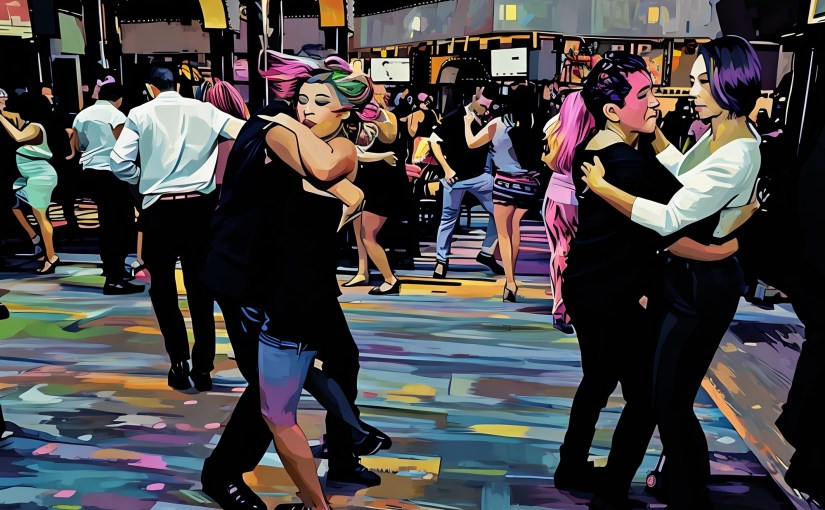
Jésus could mambo and cha-cha-cha
He had all the right moves
The salsa girls cooed ooh-la-la
Jésus was black satin smooth
He saw Lily swaying by the bandstand
Danced over and took her by the hand
They were magic on the disco floor
Texarkana 1984

Duane, who Maxine left behind
Came to Dallas for his Subaru
How hard could Maxine be to find?
Duane was nobody’s stooge
Maxine was workin’ at a Deep Ellum bar
That’s where Duane saw his car
His luck was improvin’ for sure
Texarkana 1984

Duane staked out Maxine
Tailed her everywhere she’d go
Took notes on her routine
Where she went, what she did, he’d know
He showed up at the salsa club
Drank too much to build his courage up
He wasn’t sure like he was before
Texarkana 1984

Jésus was standing in the way
This Latin guy might give him trouble
Duane was just about to make his play
When Maxine sat down at his table
She said “Duane, here, take your keys,
I’m sorry, but I just had to leave.
I dreamed of this and so much more.”
Texarkana 1984

Maxine dealt blackjack in Reno, Nevada
Jésus and Lily ran the salsa club
Duane had a car lot in Texarkana
Sold the Subaru for $500 bucks
Their dreams partly came true
Funny, how they sometimes do
One by one they knew the score
Texarkana 1984
They got about what they bargained for
Texarkana 1984

.© 2022 Frank David Leone, Jr./Highway 80 Music (ASCAP). The songs and stories on the Highway 80 Stories website are works of fiction. Names, characters, businesses, places, events, locales, and incidents are either the products of the author’s imagination or used in a fictitious manner. Any resemblance to actual persons, living or dead, or actual events is purely coincidental.

“Jess Harper Returns to Macon”


LOCATION: San Francisco, California; Macon, Georgia
PERIOD: 1967-2007
DRAMATIS PERSONAE: Jess Harper (1949); Dooley Johnson (1949-2007)


Jess Harper (1949) and Dooley Johnson (1949) grew up in Macon, Georgia in the 1950s. During this decade the civil rights movement was gathering momentum, but it would still take a decade or more before a change in consciousness, especially in the South, would coalesce and the culture would begin to change. This process was helped along by the participation of progressive Southern intellectuals, like the family that produced Dooley Johnson, who offered their support to African American leaders by writing editorials, raising money and pressuring local elected officials.

Dooley and Jess met in grade school and grown up together forming a close friendship which by the time they were teenagers deepened into a romantic relationship. However, interracial dating was considered taboo, particularly in Macon, Georgia, in the Sixties.

Jess was 18 in 1967, the Summer of Love, and had heard about all the exciting things going on in California, Haight-Ashbury, and elsewhere. She desired to escape the claustrophobic racism of Georgia and the lure of California was strong. Despite her young love for Dooley she reluctantly began to believe that their relationship was doomed and chose instead to try her luck in San Francisco. This song is a flashback to the day she left Macon soon after graduating from high school.

Dooley who had been interested in history as a small child, reading about the early settlement of Georgia and forming a critical opinion about the treatment of Native Americans as well as the racial reality of his state. Dooley remained in Georgia where he pursued a degree in history eventually earning a doctorate and becoming a tenured professor of history at Mercer University in Macon.

Jess spent two years just hanging out in San Francisco until she learned that the University of California-Berkeley had created an African American Studies program. She realized that this is what she wanted to do with her life and enrolled in 1970.

She kept up on news from Macon through her mother, and when she learned of Dooley’s death in 2007 she made the long trip back to Macon for his funeral.


JESS HARPER RETURNS TO MACON
(F. D. Leone, Jr.)

Jess Harper threw some clothes into a suitcase
Took what she could but left a lot behind
She’s been thinking ‘bout leaving Macon
Got an early start ‘fore she changed her mind
She didn’t tell nobody not even her mama
Just got on 80 heading west
She’ll try and call Dooley from Alabama
The first chance that she gets

Her mama said they were asking for trouble
She could love a black boy just as easy as one who’s white
Plenty of Georgia don’t like to see a mixed couple
Jess began to think her mama was right

Jess met Dooley Johnson in first grade
They’ve been best friends ever since
He opened up her mind to new things
Like no other boy ever did
When Dooley was sixteen and had his license
He took Jess to see the Indian mounds
Left there by the great Mississippian people
A thousand years before the white man was around

Many nights Dooley told Jess stories
About the Choctaw and the Creek and their fate
Dooley’s family’s been in Georgia for generations
Jess knows Dooley’ll never leave this state

Jess pulls off the highway at Columbus
Stands at the river as a warm rain starts to fall
Her destination remains undecided
Dooley never did get that call
Forty years will pass before Jess returns to Macon
From California back to the land of her birth
In his Georgia drawl Jess hears Dooley talking
As they lower his body into the blood-red earth

© 2020 Frank David Leone, Jr./Highway 80 Music (ASCAP). The songs and stories on the Highway 80 Stories website are works of fiction. Names, characters, businesses, places, events, locales, and incidents are either the products of the author’s imagination or used in a fictitious manner. Any resemblance to actual persons, living or dead, or actual events is purely coincidental.

“Hit the Road”


After five years, Pearl decides to leave Jake and Shreveport. She doesn’t know she is pregnant when she leaves for Texas where her sister is living.

Pearl Robison comes from a fractured family line going back before the Civil War, and her life has carved a jagged line as well. She is related through her father, Jason Jones Robison (1946- ) to Ruby Robison (1843-1933), who was the sister of Marcus Walsh Robison (1836-1897) Pearl’s great-great-great-grandfather. Ruby Robison was a young prostitute in Shreveport who gave birth to a Civil War soldier’s child, the first Pearl Robison (see songs, “Fannin Street” and “Levi Motts is My Name“).


HIT THE ROAD
(F. D. Leone, Jr.)

Last five years been a good run
She hates to see it end like this
She can tell it’s coming undone
Can’t say just why that is

It’s the longest she’s stayed in one place
This leaving feeling is one she knows
She don’t want to see the hurt on his face
Best thing for her to do is just go

Gonna hit the road
It’s what she knows
When her back’s against the wall she goes
Gonna pack it in
Once again
When that old feeling grows
It’s time to hit the road

Got a sister in Fort Worth
Been years since she’d seen her mama and them
‘Bout three hours from Shreveport
She sure hates to run from him

Gonna hit the road
It’s what she knows
When her back’s against the wall she goes
Gonna pack it in
Once again
When that old feeling grows
It’s time to hit the road
When that old feeling grows
It’s time to hit the road

© 2023 Frank David Leone, Jr./Highway 80 Music (ASCAP). The songs and stories on the Highway 80 Stories website are works of fiction. Names, characters, businesses, places, events, locales, and incidents are either the products of the author’s imagination or used in a fictitious manner. Any resemblance to actual persons, living or dead, or actual events is purely coincidental.


Related songs in chronological order:
McLemore’s
Between Here and Gone
Pearl and Jake
Hit the Road
The River and Jake
Terrell
The Red River Flows
Sadie Jo