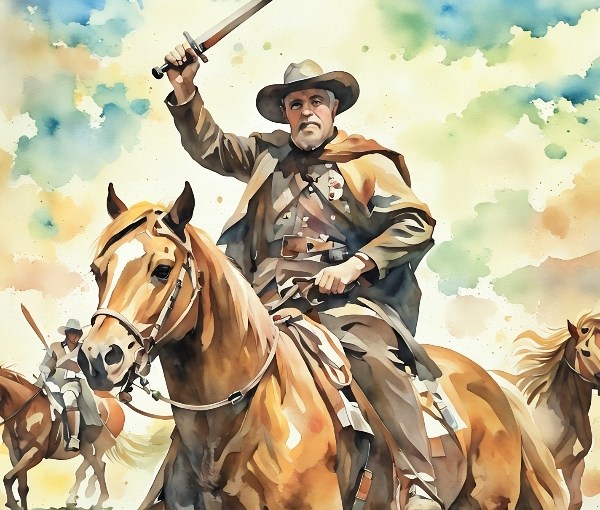
“The Ballad of Cunn’l Cooper”


LOCATION: Russell County, Alabama; Columbus, GA; Girard, AL
PERIOD: 1850s-1960s
DRAMATIS PERSONAE: Roy Cooper (1794-1858); Mary O’Neill (1801-1826); Edith Carter (1799-1872); Frank Roy “Th’ Cunn’l” Cooper (1823-1865); Luther “Sonny Ray” Cooper (1827-1876); Lucas Keith Cooper (1887-1965); Henry Barbour (1848-1924); Charles Thomas Barbour (1933-1955).


Henry Barbour was part Black and part Catawba Indian was brought as a slave to eastern Alabama by his owner Frank Roy “Th’ Cunn’l” Cooper. Cooper fought and died in the last battle of the War Between the States, which took place near the 14th Street Bridge across the Chattahoochee River on April 16th, 1865. The news of Lee’s surrender at Appomattox a week earlier had not reached Alabama yet.

Th’ Cunn’l was a contractor and builder, and Barbour was his labor foreman, constructing most of the first houses of Columbus, Georgia and Girard, Alabama. After Th ‘Cunn’l’s death, Barbour provided for his widow as long as she lived.

During Reconstruction, Barbour served in the Alabama legislature as a representative from Russell County. Over his former owner’s grave, Barbour erected a shaft with an inscription stating that the stone was placed by Henry Barbour in lasting remembrance of the love and gratitude he felt for his lost friend and former master.

Roy Cooper (1794-1858), Th’ Cunn’l’s father, had a second wife, Edith Carter (1799-1872), who he married after his first wife, Mary O’Neill (1801-1826), died giving birth to his second son, Lucas Neil Cooper (1826-1901).  This second family would produce Frank’s half brother, Luther “Sonny Ray” Cooper (1827-1876).

“Sonny Ray”  rode with Bedford Forrest, and together after the war, they were early members of the Ku Klux Klan (KKK), which was formed by six veterans of the Confederate Army in Pulaski, Tennessee, during the spring of 1866.  Two years after Appomattox, Forrest was reincarnated as grand wizard of the Ku Klux Klan. As the Klan’s first national leader, he became the Lost Cause of the Confederacy’s avenging angel, galvanizing a loose collection of boyish secret social clubs into a reactionary instrument of terror.

But their activities were mostly limited to harassing Federal troops attempting to enforce the new laws of Reconstruction (1865-1877). Forrest also hoped to persuade black voters that returning to their pre-war state of bondage was in their best interest.

Because of the essentially ungovernability of the larger membership of the KKK, and a number of what Forrest thought of as counterproductive violent attacks and lynchings, he announced the dissolution of the organization, and officially left the group. The Klan remained mostly dormant until the early 1910s.

This second iteration of the Klan was the first to use cross burnings and standardized white-hooded robes. The KKK of the 1920s had a nationwide membership in the millions and reflected a cross-section of the native born white Protestant population. The third and current Klan formed in the mid 20th century, was largely a reaction to the growing civil rights movement. It used murder and bombings to achieve its aims.

Each  generation of the Cooper family, after  Lucas “Sonny Ray” Cooper were sympathetic to the Klan,imbibed it’s racist ideology, and were mostly white supremacists.  It was Sonny Ray’s great-grandson, Lucas “Sonny Boy” Cooper (1935-1965), who would be among the mob that lynched Henry Barbour’s great-grandson, Charles Thomas Barbour (1933-1955) in 1955.

Ten years later, the narrator of this song, Lucas Keith Cooper (1887-1965), would confront Sonny Boy. They would fight, both dying from their wounds – 100 years to the day of the death of Frank Roy Cooper.


THE BALLAD OF CUNN’L COOPER
(F. D. Leone, Jr.)

My name is Lucas Cooper;
I died in 1965.
Hundred years from the day,
My grandpa Frank died.
Th’ Cunn’l was killed,
16th of April.
The last battle of the war,
A final betrayal.
 
Way down;
Way down.
Soldier fights a cause lost,
On bloody Southern ground.
Way down;
Way down.
All the rest is talk,
An empty sound; way down.
 
Henry Barbour was a slave;
Part Black, part Catawba Injun.
Worked for Th’ Cunn’l,
Supervising construction.
Provided for his widow,
Long as she was livin’.
Carved grandpa’s tombstone,
With a loving inscription.
 
Way down;
Way down.
Folks will surprise you,
Step out from the crowd.
Way down;
Way down.
Stand beside you,
On common ground; way down.

Grandpa had a half-brother,
Cut from a different cloth.
Th’ Cunn’l was a Christian;
Luther had no god or law.
That’s what he passed down,
Till it produced the one,
Who was in the mob that hanged,
Henry Barbour’s great-grandson.
 
Way down;
Way down.
Destiny foretold,
Around a neck a noose is wound.
Way down;
Way down.
History is a long road,
Twisting around; way down.
 
That fella, Sonny Boy Cooper,
Lived ’til 1965.
When he stumbled cross my path;
We fought; we died.
Sank like lead,
The die had been cast.
The past ain’t dead,
It ain’t even past.
 
Way down;
Way down.
Our stars crossed;
In an Alabama town.
Way down;
Way down.
Battles had been fought,
Been lost; been found; way down.

© 2025 Frank David Leone, Jr./Highway 80 Music (ASCAP). The songs and stories on the Highway 80 Stories website are works of fiction. Names, characters, businesses, places, events, locales, and incidents are either the products of the author’s imagination or used in a fictitious manner. Any resemblance to actual persons, living or dead, or actual events is purely coincidental.


“King Cotton”


LOCATION: Thomas William Monroe (1812-1909)
PERIOD: 1890s
DRAMATIS PERSONAE: Tullison Tate (1866-1938); Jessie “Crawford” (1828-1905); Thomas William Monroe (1812-1909); Celsie Monroe (1844-1936)


It’s July 1899 and Tullison Tate (1866-1938) is sitting in his wagon, loaded with cotton, in line waiting for it to be ginned.  The Monroe family has owned most of this Perry County, Alabama, town’s businesses including the gin. Tully’s grandmother was a slave from a neighboring plantation, Jessie “Crawford” (1828-1905), who was impregnated by Thomas William Monroe (1812-1909), producing a mixed blood daughter, Celsie in 1844, Tully’s mother.  Tully’s status in the community is as complicated as his blood.


KING COTTON
(F. D. Leone, Jr.)

Line of wagons filled with cotton
Moving up one by one
Line ends at Tommy, Jr.
Ol’ man Monroe’s son

Monroe owns the gin, an’ smith
The bank, an’ the store
It’s been a Monroe town
Since before The War

Heard ’em say cotton is king
Well, I ain’ seen one yet
The more I work, all it seems
The more I get in debt

Price of cotton keeps fallin’
Soon it won’t make sense to plant
Most are still plantin’ and pickin’
A few walked off their land

Sittin’ in a wagon of cotton
Won’t get ginned ’til ‘roun’ four
Tommy says what I got comin’
Less my bill at the store

Heard ’em say cotton is king …

They call me Monroe’s Tully
Makin’ sure I know my place
Tom Monroe is my granddaddy
But my grandma was a slave

© 2018 Frank David Leone, Jr./Highway 80 Music (ASCAP). The songs and stories on the Highway 80 Stories website are works of fiction. Names, characters, businesses, places, events, locales, and incidents are either the products of the author’s imagination or used in a fictitious manner. Any resemblance to actual persons, living or dead, or actual events is purely coincidental.

“Crossin’ the Edmund Pettus Bridge”


LOCATION: Marengo County, Selma & Montgomery, Alabama
PERIOD: 1850s-1960s
DRAMATIS PERSONAE: Celsie Monroe (1844-1936); Jesse Harper (1850-1922); Joshua Tate (1828-1867); Tullison Monroe Tate (1866-1948); William Harper (1877-1945); Mason Harper (1905-1979); William Crawford Harper (1942-2001)


In 1844 Celsie Monroe was born into slavery; in 1865 she was freed. One hundred years later her great-grandson, Willie Harper, was one of those who joined the Selma March.

Celsie Crawford Monroe (1844-1936) was born into slavery but was freed by Will Monroe, a wealthy white planter and her father, in 1863 as a result of Abraham Lincoln’s Emancipation Proclamation.
Celsie’s mother, Jessie Crawford (1828-1905), was a slave from a neighboring plantation of whom Will Monroe had grown quite fond. Monroe made sure Jessie was provided for and also insisted that she be freed in 1863 by paying off her owner Carson Crawford.

Celsie was what was called a “yellow gal”, and quite beautiful. Once she was freed at age 19, Celsie began seeing a white man, Joshua Tate (1828-1867), and their relationship developed into a common law marriage, although the possibility of such a union was denied at the time.

The Tates were a wealthy Alabama family held in high regard and Joshua’s indiscretion was of course never openly acknowledged by the family and surrounding community, although everyone knew of it and the child it eventually produced.

Joshua was nominally a lawyer handling cotton trades and other mercantile business for the planters. But as was the custom for sons of his class, his hours were at his own instigation. Although he made a daily trip to town, he might only spend an hour or two in the afternoon in his office, often asleep on the leather couch sitting against the wall, next to the large hearth fire.

After the War, Republican “carpetbaggers” entered the former Confederacy and worked to overturn every vestige of slavery and the old ways at every turn; Alabama was no exception. These men were hated since they were seen as enemy outsiders, and interlopers and exploiters who added insult to the injury of losing the war. It was during this turbulent period that Joshua Tate was murdered in 1867 in his second floor office by a man with a three barreled derringer pistol, while Joshua was relaxing on the couch with a volume of Homer.

Some said the motivation behind the killing was Tate’s relationship with Celsie Monroe; others said he was killed because of his covert support of the Republicans. Still a few others said he was killed by a carpetbagger. However, no one was ever accused much less arrested and convicted of Josh Tate’s murder.

Tate lingered for two days before dying, leaving Celsie with a son, Tullison Monroe Tate (1866-1948). Tully Tate was one-quarter African-American, light-skinned and who would marry a white woman and whose descendants would all be considered white, Tully’s blood becoming less and less present with each successive generation.

In 1872 Celsie’s first official marriage was to a African-American man, Jesse Harper (1850-1922), and Celsie and Jesse enjoyed a long and happy union, raising four children, seven grandchildren, and many great-grandchildren. However, Celsie’s oldest child, Tully, was raised by his spinster Aunt Ruth, his father’s sister.

One of Celsie’s great-grandchildren, William Crawford Harper (1942-2001), marched from Selma to Montgomery in 1965. Willie Harper lived to see most of the Jim Crow laws reversed even as the stubborn stain of racism remained.


CROSSING THE EDMUND PETTUS BRIDGE
(F. D. Leone, Jr.)

Named for a Confederate general
Who has all but faded from history
That bridge is a landmark of a struggle
Where slave descendants took a step towards victory

It’s only fifty miles from Selma to Montgomery
But that’s not really how far it is
It’s been a hundred year long journey
Crossin’ the Edmund Pettus Bridge

Celsie Monroe was a slave woman
Her great-grandson was William Crawford Harper
He was just a few miles from her plantation
When he stood with the hundreds of other marchers

It’s only fifty miles from Selma to Montgomery
But that’s not really how far it is
It’s been a hundred year long journey
Crossin’ the Edmund Pettus Bridge

Four girls were bombed in Birmingham
“The eagle stirs her nest”
Jimmy Lee Jackson shot down in Marion
Willie Harper was on that bridge for justice

It’s only fifty miles from Selma to Montgomery
But that’s not really how far it is
It’s been a hundred year long journey
Crossin’ the Edmund Pettus Bridge

© 2018 Frank David Leone, Jr./Highway 80 Music (ASCAP). The songs and stories on the Highway 80 Stories website are works of fiction. Names, characters, businesses, places, events, locales, and incidents are either the products of the author’s imagination or used in a fictitious manner. Any resemblance to actual persons, living or dead, or actual events is purely coincidental.

Celsie Crawford Monroe (1844-1936)

Celsie Crawford Monroe (1844-1936) was born into slavery but was freed by Will Monroe, a wealthy white planter and her father, in 1863 as a result of Abraham Lincoln’s Emancipation Proclamation.

Celsie’s mother, Jessie Crawford (1828-1905), was a slave from a neighboring plantation of whom Will Monroe had grown quite fond. Monroe made sure Jessie was provided for and also insisted that she be freed in 1863 by paying off her owner Carson Crawford.

Celsie was what was called a “yellow gal”, and quite beautiful.  Once she was freed at age 19, Celsie began seeing a white man, Joshua Tate (1828-1867), and their relationship developed into a common law marriage, although the possibility of such a union was denied at the time.

The Tates were a wealthy Alabama family held in high regard and Joshua’s indiscretion was of course never openly acknowledged by the family and surrounding community, although everyone knew of it and the child it eventually produced.

Joshua was nominally a lawyer handling cotton trades and other mercantile business for the planters. But as was the custom for sons of his class, his hours were at his own instigation. Although he made a daily trip to town, he might only spend an hour or two in the afternoon in his office, often asleep on the leather couch sitting against the wall, next to the large hearth fire.

After the War, Republican “carpetbaggers” entered the former Confederacy and worked to overturn every vestige of slavery and the old ways at every turn; Alabama was no exception.  These men were hated since they were seen as enemy outsiders, and interlopers and exploiters who added insult to the injury of losing the war.  It was during this turbulent period that Joshua Tate was murdered in 1867 in his second floor office by a man with a three barreled derringer pistol, while Joshua was relaxing on the couch with a volume of Homer.

Some said the motivation behind the killing was Tate’s relationship with Celsie Monroe; others said he was killed because of his covert support of the Republicans.  Still a few others said he was killed by a carpetbagger.  However, no one was ever accused much less arrested and convicted of Josh Tate’s murder.

Tate lingered for two days before dying, leaving Celsie with a son, Tullison Monroe Tate (1866-1948). Tully Tate was one-quarter African-American, light-skinned and who would marry a white woman and whose descendants would all be considered white, Tully’s blood becoming less and less present with each successive generation.

In 1872 Celsie’s first official marriage was to a African-American man, Jesse Harper (1850-1922), and Celsie and Jesse enjoyed a long and happy union, raising four children, seven grandchildren, and many great-grandchildren. However, Celsie’s oldest child, Tully, was raised by his spinster Aunt Ruth, his father’s sister.

One of Celsie’s great-grandchildren, William Crawford Harper (1942-2001), marched from Selma to Montgomery in 1965 (see song “Crossin’ the Edmund Pettus Bridge“). Willie Harper lived to see most of the Jim Crow laws reversed even as the stubborn stain of racism remained.

© 2018 Frank David Leone. The songs and stories on the Highway 80 Stories website are works of fiction. Names, characters, businesses, places, events, locales, and incidents are either the products of the author’s imagination or used in a fictitious manner. Any resemblance to actual persons, living or dead, or actual events is purely coincidental.