“A River Runnin’ Wild”

This story takes place in the north Georgia mountains, early 1933.  Clara Sprague Robison (1911-1993) sees her future husband, Johnny Campbell (1905-1944), at church one Sunday.  Clara had met Johnny before, but only briefly, and she knew he lived off the mountain. The fact that he came to her church, as opposed to the one he regularly attended, was significant to her, letting her know that he made the trip specifically to see her.  

Clara is the great-grandaunt of Pearl Robison. Clara and Johnny would have three children, Marcus, Nora and Emily before Johnny is killed in WWII.

A RIVER RUNNIN' WILD
(F.D. Leone, Jr.)

Johnny came to Clara’s church that Sunday,
Him on the mountain was a surprise
She’d have to walk right past him
Lord she thought she just might die

She seen the look in his eye
Like there was no one, just them two
Something rose up in her heart
Like a river runnin’ wild busting loose

Johnny touched his new wool cap
As Clara hurried past him up the steps
All through the preachin’ she felt his eyes
On the back of her neck

She seen the look in his eye …

Soon as the service was over
Clara felt her face burnin’ red
Johnny took her hand, they went walkin’
She couldn’t tell you a word of what they said

She seen the look in his eye …

© 2018 Frank David Leone, Jr./Highway 80 Music (ASCAP). The songs and stories on the Highway 80 Stories website are works of fiction. Names, characters, businesses, places, events, locales, and incidents are either the products of the author’s imagination or used in a fictitious manner. Any resemblance to actual persons, living or dead, or actual events is purely coincidental.

Tullison Monroe Tate (1866-1948)

Tullison Monroe “Tully”Tate was the direct descendant of the major landowner and planter of Perry County Alabama, Thomas William Monroe but was not considered an heir because he was an illegitimate offspring.  Tully was just another cotton sharecropper, on his grandfather’s land with no more status than any other black farmer  in Alabama around the turn of the 20th century.  The reason he was not acknowledged as a true Monroe heir was not simply because he was born outside of marriage, but more importantly, because his grandmother was a slave whom Will Monroe had impregnated in 1844.  The result of this miscegenation was Tully’s mother Celsie Monroe.

Celsie was briefly married to a white man, Joshua Tate, and Tully was their only child before separating. Josh Tate was unusual for that time, he was sympathetic to the plight of negroes and his marriage to Celsie was one of love.  After the war the years of Reconstruction were hardly less violent than the war itself. Joshua Tate wished to see the local political power elites toppled and sought to help the Republican elect suitable progressive candidates, including whenever possible negro men.  And he was shot down in 1867 at one of these elections when he confronted a mob that was attempting to control who was allowed to vote.

Tully was a cotton farmer whose status within the community was complicated by the fact of his heritage, which everyone knew, calling him Monroe’s Tully (see song “King Cotton“). After leaving Tully’s father, Celsie would go on to marry Mingo Harper, also a former slave, and they would have four other children, two of whom would play a not insignificant role in the civil rights struggles of the 1950s and ’60s.

Tully Tate would marry Pearl Robison, the daughter of Ruby Robison and Levi Motts resulting in the birth of Hazel Tate.  Hazel would in turn marry Virgil Raney, descendant of Lonsom Raney producing a son, Vernon Raney, husband of Molly Motts. This created the complicated reality that Tullison Monroe Tate’s mixed blood ran through the various strands of the Tate, Raney, Motts and Robison families.

Almost exactly one century later there would be another Tully Tate, the son of a country singer in Louisiana.

Ruby Jones Robison (1955)

Ruby Jones Robison is Pearl Robison’s aunt, on her father’s side. Ruby was also from Conyers, Georgia and for whatever reason, wanted to get as far away as she could. She chose Texas Tech in Lubbock, Texas when she went off to school, over 1,100 miles away.

She was a freshman when she met Darrel Haynes, a senior and with his wiry frame, Restitol hat and slow Texas drawl, he swept her off her feet. He was an engineering student and had a job in hand upon graduation at Baker Oil in Midland, Texas.

Ruby just managed to graduate before marrying Darrel in 1977.  An engineer at Baker Oil makes good money, and compared to her upbringing, Ruby felt like she was rich.  They lived in a 3,000 square foot house, to her a mansion, and she drove a Mercedes Benz. They had a good life and were happy for the first few years, but things started to sour when it became obvious that marriage was not enough to keep Darrel from succumbing to the attractions of single women in the local bars.

When Ruby lost their first baby, a little girl, and Darrel’s reaction was crudely insensitive, the next piece of evidence that she found of his cheating pushed Ruby over the edge and out the door. It took some courage for Ruby to walk away from the kind of life she had, but she was made of strong stuff.

She rode a bus the entire 1,000 mile journey back to Conyers, nursing a bottle of bourbon the whole time. By the time she got back home she had pretty much put Darrel behind her. What she grieved over more than anything was the loss of her little girl, whom she named Catherine Jane after her mother and grandmother.

Ruby stayed in Conyers and went to work for an attorney, who later proposed, and remained a close confidant to Pearl. Eventually Ruby told the story of the failure of her first marriage to her sister Ruth Ann Robison long after the fact (see song “Feel Like Dirt“).


“My Pocketknife”

It took a couple of years longer than in other towns, but The Great Depression finally hit Oil City, Louisiana in 1932.  The price of oil plummeted and work ground to a stop.  They capped the wells and hauled the rigs away, to wait for better times.  In 1934, out of all other options, Lee Allen McLemore and his thirteen year old son Charlie hit the road looking for work, and like many others head west to California.

MY POCKETKNIFE
(F.D. Leone, Jr.)

Charlie and his father crawl up the embankment
Hidden by the bend they crouch and wait
The train’ll have to slow down maybe just enough
With any luck they’ll grab that freight

Charlie and his father left Oil City at dawn
Somethin’ called The Depression had arrived
Work was for the takin’ out in California
Pickin’ cotton under sunny skies

Long as I have my pocketknife
I’ll be alright, be alright
I can make it through the coldest night
Long as I have my pocketknife

Charlie and his father join a migrant army
Ride the rails with tramps an’ hoboes
Tent camps were jungles, danger everywhere
Do your best to hang on to your coat

Charlie and his father dodge a railroad bull
Hidin’ in the tender ’til he’s gone
A man was crumpled in the corner, frozen overnight
It’s a damp and cold L.A. dawn

Long as I have my pocketknife …

© 2018 Frank David Leone, Jr./Highway 80 Music (ASCAP). The songs and stories on the Highway 80 Stories website are works of fiction. Names, characters, businesses, places, events, locales, and incidents are either the products of the author’s imagination or used in a fictitious manner. Any resemblance to actual persons, living or dead, or actual events is purely coincidental.

Lee Allen McLemore (1903-1965)

Lee Allen McLemore was the son of a oil strike wild-catter and the father of a multi-national corporation executive. His life bridged the wildest years of the oil boom, it’s crash during the Depression and then the economic surge after the Second World War.

His father was Jacob Mac McLemore and his son was Charlie McLemore.

Lee Allen might be seen as having been over-shadowed by both of these other men but he was a capable and resilient individual who made it possible for both his father and his son to realize their dreams.

His life was cut short by a oil rig accident, he died at the age of 62 when a over-pressurized well exploded.

Charles Taylor “Charlie” McLemore (1921-2001)

Jake McLemore’s father was Charles Taylor “Charlie” McLemore.

Charlie grew up during the depression, traveling with his father, Lee Allen, on trains, with other hobos, with the putative goal of finding work. When the crash hit the oil industry, it took longer than for most other industries, but eventually the bottom fell out of the oil business in 1932. The wells were capped and the rigs hauled away, leaving the men who had depended upon the work stranded in small oil patch towns with no other opportunities for work. Many of them joined the large numbers of itinerant men riding the rails. Some looked for work but many had given up and made do as best they could.

But when we think of hobos riding in boxcars we don’t usually think of children doing the same thing. But when families had no money, little food and nothing on the horizon, they simply sent their children away to fend for themselves, as best they could.

“At the height of the Depression, as many as a million teenagers traveled the rails looking for work and community, moving in vagabond packs and living in hobo jungles, finding both charity and brutality in the broken-back cities of America. They crowded the cars and hid down in the tenders where the coal and water were stored; they squeezed between cars and clung atop their bucking roofs. In 1932, about 75 percent of the nearly six hundred thousand transients on the Southern Pacific line through Texas, New Mexico, and Arizona were under the age of twenty-five.”

“Fathers, and sometimes sons, stayed in the network of “jungles” along the route, tucked amid the timber and hidden from view. Each camp had its own division of labor—one person went into town to find a potato for soup while another brought salt or an extra spoon. Pots and pans hung from tree branches; crude shelters were made from cardboard or tin scrap and sometimes built up in the trees. Pocketknives were like gold in the jungles. Blades were “hired out” in exchange for soap or a bowl of stew. In a pinch, a knife could be traded for a pair of shoes or sold for cash. Men cooked possums and jackrabbits caught in snares along the brush lines and traded their hides for food.” (Mealer, Bryan. The Kings of Big Spring: God, Oil, and One Family’s Search for the American Dream. 2018.)

This was the kind of life Charlie McLemore lived during his childhood.

Charlie and his father worked picking cotton in California for a few weeks and also fruit when they could. They managed to work just enough to feed themselves, as well as, put a little aside. Eventually they got back to Oil City just as things were starting to come back.

By the time World War II started, and a need for oil exploded, Charlie was in his late teens. His father got work immediately at a refinery and from then on, the Lee McLemore family did okay.

Charlie went into the oil business as well, but oil was not the only resource product that supported the Oil City economy. Natural gas was even more abundant and Charlie got a job at United Gas Corporation, headquartered in Shreveport, Louisiana, and moved his family there in 1960 a year after Jake was born.

Charlie worked at United Gas and survived the hostile takeover by Pennzoil in 1968, and became part of the management of Pennzoil United, Inc. He did pretty well, well enough to send his son Jake to Vanderbilt University in Nashville.

Retiring at the age of 70 in 1991, Charlie lived long enough to see Jake get married and have children.  Charles Taylor McLemore died in 2001 at the age of 80 from a heart attack a few months before 9/11, and several years before his grandson Lee’s death in 2004 in Iraq.

Despite surviving the Great Depression by riding the rails with his father, he was among the generation that experienced the economic boom after WWII.  Charlie McLemore saw nothing in his lifetime that undermined his faith in the American Dream.  A dream he lived out to the fullest.

Jedadiah Phelps (1856-1888?)

Jed Phelps was the younger brother of Nellie Phelps, the grandmother of Earl Bowden’s maternal grandmother.  Earl Bowden was Louanne Bowden’s father, which makes Jed Phelps her great-great-great-granduncle.

By the time Jed was six he’d lost his older brother Burch and his mother.  Ten years later his father died leaving his sister and him alone on the family farm in Tennessee (see song “I Didn’t Know What Else to Do“).  Nellie married Robert Dorsey the son of a wealthy Texas rancher when she was 17, in 1873.  Dorsey brought Nellie and Jed with him back to his family’s Texas ranch, which was rather large.  Dorsey land stretched between what would become the future cities of Monahans and Abilene.

Abilene was established by cattlemen such as Charles Dorsey, Bob’s father, as a stock shipping point on the Texas and Pacific Railway in 1881. Monahans grew up around a deep water well dug a few years later when the railroad surveyors discovered that the lack of water for the laying crew and their animals would slow down construction of the rail.  Monahans’ digging of a water well produced an abundance of good water and the town would thrive.

Jed was a disgruntled young man, at sixteen he didn’t much like being bossed around by Bob Dorsey.  Having an active imagination Jed dreamed of joining the Texas Rangers whose fame of heroic deeds fighting the Indians and Mexicans he’d heard all about in the bunkhouse.  And so, that’s what he did as soon as he turned nineteen.

But by then the Indians had been run off and the Mexicans no longer posed much of a threat.  Mainly the Rangers were a mercenary band supporting the ranchers whose barbed wire fences were an obstacle for the old cattle drovers accustomed to driving their herds north unobstructed.

There had been a fence war raging between the cattlemen taking large herds across Texas to places like Kansas City and the ranchers who tried to preserve the integrity of their ranches.  This conflict eventually petered out when the railroad was completed since it made no sense to drive the herds north when they could much easier be loaded onto a train.

Disenchanted with this life, in 1888 Jed decided to return to Tennessee and the family  farm to see what was there.  More disappointment awaited him, and so he rode off again, never to be heard from again (see song “A Rusted Plow“).

Levi Motts (1845-1864)

Levi Motts (1845-1864).  Young confederate soldier in love with Ruby Robison.  He fights and dies in Battle of Mansfield, April 8, 1964.

Ancestors:  Randall Motts (1752- 1821); Lucas Motts (1797-1875); Luther Motts (1820-1871).

Randall Motts was an Englishman who came to the Colonies in 1782, entering first at Pennsylvania and then making his way across the mountains into Alabama.  He amassed twelve sections of land planted for cotton and became quite wealthy.  His son Lucas, always one for adventure and not a timid young man, headed west and settled in North Louisiana.  There he found a land ideal for growing cotton and created his own large plantation.  Lucas was Levi’s grandfather.

Lucas’s son, Luther Motts, Levi’s father, took over the day-today operations of his father’s cotton farm and managed it extremely well.  Levi grew up in a house of plenty, and took it completely for granted.  Happy to live off his father’s largess and not one to get his hands dirty, much less calloused, Levi spent his time playing cards, drinking and visiting the growing number of brothels in the new town of Shreveport.

Levi was not like like his father who balanced his somewhat reckless ambition with disciplined hard work.  Levi saw the South’s secession and march towards war as an adventure that he would not miss. Levi as was true for most of the young men of his generation, never thought of war as anything but a short term, almost harmless, righteous fight filled with excitement.  Having grown up reading the novels of Walter Scott, Levi imagined himself as one of those Scottish heroes embarking upon the opportunity of a lifetime to prove his mettle as a man standing up against oppression.  So it came as no surprise to his father and grandfather that as soon as the canons fired upon Fort Sumter, Levi volunteered in 1862 to fight in the Rebel cause.

Mustering out of Monroe, Louisiana Levi and his cousin Coleman Broussard  joined up with in Colonel Henry Gray’s brigade, the Louisiana Gray’s.  It did not take them long to find their way to the burgeoning red light district of Shreveport. There Levi met and took up with one of the young sporting girls there, Ruby Robison.  Cole was also smitten and Ruby seeing Levi for what he was, a rake and leaky vessel for her to place her future, encouraged Cole in his romantic dreams.  They were a inseparable trio, the two kinsmen and the beautiful and fragile young whore hedging her bets, so to speak.

Despite Coleman’s obvious romantic aspirations, Ruby couldn’t deny her stronger feelings for Levi.  Defying the conventions of the time she and Levi made plans for marriage as soon as the war was over.  However, the Louisiana Grays were called up to confront the Union troops already marching towards Louisiana after conquering Vicksburg.  Gray’s brigade is one of the units in Gen. Robert Taylor’s army tasked with stopping the Trans-Mississippi Campaign of Nathaniel Bank’s invading force at Mansfield.

While the Battle of Mansfield was a Confederate victory, Levi Motts was one of only about a hundred Southern men who died there on April 8, 1864.  When he went into battle, Levi knew that Ruby was pregnant with their child. This child, a girl Ruby named Pearl, is born in late December of 1864. Because of her illegitimate status Pearl chose to use the name Robison for most of her life (see songs “Levi Motts is My Name” and “Fannin Street“).

Coleman returned to Shreveport and Ruby alone.  She and Cole both loved Levi, and bonded over their shared loss and their prior closeness matured into kind of a love of their own.  Coleman would raise Levi’s daughter and he and Ruby would have more kids of their own.  But Cole never forgot he was her second choice and would never excite her heart the way Levi had.

Lucas Motts lived to bury both his son and grandson and watching as the Mott family fortunes are destroyed by the war and Reconstruction.

“Levi Motts Is My Name”

LEVI MOTTS IS MY NAME
(F.D. Leone, Jr.)

Levi Motts is my name
Come from Northwest Louisiana
I joined up with Colonel Gray
He said be ready to march today
Don’t know when I’ll be back again
If this war will ever end

Ruby Robison is my gal
Keeps a room down in the bottoms
We talked of gettin’ out of there
Make a new life anywhere
Don’t know when I’ll be back again
If this war will ever end

Ruby wrote me a letter
We were waitin’ outside Mansfield
Wrote there’s a baby on the way
We fought the Yankees April Eighth
Don’t know when I’ll be back again
If this war will ever end

Levi Motts is my name
Come from Northwest Louisiana
Lead ball went through my neck
That afternoon I bled to death
Don’t know when I’ll be back again
If this war will ever end

© 2017 Frank David Leone, Jr./Highway 80 Music (ASCAP). The songs and stories on the Highway 80 Stories website are works of fiction. Names, characters, businesses, places, events, locales, and incidents are either the products of the author’s imagination or used in a fictitious manner. Any resemblance to actual persons, living or dead, or actual events is purely coincidental.

The Battle of Mansfield

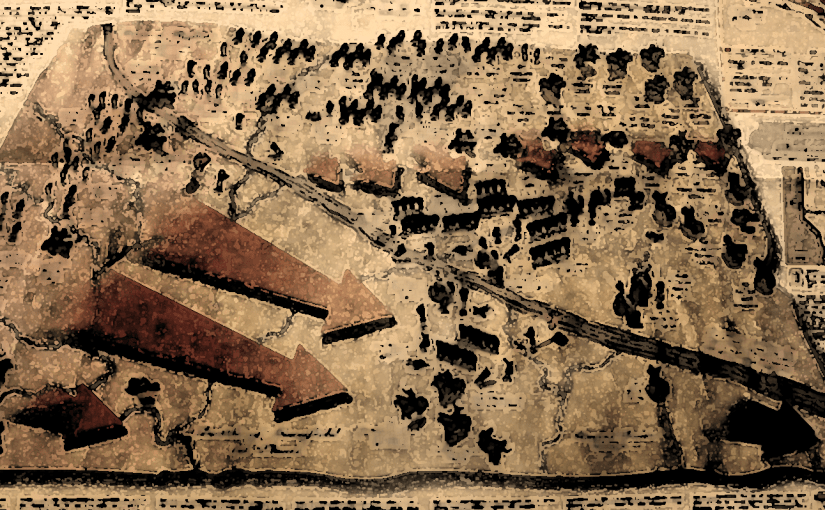
The Red River campaign of Union General Nathaniel Banks grinds to a halt when Confederate General Richard Taylor routs Banks’ army at Mansfield, Louisiana.

Gray and Taylor

The Red River campaign, which had begun a month earlier, was an attempt by the Union to invade Confederate Texas from Shreveport, Louisiana. Banks, accompanied by a flotilla on the Red River, would move northwest across the state and rendezvous at Shreveport with a force under General Frederick Steele moving from Little Rock, Arkansas.

The slow-moving Banks approached Mansfield and opted to take a shorter road to Shreveport than one that ran along the Red River. Not only was the road narrow, it was far away from the gun support offered by the Union flotilla on the river. Banks’ troops ran into Taylor’s force and a skirmish erupted. At 4 p.m., Taylor ordered an all-out assault on the Yankees. The Rebels eventually broke the Union lines, sending the Federals in a disorganized retreat. The Yankees fell back three miles before reinforcements stopped the Confederate advance.

Banks suffered 113 men killed, 581 wounded, and 1,541 missing, while Taylor had about 1,500 total casualties. But Banks was now in retreat, and the Red River campaign was failing. Taylor attacked again the next day, but this time Banks’ men held the Confederates at bay. Banks was unnerved, though, and he began to retreat back down the Red River without penetrating into Texas.