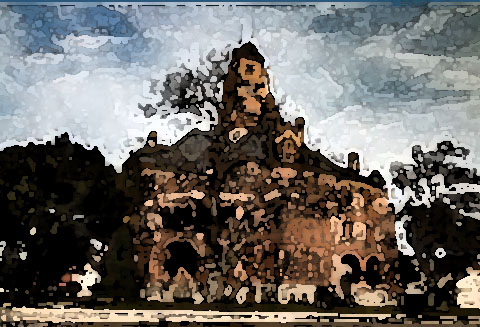
“Terrell”


LOCATION: Shreveport, Louisiana; Forth Worth, Texas; Terrell, Texas
PERIOD: 2015-2019
DRAMATIS PERSONAE: Pearl Boone Robison (1973); Jake McLemore (1959); Sadie Jo Robison McLemore (2015)


The stories of Jake McLemore and Pearl Robison are told in a group of songs that describe their lives before and after they meet and then their relationship together.

Jake is introduced with the song “McLemore’s“, which tells about his bar in Nashville and describes his character as seen through the eyes of young man. At the end of the song, Jake has sold his bar and moved outside Shreveport, Louisiana.

The song “Between Here and Gone” is our first exposure to Pearl, when she is in Macon, Georgia, contemplating leaving a dead end job. She travels west on Highway 80 to Shreveport where she stops at an all night diner and Jake McLemore enters her life (see song, “Pearl and Jake“) .

They live together for five years before Pearl chooses to leave when their relationship stagnates. She heads further west on 80, this time heading for Fort Worth to camp out with with her sister while she attempts to get back on her feet (see song “Hit the Road“).

The songs “The River and Jake” and “The Red River Flows” address Jake’s confusion and sadness after Pearl’s seemingly unexplained disappearance.

When she leaves Shreveport, Pearl is not yet aware that she is carrying Jake’s baby, but while she is living with her sister it soon becomes obvious. She ends up getting her own place and prepares for the baby’s arrival, but chooses not to inform Jake immediately.

Pearl gives birth in 2015 to a baby girl whom she names Sadie Jo, after her parents, Jason Jones Robison and Sadie Boone. About two years after leaving Shreveport Pearl calls Jake and, in her first contact since she left, tells him he is a new father.

Pearl and Jake get married in 2018 and raise Sadie Jo McLemore together.


TERRELL
(F. D. Leone, Jr.)

All Pearl knew, she was heading to Texas
When she packed up and left Shreveport
She didn’t know then she was pregnant
When she landed on her sister’s porch

Six months later, Myrna asked if she’d thought about
How she planned on raising this baby alone
Her brother-in-law said it was time for her to move out
Pearl needed a place of her own

Terrell, Texas
Where Pearl calls home
Terrell, Texas
Where Pearl lives alone

Year later, Pearl was working at the Donut Hole
Which made her think of Jake
Sadie Jo’s his, he deserves to know
Not telling him was a mistake

That weekend Pearl prayed for the courage
And help to find the right words to say
Knowing Jake, he might speak of marriage
And Pearl just might say okay

Terrell, Texas
Where Pearl calls home
Terrell, Texas
Where Pearl lives alone

© 2019 Frank David Leone, Jr./Highway 80 Music (ASCAP). The songs and stories on the Highway 80 Stories website are works of fiction. Names, characters, businesses, places, events, locales, and incidents are either the products of the author’s imagination or used in a fictitious manner. Any resemblance to actual persons, living or dead, or actual events is purely coincidental.


Related songs in chronological order:
McLemore’s
Between Here and Gone
Pearl and Jake
Hit the Road
The River and Jake
Terrell
The Red River Flows
Sadie Jo

“Hit the Road”


After five years, Pearl decides to leave Jake and Shreveport. She doesn’t know she is pregnant when she leaves for Texas where her sister is living.

Pearl Robison comes from a fractured family line going back before the Civil War, and her life has carved a jagged line as well. She is related through her father, Jason Jones Robison (1946- ) to Ruby Robison (1843-1933), who was the sister of Marcus Walsh Robison (1836-1897) Pearl’s great-great-great-grandfather. Ruby Robison was a young prostitute in Shreveport who gave birth to a Civil War soldier’s child, the first Pearl Robison (see songs, “Fannin Street” and “Levi Motts is My Name“).


HIT THE ROAD
(F. D. Leone, Jr.)

Last five years been a good run
She hates to see it end like this
She can tell it’s coming undone
Can’t say just why that is

It’s the longest she’s stayed in one place
This leaving feeling is one she knows
She don’t want to see the hurt on his face
Best thing for her to do is just go

Gonna hit the road
It’s what she knows
When her back’s against the wall she goes
Gonna pack it in
Once again
When that old feeling grows
It’s time to hit the road

Got a sister in Fort Worth
Been years since she’d seen her mama and them
‘Bout three hours from Shreveport
She sure hates to run from him

Gonna hit the road
It’s what she knows
When her back’s against the wall she goes
Gonna pack it in
Once again
When that old feeling grows
It’s time to hit the road
When that old feeling grows
It’s time to hit the road

© 2023 Frank David Leone, Jr./Highway 80 Music (ASCAP). The songs and stories on the Highway 80 Stories website are works of fiction. Names, characters, businesses, places, events, locales, and incidents are either the products of the author’s imagination or used in a fictitious manner. Any resemblance to actual persons, living or dead, or actual events is purely coincidental.


Related songs in chronological order:
McLemore’s
Between Here and Gone
Pearl and Jake
Hit the Road
The River and Jake
Terrell
The Red River Flows
Sadie Jo
Anabel March McLemore (1796-1832)

Anabel March was a Tennessee girl who married Owen McLemore in 1812.  She knew she had some Indian blood in her, and this is how she described her background:

“My great-grandma Macum, Dilsey, was half Indian and half white and my grandma told me how it happened, just as her mamma had told her.   Back when the Macums had just come to Carlina from Pennsylvania they were living out on Bear Creek.  They had built a kind of lean-to under an overhang they had kind of framed up with poles and mud.  Well, while the men was buildin’ a real house, my great-great-grandmamma went out with a basket hoping to find some chestnuts in the woods.  She was about fourteen years old and while she was out there by herself she was grabbed by two Indians and taken off to Kentucky.”

Eventually Dilsey got away but was already about six months pregnant.  When she showed up back at her family’s place, she told them what happened and her brothers think they got the Indian who took her. Anyway, a few weeks later she gave birth to the child, who was Anabel’s great-grandmother, Beatrice Macum.

Anabel used to say, “I got the Indian look from my Pa’s side. And it is true I have his black eyes and hair. But I got Ma’s fair skin and features.”  By the time Anabel had come around, the March family had crossed the mountain from North Carolina to East Tennessee.  After her mother died Anabel pretty much raised her brothers and acted as the woman of the house from the time she was around ten.

The McLemores had the neighboring farm and Owen, who was older, began courting Anabel when she was around 15 and soon after they married. Anabel gave birth to seven children, all boys, by the time she was 36, but the last was a difficult birth.  She died during the delivery and the child was sickly, and lived but two years.  Owen grieved bitterly for his wife and left Tennessee taking his six remaining sons to Texas right after the youngest had died (see songs “My Anabel” and “Blinkin’ Back a Tear“).  He never re-married.

Anabel once described herself like this, “people always said I went my own way, and that much I’ll admit. Some said it was because Mama died when I was young, and I never had nobody to show me how a girl ought to be.  I turned out to be sort of stubborn more like my Pa and brothers than any woman around here. Others said it was the revival meetings that got me all mixed up and queer. And still others said it was because I read too many books. But I did love to read books, and always have, when ever I can.”

© 2018 Frank David Leone, Jr./Highway 80 Music (ASCAP). The songs and stories on the Highway 80 Stories website are works of fiction. Names, characters, businesses, places, events, locales, and incidents are either the products of the author’s imagination or used in a fictitious manner. Any resemblance to actual persons, living or dead, or actual events is purely coincidental.

Ruby Jones Robison (1955)

Ruby Jones Robison is Pearl Robison’s aunt, on her father’s side. Ruby was also from Conyers, Georgia and for whatever reason, wanted to get as far away as she could. She chose Texas Tech in Lubbock, Texas when she went off to school, over 1,100 miles away.

She was a freshman when she met Darrel Haynes, a senior and with his wiry frame, Restitol hat and slow Texas drawl, he swept her off her feet. He was an engineering student and had a job in hand upon graduation at Baker Oil in Midland, Texas.

Ruby just managed to graduate before marrying Darrel in 1977.  An engineer at Baker Oil makes good money, and compared to her upbringing, Ruby felt like she was rich.  They lived in a 3,000 square foot house, to her a mansion, and she drove a Mercedes Benz. They had a good life and were happy for the first few years, but things started to sour when it became obvious that marriage was not enough to keep Darrel from succumbing to the attractions of single women in the local bars.

When Ruby lost their first baby, a little girl, and Darrel’s reaction was crudely insensitive, the next piece of evidence that she found of his cheating pushed Ruby over the edge and out the door. It took some courage for Ruby to walk away from the kind of life she had, but she was made of strong stuff.

She rode a bus the entire 1,000 mile journey back to Conyers, nursing a bottle of bourbon the whole time. By the time she got back home she had pretty much put Darrel behind her. What she grieved over more than anything was the loss of her little girl, whom she named Catherine Jane after her mother and grandmother.

Ruby stayed in Conyers and went to work for an attorney, who later proposed, and remained a close confidant to Pearl. Eventually Ruby told the story of the failure of her first marriage to her sister Ruth Ann Robison long after the fact (see song “Feel Like Dirt“).


Jedadiah Phelps (1856-1888?)

Jed Phelps was the younger brother of Nellie Phelps, the grandmother of Earl Bowden’s maternal grandmother.  Earl Bowden was Louanne Bowden’s father, which makes Jed Phelps her great-great-great-granduncle.

By the time Jed was six he’d lost his older brother Burch and his mother.  Ten years later his father died leaving his sister and him alone on the family farm in Tennessee (see song “I Didn’t Know What Else to Do“).  Nellie married Robert Dorsey the son of a wealthy Texas rancher when she was 17, in 1873.  Dorsey brought Nellie and Jed with him back to his family’s Texas ranch, which was rather large.  Dorsey land stretched between what would become the future cities of Monahans and Abilene.

Abilene was established by cattlemen such as Charles Dorsey, Bob’s father, as a stock shipping point on the Texas and Pacific Railway in 1881. Monahans grew up around a deep water well dug a few years later when the railroad surveyors discovered that the lack of water for the laying crew and their animals would slow down construction of the rail.  Monahans’ digging of a water well produced an abundance of good water and the town would thrive.

Jed was a disgruntled young man, at sixteen he didn’t much like being bossed around by Bob Dorsey.  Having an active imagination Jed dreamed of joining the Texas Rangers whose fame of heroic deeds fighting the Indians and Mexicans he’d heard all about in the bunkhouse.  And so, that’s what he did as soon as he turned nineteen.

But by then the Indians had been run off and the Mexicans no longer posed much of a threat.  Mainly the Rangers were a mercenary band supporting the ranchers whose barbed wire fences were an obstacle for the old cattle drovers accustomed to driving their herds north unobstructed.

There had been a fence war raging between the cattlemen taking large herds across Texas to places like Kansas City and the ranchers who tried to preserve the integrity of their ranches.  This conflict eventually petered out when the railroad was completed since it made no sense to drive the herds north when they could much easier be loaded onto a train.

Disenchanted with this life, in 1888 Jed decided to return to Tennessee and the family  farm to see what was there.  More disappointment awaited him, and so he rode off again, never to be heard from again (see song “A Rusted Plow“).

Louanne Murphy Bowden (1967- )

Louanne Murphy Bowden (1967- ) comes from an old Texas family, descendants of Archibald Edward Burden (1802-1859), one of The Old Three Hundred and the first Burden to live in Texas.

The name Burden was changed to Bowden by Henry Baxter (Burden) Bowden (1829-1913) because he did not share his family’s politics prior to and during ther Civil War.  Feelings ran high during this period and Henry thought it best to make a clean break with the Burdens.

The Bowdens became quite wealthy during the first decade of the 20th century when Louanne’s great-great-grandfather, Jonus Caldwell Bowden (1860-1914), struck oil on his ranch, before dying of a stroke.  The ranch and oil wells went to his son, James Neal Bowden (1889-1961), who proved himself more than a competent steward of the family’s burgeoning wealth.

By the time Louanne was born the family had been living for decades in Dallas, the “old-money” part of town, Highland Park.  As was true for many kids who grew up during the Seventies, of privilege, Louanne’s idea of rebellion centered upon hanging out with kids from “the wrong side of the tracks”, and in general, frustrating her parents’ ideas about whom she ought to date, i.e. a nice boy from the club.  When it came time for Louanne to go off to college, she chose the University of Mississippi in Oxford because she had heard from some friends in Baton Rouge that it was an even bigger party school than LSU (see song, “Louanne in Vicksburg“).

In her first semester at Ol’ Miss, Louanne met a good-looking fellow, Ronnie Raney, who definitely was not a boy from the club, and not even enrolled at the university.  His main preoccupation appeared to be selling quality weed to fraternity boys.  One thing led to another and soon Louanne and Ronnie began dating, ending up with Louanne unofficially dropping out of school and moving to Vicksburg with him.

Louanne did not fully appreciate what she was getting into, since unbeknownst to her, Ronnie’s little pot business was only the tip of the criminal iceberg run by Ronnie’s mother, Molly Raney.  The Raney family led by Molly had a strong hold on the political and judicial levers of power in Warren County, and in fact, exerted influence and received protection from prosecution from Natchez to Memphis.

Shotgun House VicksburgFor a while Louanne partnered with Ronnie in the marijuana distribution enterprise, but her main occupation was managing the bar owned by the Raney family.  However, after few years, even getting married to Ronnie, she got tired of Ronnie’s habit of becoming violent when he’d had too much to drink, which was often.  She finally found the nerve to shoot him while he sat at their dinner table eating a slice of chess pie with a beer (see song, “One Time Too Many“).

She did not even attempt to flee the jurisdiction nor avoid prosecution for this crime.  She was well aware that Ronnie’s older brother, Lonnie, sheriff of the county, would make sure that her justifiable homicide defense at trial would not convince the jury.  In short order Louanne was found guilty of second degree murder and sentenced to twenty years to be served at the Central Mississippi Correctional Facility.

While at CMCF, Louanne developed an exemplary record of good behavior including mentoring several other young female prisoners.  For example, about half way through her sentence, a young woman, Lucy Cooper, was sent to CMCF on a drug charge, given eighteen months.  Lucy was a funny, bright, and street smart but fragile woman who simply could not do the time for her crime.  Despite being taken under Louanne’s wing, Lucy became increasingly more and more despondent, eventually suiciding from an overdose – within weeks of her release (see song, “When Louanne Met Lucy in Prison“).

LouannePSNot long after this tragedy Louanne’s case was reviewed by a judge who ruled that hers was a case of justified homicide and her sentence was commuted to time served. These events coincided with the death of her grandmother in 2015, when she was released after serving about 60% of her original sentence.  She returned to Texas for her grandmother’s funeral and remained there with her mother, to live once again in Highland Park, however, now in somewhat reduced grandeur (see song, “A Waxahachie Funeral“).

“Louanne in Vicksburg”


Louanne Murphy Bowden (1967- ) comes from an old Texas family, descendants of Archibald Edward Burden (1802-1859), one of The Old Three Hundred and the first Burden to live in Texas.

The name Burden was changed to Bowden by Henry Baxter (Burden) Bowden (1829-1913) because he did not share his family’s politics prior to and during ther Civil War.  Feelings ran high during this period and Henry thought it best to make a clean break with the Burdens.

The Bowdens became quite wealthy during the first decade of the 20th century when Louanne’s great-great-grandfather, Jonus Caldwell Bowden (1860-1914), struck oil on his ranch, before dying of a stroke. The ranch and oil wells went to his son, James Neal Bowden (1889-1961), who proved himself more than a competent steward of the family’s burgeoning wealth.

By the time Louanne was born the family had been living for decades in Dallas, the “old-money” part of town, Highland Park. As was true for many kids who grew up during the Seventies, of privilege, Louanne’s idea of rebellion centered upon hanging out with kids from “the wrong side of the tracks”, and in general, frustrating her parents’ ideas about whom she ought to date, i.e. a nice boy from the club. When it came time for Louanne to go off to college, she chose the University of Mississippi in Oxford because she had heard from some friends in Baton Rouge that it was an even bigger party school than LSU (see song, “Louanne in Vicksburg“).

In her first semester at Ol’ Miss, Louanne met a good-looking fellow, Ronnie Raney, who definitely was not a boy from the club, and not even enrolled at the university. His main preoccupation appeared to be selling quality weed to fraternity boys. One thing led to another and soon Louanne and Ronnie began dating, ending up with Louanne unofficially dropping out of school and moving to Vicksburg with him.

Louanne did not fully appreciate what she was getting into, since unbeknownst to her, Ronnie’s little pot business was only the tip of the criminal iceberg run by Ronnie’s mother, Molly Raney. The Raney family led by Molly had a strong hold on the political and judicial levers of power in Warren County, and in fact, exerted influence and received protection from prosecution from Natchez to Memphis.

For a while Louanne partnered with Ronnie in the marijuana distribution enterprise, but her main occupation was managing the bar owned by the Raney family. However, after few years, even getting married to Ronnie, she got tired of Ronnie’s habit of becoming violent when he’d had too much to drink, which was often. She finally found the nerve to shoot him while he sat at their dinner table eating a slice of chess pie with a beer (see song, “One Time Too Many“).

She did not even attempt to flee the jurisdiction nor avoid prosecution for this crime. She was well aware that Ronnie’s older brother, Lonnie, sheriff of the county, would make sure that her justifiable homicide defense at trial would not convince the jury. In short order Louanne was found guilty of second degree murder and sentenced to twenty years to be served at the Central Mississippi Correctional Facility.

While at CMCF, Louanne developed an exemplary record of good behavior including mentoring several other young female prisoners. For example, about half way through her sentence, a young woman, Lucy Cooper, was sent to CMCF on a drug charge, given eighteen months. Lucy was a funny, bright, and street smart but fragile woman who simply could not do the time for her crime. Despite being taken under Louanne’s wing, Lucy became increasingly more and more despondent, eventually suiciding from an overdose – within weeks of her release (see song, “When Louanne Met Lucy in Prison“).

Not long after this tragedy Louanne’s case was reviewed by a judge who ruled that hers was a case of justified homicide and her sentence was commuted to time served. These events coincided with the death of her grandmother in 2015, when she was released after serving about 60% of her original sentence. She returned to Texas for her grandmother’s funeral and remained there with her mother, to live once again in Highland Park, however, now in somewhat reduced grandeur (see song, “A Waxahachie Funeral“).


LOUANNE IN VICKSBURG
(F. D. Leone, Jr.)

Louanne came from Dallas money
A mansion in Highland Park
Brought julips to her daddy on the veranda
While fireflies flickered in the dark
A summer of magnolia ‘n’ mimosa
Sweet perfume on the heavy August air
Louanne left for college, Oxford Mi’sippy
Ronnie Raney was what she’d find there

When you don’t hear what momma says
And don’t think daddy knows best
If nothin’ is all they’re owed
You’re headed down your own road

Ronnie Raney was the perfect antidote
For Louanne’s Highland Park innocence
They traded Ol’ Miss for a shotgun house in Vicksburg
With no thought to consequence
Molly Raney was Ronnie’s mother
His brother Lonnie was shurf
The Raneys sold drugs from Natchez to Memphis
You get in their way, you got hurt

When you don’t hear what momma says
And don’t think daddy knows best
If nothin’ is all they’re owed
You’re headed down your own road

November and an iron sky
Fields of skeleton cotton and corn
Louanne was tryin’ to drive back to Dallas
To the one she was when she was born
At a Pak-a-Sak this side of Waskom
Standing at the Texas line
Drizzlin’ rain fallin’ steady since she left Monroe
She ain’t ready to leave Vicksburg behind

© 2017 Frank David Leone, Jr./Highway 80 Music (ASCAP). The songs and stories on the Highway 80 Stories website are works of fiction. Names, characters, businesses, places, events, locales, and incidents are either the products of the author’s imagination or used in a fictitious manner. Any resemblance to actual persons, living or dead, or actual events is purely coincidental.

Highland Park, Dallas

(Information taken from Wikipedia)

Highland Park is a town in central Dallas County, Texas, United States. It is among the five wealthiest locations in Texas, and the most affluent suburb of Dallas. The population was 8,564 at the 2010 census. It is located between the Dallas North Tollway and U.S. Route 75 (North Central Expressway), 4 miles (6 km) north of downtown Dallas.

Highland Park is bordered on the south, east and west by Dallas and on the north by the city of University Park. Highland Park and University Park together comprise the Park Cities, an enclave of Dallas.

Addresses in Highland Park may use either “Dallas, Texas” or “Highland Park, Texas” as the city designation, although the United States Postal Service prefers the use of the “Dallas, Texas” designation for the sake of simplicity. The same is true for mail sent to University Park.

The land now known as Highland Park was bought in 1889 by a group of investors from Philadelphia, Pennsylvania, known as the Philadelphia Place Land Association, for an average price of $377 an acre, with a total of $500,000. Henry Exall, an agent, intended to develop the land along Turtle Creek as Philadelphia Place, exclusive housing based on parkland areas in Philadelphia. He laid gravel roads, and dammed Turtle Creek, forming Exall Lake, before the Panic of 1893 brought a blow to his fortunes, halting development. Afterwards, he began a horse breeding farm. In the 1890s, Exall Lake was a common picnic destination for Dallas residents.

Highland Park 2


In 1906, John S. Armstrong (the former partner of Thomas Marsalis, the developer of Oak Cliff), sold his meatpacking business and invested his money in a portion of the former Philadelphia Place land, to develop it under the name of Highland Park. He chose this name as it was located on high land that overlooked downtown Dallas. Wilbur David Cook, the landscape designer who had planned Beverly Hills, California, and George E. Kessler, who had previously planned Fair Park and most of downtown Dallas, were hired to design its layout in 1907. Notably, twenty percent of the original land was set aside for parks. A second development in Highland Park was developed in 1910.

In 1913, Highland Park petitioned Dallas for annexation, but was refused. The 500 residents voted to incorporate on November 29, 1913, and incorporation was granted in 1915, when its population was 1,100. The first mayor of Highland Park was W. A. Fraser. A third and fourth development were added to the town in 1915 and 1917, respectively. In 1919, the city of Dallas sought to annex Highland Park, beginning a lengthy controversy that lasted until 1945. J. W. Bartholow led the fight to resist the annexation. The final major land development occurred in 1924. In 1931, Highland Park Village was constructed, the first shopping center of its kind in the United States. The distinctive Moorish Style ornamental metalwork and lighting in Highland Park Village were created by Potter Art Metal Studios, a 90-year-old custom metalwork company still in existence today.

Because of its location near Dallas, Highland Park had, by the early 1930s, developed a moderately large (8,400) population, with a few businesses. Eventually the school districts and newspapers of Highland Park and University Park were combined. In the 1940s, after the failure to annex Highland Park, Dallas began annexing the land surrounding it. Reaching a population high of just under 13,000 in the late 1950s, Highland Park afterwards grew only by building houses on the remaining vacant lots, and by the destruction of old buildings. Since 1990, Highland Park has maintained strict zoning ordinances. Known for its quality housing, the town still has many parks running along Turtle Creek and is home to the Dallas Country Club.

Highland Park became somewhat famous in the early 1980s when the popular television show Dallas used to shoot on location there. From the Netflix original show, House of Cards, main character Claire Underwood (played by Robin Wright) grew up in Highland Park.

Nellie Phelps (1855-1922)

Eleanor “Nellie” Davis (1923-2007) was Louanne Bowden’s paternal grandmother.  She was named Eleanor and called Nellie for her own great-grandmother, Nellie Phelps (1855-1922).  Nellie Phelps had died the year prior to Louanne’s grandmother’s birth.

The Phelps family had come from England to America in the 1690s, the first Phelps born in Pennsylvania was William Phelps (1721).  From Pennsylvania the family went to Tennessee and began farming.  Nellie Phelps had two brothers, Burch and Jethro (“Jed”).  Their parents, were another William Phelps (1834-1872) and his wife Martha Massey (1835-1862).  Martha died when Nellie was eight, probably from some kind of “heart sickness” after Burch, their oldest, had died from a fever.  She had never been happy on the frontier anyway, and just went to bed one day and never got up.

Nellie and her brother Jed were left with their father to tend to the farm, which they did for nearly a decade before William, too, got sick with consumption.  He died when Nellie was 17 and Jed only sixteen (see song “I Didn’t Know What Else to Do”).  When Nellie got married the next year to Robert Abbott, they and Jed all went to Texas where the Abbotts had a nice sized ranch.

Nellie lived a long life in Texas, but Jed died young, only 32, as a Texas Ranger in the Indian wars.

Waxahachie, Texas

(Information taken from Wikipedia)

Waxahachie was founded in August 1850 as the seat of the newly established Ellis County on a donated tract of land given by early settler Emory W. Rogers, a native of Lawrence County, Alabama, who migrated to Texas in 1839. It was incorporated on April 28, 1871, and in 1875 the state legislature granted investors the right to operate a rail line from Waxahachie Tap Railroad to Garrett, Texas, which greatly increased the population of Waxahachie.

From 1902 to 1942, Waxahachie was the 2nd home of Trinity University, which was a Presbyterian-affiliated institution founded in 1869. Then-Trinity’s main administration and classroom building is today the Farmer Administration Building of Southwestern Assemblies of God University. Trinity’s present-day location is San Antonio.

Waxahachie was the home of Constance Maddox Haynes (1928-2015), Louanne Borden‘s maternal grandmother, and the only member of her extended family to which she had a special closeness. Louanne’s release from prison coincided with Constance Haynes’s funeral in Waxahachie.

In the mid-1980s Waxahachie became popular with the movie industry.

The majority of Tender Mercies, a 1983 film about a country western singer, was filmed in Waxahachie. The 1984 film Places in the Heart starring Sally Field was also filmed in Waxahachie. The 1985 film The Trip to Bountiful starring Geraldine Page was also filmed in Waxahachie.