“The Orphan Son”


LOCATION: North Georgia
PERIOD: 1874-1934
DRAMATIS PERSONAE: Wyatt Raney (1874-1934); Isaac “Ike” Raney (1848-1874); Eleanor “Ella” McLemore (1848-1874);Ransom Raney (1848-1905)


Wyatt Raney (1874-1934) was the son of Isaac “Ike” Raney (1848-1874) and Martha “Mattie” McLemore (1848-1874).  He was orphaned when his father murdered his mother because of jealousy.

After being orphaned, Wyatt was taken in by his uncle, Ransom Raney (1847-1929), and spent most of his time with his cousin, August Raney (1875-1898). They hunted in the Fannin County, Georgia hills, until they were old enough at which time they both enlisted and fought in the 1898 Mexican-American War.  At the Battle of San Juan Hill both cousins were wounded, Wyatt losing a leg, but August dying from his wound.

Wyatt went home to Georgia and married his sweetheart, Belinda Barnes (1880-1902) and they had two children, Charles and Charlotte. When Charles was old enough he joined up to fight in World War I, but by that time Wyatt had seen the folly in war, and did not understand his son’s desire to run off and fight.  Wyatt’s fears were fulfilled when Charles was killed, and buried along with other Raney dead.

After losing his wife during the birth of his daughter, Wyatt retreated from the world, until his death in 1934, using his last words and breath to curse God.

THE ORPHAN SON
(F. D. Leone, Jr.)

My name is Wyatt Raney
I’m an orphan son
They hanged my Pa for killing Ma
When I was a child of one
Raised by my uncle Ransom
Some said he was really my Pa
That talk made Pa angry
Was why he shot my Ma
I’m an orphan son

Grew up with my cousin August
In the Fannin County hills
Up and down the hollers
We honed our hunting skills
Spring we went for turkey
Deer in the fall
Summers we’d help wi’ th’ whiskey
Th’ most fun of all

I’m an orphan son
Orphaned by a gun
I am but one
An orphan son

1898 me and August
Fought at San Juan Hill
I lost my left leg
But August he was killed
I limped back to Georgia
To Belinda I’d left behind
Our first son Charles was born
In 1899
I’m an orphan son

Charles was just like Ransom
He was his grandpa’s son
Spending weeks out hunting
Always with his gun
That stubborn Raney streak
Just like Ransom and Pa
Brothers, fathers, ‘n’ bad blood
Like a natural law

I’m an orphan son
Orphaned by a gun
I am but one
An orphan son

Charles joined up in ’17
What was he was fighting for
After Vicksburg and Gettysburg
Where’s the glory in war
He’s buried there on the hill
Another Raney sacrifice
My forebears fought for honor
And were proud to pay the price
I’m an orphan son

When I came into this world
Death defined my life
When my daughter Charlotte was born
I lost my wife
1934 and I’m tired
Ready to leave this world behind
If there’s a god in heaven
He’s deaf, dumb, and blind

I’m an orphan son
Orphaned by a gun
I am but one
An orphan son

.© 2022 Frank David Leone, Jr./Highway 80 Music (ASCAP). The songs and stories on the Highway 80 Stories website are works of fiction. Names, characters, businesses, places, events, locales, and incidents are either the products of the author’s imagination or used in a fictitious manner. Any resemblance to actual persons, living or dead, or actual events is purely coincidental.
“Texarkana 1984”


LOCATION: Texarkana, Arkansas; Shreveport, Louisiana; Dallas, Texas
PERIOD: 1980s
DRAMATIS PERSONAE:  Maxine “Maxie” Broussard; Lily Broussard; Rocky Rhodes; Duane Dickson (1949)


Maxine “Maxie” Broussard was the younger sister of Mike “Sarge” Broussard. Mike and Maxie were born and grew up in Vivian, Louisiana, but when their parents separated Maxie went with her mother to Texarkana, Arkansas. Lily was born, unplanned, the result of a one night stand with a guy, Rocky Rhodes, she hardly wanted, and never saw again, meaning she raised Lily by herself. When Lily was 15, they left Texarkana and went to Shreveport, then Dallas where this story takes place.


TEXARKANA 1984
(F. D. Leone, Jr.)

The shoulder pads from her mama’s jacket
Lily stuffed into her bra
Fixed her hair, and did her makeup
Left no trace of Arkansas
In a little black sequined clutch,
She had a condom she’d kept there f’months
She was fifteen, but so much more
Texarkana 1984

When her mama, Maxine, met Duane
She thought he might be her ticket out
He promised her Dallas, then claimed
“I wanna try Shreveport for now”
Maxine did the one thing she knew
She an’ Lily left in Duane’s Subaru
Hell bent for Dallas in a thunderstorm
Texarkana 1984

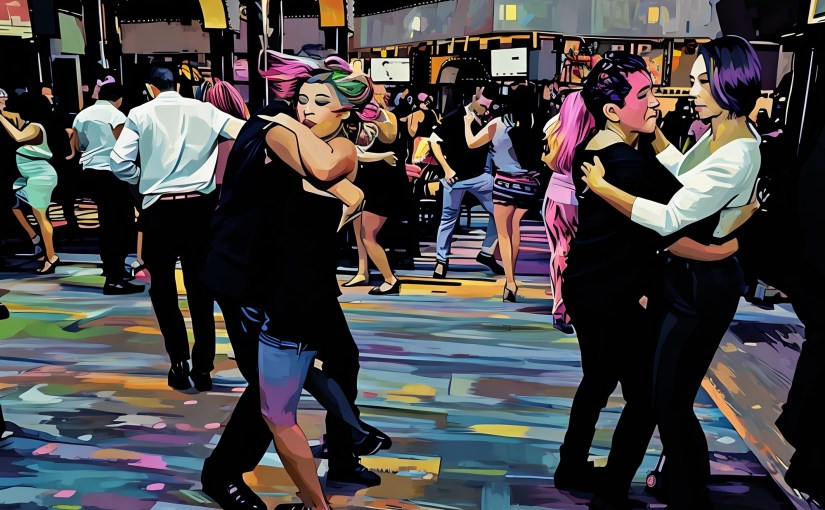
Jésus could mambo and cha-cha-cha
He had all the right moves
The salsa girls cooed ooh-la-la
Jésus was black satin smooth
He saw Lily swaying by the bandstand
Danced over and took her by the hand
They were magic on the disco floor
Texarkana 1984

Duane, who Maxine left behind
Came to Dallas for his Subaru
How hard could Maxine be to find?
Duane was nobody’s stooge
Maxine was workin’ at a Deep Ellum bar
That’s where Duane saw his car
His luck was improvin’ for sure
Texarkana 1984

Duane staked out Maxine
Tailed her everywhere she’d go
Took notes on her routine
Where she went, what she did, he’d know
He showed up at the salsa club
Drank too much to build his courage up
He wasn’t sure like he was before
Texarkana 1984

Jésus was standing in the way
This Latin guy might give him trouble
Duane was just about to make his play
When Maxine sat down at his table
She said “Duane, here, take your keys,
I’m sorry, but I just had to leave.
I dreamed of this and so much more.”
Texarkana 1984

Maxine dealt blackjack in Reno, Nevada
Jésus and Lily ran the salsa club
Duane had a car lot in Texarkana
Sold the Subaru for $500 bucks
Their dreams partly came true
Funny, how they sometimes do
One by one they knew the score
Texarkana 1984
They got about what they bargained for
Texarkana 1984

.© 2022 Frank David Leone, Jr./Highway 80 Music (ASCAP). The songs and stories on the Highway 80 Stories website are works of fiction. Names, characters, businesses, places, events, locales, and incidents are either the products of the author’s imagination or used in a fictitious manner. Any resemblance to actual persons, living or dead, or actual events is purely coincidental.

“Elegy for Dred Scot Lee”


LOCATION: Bossier City, Louisiana; Shreveport, Louisiana
PERIOD: 1903-2023
DRAMATIS PERSONAE: Joy Brown; Dred Scot Lee; Gaither Luther Motts (1883-1971); Earl “Dooky” Ford


From 1882 to 1968, 4,743 lynchings occurred in the U.S., according to records maintained by NAACP. Other accounts, including the Equal Justice Initiative’s extensive report on lynching, count slightly different numbers, but it’s impossible to know for certain how many lynchings occurred because there was no formal tracking. Many historians believe the true number is underreported.

The highest number of lynchings during that time period occurred in Mississippi, with 581 recorded. Georgia was second with 531, and Texas was third with 493. Lynchings did not occur in every state. There are no recorded lynchings in Arizona, Idaho, Maine, Nevada, South Dakota, Vermont, and Wisconsin.

Black people were the primary victims of lynching: 3,446, or about 72 percent of the people lynched, were Black. But they weren’t the only victims of lynching. Some white people were lynched for helping Black people or for being anti-lynching. Immigrants from Mexico, China, Australia, and other countries were also lynched. [Staff writer NAACP. “History of Lynching in America”. In NAACP History Explained. Web. Retrieved on May 9, 2023, from https://naacp.org/find-resources/history-explained/history-lynching-america.%5D

Joy Brown met Dred Scot Lee in 1903 when they happen to share a Coke.  At this time it was prohibited to drink after a black person, hence the existence of separate water fountains, and so, drinking from the same bottle was quite rebellious. They began to see each other, meeting in secret and hiding their friendship. And, it was only a friendship.

However, Joy did experience sexual intercourse when she was raped by her maternal uncle, Gaither Motts. It was obvious to her parents that Joy had been attacked, and after some intense questioning Joy admitted to having been raped. But instead of accusing her uncle, her mother’s brother, she named Dred – a defenseless negro boy.

During the Jim row era, a negro was often lynched for merely looking at a white woman.  It was assumed any negro, even a boy, accused of rape was certain to be hung – which Dred was.

His body was left for two days. People took pictures, and some had post cards made up which were mailed to friends and family across the country. Until finally, his mama had him cut him down and buried in a nearby field behind her house. They put a wooden cross to mark his grave but after his mama died, no one tended the grave and it was not long before there was nothing left to mark his grave.

Feeling ashamed over being raped and guilty for accusing an innocent negro boy, Joy dropped out of school and began drinking and doing anything to blot the entire chain of events out of her mind. Her uncle too, regretted his crime and that an innocent black boy was killed for it. But kept his secret for nearly 70 years until his death in 1971.

Joy went to Shreveport, and found herself on Fannin Street and became a working girl and heroin addict. Joy was taken over by a pimp, Dooky Ford, who as was his custom, also raped her. But this time, Joy was already pregnant with Gaither’s child.

Dooky let her know that as long as she was pregnant, her duties in the brothel would not include seeing clients. But Dooky told her, “If you can’t fuck you got to clean and cook.” Which she did, happily. However, when the child was born, a boy, she decided that she had to get away from there. She drowned the boy in the bathtub and in remorse intentionally overdosed herself.

More than 100 years later, and after being petitioned for decades by his family, the governor of Louisiana pardoned Dred Scot Lee. Pardoned is not accurate since Dred had not actually been convicted of raping Joy Brown. But it was a long overdue attempt to wash the stain off Dred Scot Lee’s name, as well as trying to retrieve some dignity for the people of north Louisiana.

A slate plaque was erected at the site of his hanging, a nondescript field outside of Bossier on Highway 80. On the stone were carved these words: “Dred Scot Lee / Hung in 1896 / For something he never done / He was 15.”


ELEGY FOR DRED SCOT LEE
(F. D. Leone, Jr.)

Bossier City nineteen-aught-three
Joy Brown met Dred Scot Lee
Forbidden love never seemed so right
They saw each other despite the risk
Only when they wouldn’t be missed
‘Cuz Dred was black and Joy was white

It began when they shared a Coke
The glacial ice was broke
They crossed a line and could not go back
When her lips touched where Dred’s had been
She felt a thrill, a first taste of sin
Their lives were changed with that one act

Joy was ashamed about who had raped her
Never said it was Uncle Gaither
She named the only negro boy she knew
Silhouetted in the setting sun
For two days Dred Scot Lee hung
And into a darkness Joy withdrew

Fannin Street, nineteen-aught-four
Dooky turned Joy into a whore
When her belly began to swell up
Dooky said, “if you can’t earn on your back,
You have to pick up the slack
Changin’ chamber pots, pushin’ a mop”

Gaither’s boy looked at Joy and laughed
Then she drowned him in his bath
Lit a candle and stared at the flame
The water was cold, the boy was blue
She boiled double junk in her spoon
Thought of what Gaither done and who she named

Before he died at age eighty-eight
Gaither had to set the record straight
Finally tell the truth about Joy
Slowly in a shaky scrawl
He wrote his story, told it all
“It was me who raped that girl, not that nigra boy”

Gaither despised the man he’d been
Did what he could to make amends
For the rape and his role in the mob
Donated the money he had saved
What he owed could not be paid
He did his best to get right with God

Bossier City twenty-twenty-three
A marker was placed beneath a tree
These words were carved into the slate:
“Here Dred Scot Lee was hung
For something he never done
Lynching Number 328

© 2025 Frank David Leone, Jr./Highway 80 Music (ASCAP). The songs and stories on the Highway 80 Stories website are works of fiction. Names, characters, businesses, places, events, locales, and incidents are either the products of the author’s imagination or used in a fictitious manner. Any resemblance to actual persons, living or dead, or actual events is purely coincidental.

“Jess Harper Returns to Macon”


LOCATION: San Francisco, California; Macon, Georgia
PERIOD: 1967-2007
DRAMATIS PERSONAE: Jess Harper (1949); Dooley Johnson (1949-2007)


Jess Harper (1949) and Dooley Johnson (1949) grew up in Macon, Georgia in the 1950s. During this decade the civil rights movement was gathering momentum, but it would still take a decade or more before a change in consciousness, especially in the South, would coalesce and the culture would begin to change. This process was helped along by the participation of progressive Southern intellectuals, like the family that produced Dooley Johnson, who offered their support to African American leaders by writing editorials, raising money and pressuring local elected officials.

Dooley and Jess met in grade school and grown up together forming a close friendship which by the time they were teenagers deepened into a romantic relationship. However, interracial dating was considered taboo, particularly in Macon, Georgia, in the Sixties.

Jess was 18 in 1967, the Summer of Love, and had heard about all the exciting things going on in California, Haight-Ashbury, and elsewhere. She desired to escape the claustrophobic racism of Georgia and the lure of California was strong. Despite her young love for Dooley she reluctantly began to believe that their relationship was doomed and chose instead to try her luck in San Francisco. This song is a flashback to the day she left Macon soon after graduating from high school.

Dooley who had been interested in history as a small child, reading about the early settlement of Georgia and forming a critical opinion about the treatment of Native Americans as well as the racial reality of his state. Dooley remained in Georgia where he pursued a degree in history eventually earning a doctorate and becoming a tenured professor of history at Mercer University in Macon.

Jess spent two years just hanging out in San Francisco until she learned that the University of California-Berkeley had created an African American Studies program. She realized that this is what she wanted to do with her life and enrolled in 1970.

She kept up on news from Macon through her mother, and when she learned of Dooley’s death in 2007 she made the long trip back to Macon for his funeral.


JESS HARPER RETURNS TO MACON
(F. D. Leone, Jr.)

Jess Harper threw some clothes into a suitcase
Took what she could but left a lot behind
She’s been thinking ‘bout leaving Macon
Got an early start ‘fore she changed her mind
She didn’t tell nobody not even her mama
Just got on 80 heading west
She’ll try and call Dooley from Alabama
The first chance that she gets

Her mama said they were asking for trouble
She could love a black boy just as easy as one who’s white
Plenty of Georgia don’t like to see a mixed couple
Jess began to think her mama was right

Jess met Dooley Johnson in first grade
They’ve been best friends ever since
He opened up her mind to new things
Like no other boy ever did
When Dooley was sixteen and had his license
He took Jess to see the Indian mounds
Left there by the great Mississippian people
A thousand years before the white man was around

Many nights Dooley told Jess stories
About the Choctaw and the Creek and their fate
Dooley’s family’s been in Georgia for generations
Jess knows Dooley’ll never leave this state

Jess pulls off the highway at Columbus
Stands at the river as a warm rain starts to fall
Her destination remains undecided
Dooley never did get that call
Forty years will pass before Jess returns to Macon
From California back to the land of her birth
In his Georgia drawl Jess hears Dooley talking
As they lower his body into the blood-red earth

© 2020 Frank David Leone, Jr./Highway 80 Music (ASCAP). The songs and stories on the Highway 80 Stories website are works of fiction. Names, characters, businesses, places, events, locales, and incidents are either the products of the author’s imagination or used in a fictitious manner. Any resemblance to actual persons, living or dead, or actual events is purely coincidental.

“Butterfly of Tyler”

In the early decades of the twentieth century, upper class Southern families, in many ways, still lived by a code of behavior that reflected antebellum values.  Young men and women socialized at the frequent balls and dinners held at the large homes among the wealthy Southern families. Lillian Cobb was often the prettiest girl there and enjoyed the attention of most of the eligible young men, who would crowd around her, filling her dance card. She was described by some as a butterfly, flitting from partner to partner.

A vestige of what was a 19th century value system, fathers controlled whom their daughters saw socially and ultimately married.  It was unusual for a daughter in her early twenties, or more likely eighteen or nineteen, to defy her father in her choice for a husband.  Lillian Cobb’s father was no different, and she was a product of a culture which strictly prohibited her from choosing a romantic partner from outside her family’s social strata or someone whose reputation had been seriously tarnished.

In the 1910s and 1920s, prior to the Great Depression, this society was peopled by men who did not inherit their wealth but had grown rich in industry or one of the professions, doctor or lawyer.  This was especially true for East Texas towns such as Tyler, where much of the new wealth came from oil and gas production. But there were still the old money families, and these two classes, the newly rich and the old guard, made up one upper social class.

In the case of Lillian Cobb, she fell in love with the irresponsible but dashing son of a Texas family whose roots went deep, back before statehood.

William MacLachlan was the second oldest son of Andrew MacLachlan, patriarch of an old family whose money derived from huge land holdings and cattle.  Andrew had never allowed drilling on any of his land, considering it a blight on the landscape.  Cattle were living things, warm bodies which you raised from birth and fed and took care of for several years.

Andrew’s son William, Willy his friends called him, was a Romantic youth, whose mind was filled with the poetry of John Keats and Robert Browning, and ideas about manhood coming out of novels of Walter Scott.  He had aspirations to write, himself, and filled composition books with his poetry.  A couple of times Willy bound these poems into folios, adding some ink and watercolor drawings, which he then gave to Lillian as his form of courtship.

Willy had dropped out the University of Texas, living off his family without any clear direction for earning his own way, or plans for the future other than bumming around Europe.  Willy was known to drink copious amounts of whiskey, something else which would not endear him to any of the Tyler aristocracy.

William MacLachlan was just the kind of boy Randolph Cobb, Lillian’s father, would never approve of for his daughter. And he did every thing in his power to thwart any ideas of marriage between his daughter and Willy MacLachlan.

By contrast Walter Murphy was in his final year at University of Texas law school, with a promising future assured.  Lillian might have been in love with the dreamy Willy, but her father knew to whom he was going place his daughter’s hand in marriage.

Lillian Cobb (1894-1986) married Walter Murphy (1889-1966) in 1916, gave birth to Peter Cobb Murphy (1917-1999). Peter C. Murphy was father to Helen Haynes Murphy (1947), Louann Bowden’s mother.

BUTTERFLY OF TYLER
(F.D. Leone, Jr.)

There had been a round of parties
For Lillian Cobb’s upcoming wedding day
She spent the night before crying in her room
That 1916 Saturday in May

A great-aunt on her daddy’s side
Sat with her, they talked the night away
“I’ll tell your father to call this wedding off”
“You mustn’t do that; it’s too late.”

The butterfly of Tyler
Flitting on her careless wings
Young men would crowd beside her
A vision fading into a dream

Any other girl would have been thrilled
Walter Murphy was the catch of the year
But he was not who Lillian had set her eye
Her father refused the one she held dear

So she cried for the good times that would be no more
For the names that had filled her dance card
For all the twilight parties and the one
Who lives still in her heart

The butterfly of Tyler
Flitting on her careless wings
Young men would crowd beside her
A vision fading into a dream

© 2020 Frank David Leone, Jr./Highway 80 Music (ASCAP). The songs and stories on the Highway 80 Stories website are works of fiction. Names, characters, businesses, places, events, locales, and incidents are either the products of the author’s imagination or used in a fictitious manner. Any resemblance to actual persons, living or dead, or actual events is purely coincidental.

“Vernon and Molly”


LOCATION: Vicksburg, MIssissippi
PERIOD: 1950s-1980s
DRAMATIS PERSONAE: Vernon Raney (1903-1987); Molly Motts (1931-2014); Lonnie Raney (1958-2006); Ronnie Raney (1962-2004); Ginny Raney (1966- )


Vernon Raney was 49 years old when he met Molly Motts, and didn’t need to get married, but that is just what he ended up doing; to a girl less than half his age.

The Raney family were bootleggers, had been making clear whiskey for more than a century before Vernon took over the still (see song, “Lonsom Raney 1828“). He made a change, though, from the family recipe, he began to age the distilled product in charred oak barrels, turning the clear shine to a golden tobacco color, and mellowing the taste considerably (see song, “’57 Fleetwood to Memphis“).

Molly Motts, from Delta, Louisiana, just across the river from Vicksburg, was a precocious young woman, who was looking for any way out of Delta when she met Vernon at a party on the Mississippi bank of the river, just outside Vicksburg (see song, “When Molly Motts Married Vernon Raney“).

Long story short, Vernon and Molly got married; Molly took over the moonshine business and turned it into a drug enterprise. With the help of her two sons, they established a distribution network from Natchez to Memphis (see songs, “Louanne in Vicksburg” and “Molly on the Mountain“).

You could say that Vernon never knew what he was getting into when he married Molly, but then again, he was never known to say a cross word about Molly or their life together.


VERNON AND MOLLY
(F. D. Leone, Jr.)

Vernon had his whiskey business
And his V-8 coupe
But he felt something was missing
He wasn’t sure just what to do
Wasn’t sure what to do

There was a party at the river
Vernon drove by real slow
Molly was tall and slender
He felt something inside let go
Something inside let go

Vernon was old enough to be her daddy
Molly was wiser than her years
She wanted more than what a small town could deliver
Vernon was her ticket out of there
Her ticket out of there

Once a month he went to Memphis
Delivering a load of shine
He did okay with his whiskey business
And showed Molly a real good time
They had a real good time

They were always seen together
Then her belly began to show
Vernon said let’s put it on paper
She said I’m ready, let’s go
I’m ready, let’s go

Vernon was old enough to be her daddy
Molly was wiser than her years
She wanted more than what a small town could deliver
Vernon was her ticket out of there
Her ticket out of there

Molly gave him three kids
Two sons and a daughter
She had plans beyond his
Vernon never fought her
He never fought her

Molly took over the business
Began selling pot and more
Vernon stopped going to Memphis
Spent his time down at the store

Vernon was old enough to be her daddy
Molly was wiser than her years
She wanted more than what a small town could deliver
Vernon was her ticket out of there
Her ticket out of there

© 2019 Frank David Leone, Jr./Highway 80 Music (ASCAP). The songs and stories on the Highway 80 Stories website are works of fiction. Names, characters, businesses, places, events, locales, and incidents are either the products of the author’s imagination or used in a fictitious manner. Any resemblance to actual persons, living or dead, or actual events is purely coincidental.

“Ready for Change”


LOCATION: Jackson, Mississippi
PERIOD: 2013-2015
DRAMATIS PERSONAE: Lucy Bess Cooper (1980-2015); Levi Hooper (1973)


Lucy Cooper and Levi Hooper met in Jackson, Mississippi when they lived across the street from each other (see song “Levi and Lucy”). They became involved in a relationship, something of an attraction of opposites: Levi was a church-going, salt of the earth type, whereas Lucy was a hell-raising rebel, who was no stranger to a variety of mind-altering substances.

However, Lucy had begun to feel that she had reached a dead end with her life, and was looking, most likely subconsciously, for new direction, one which seemed to be provided by Levi.

Unfortunately, Levi came along too late for Lucy, who was overtaken by the momentum and trajectory of her past life. One of her marijuana customers offered her name as his dealer, in exchange for a suspended sentence for simple possession. Lucy was arrested and convicted for distribution and sent to prison, where after a year into her 18 month sentence, she succumbed to depression and committed suicide (see song, “When Louanne Met Lucy in Prison”).

Levi was left to pick up the pieces as best he could in the wake of this aborted relationship (see song, “Levi After Lucy”).


READY FOR CHANGE
(F. D. Leone, Jr.)

When Lucy and Levi met
Lucy wasn’t ready yet
To turn over a new leaf
But she really wanted to
To do what she had to do
Her life had mostly brought her grief

The mirror Lucy looked in
Showed her where she had been
But not where she wanted to go to
Levi was steady, Levi was strong
Someone Lucy could rely upon
Change ain’t what you want but what you do

Lucy wasn’t sure how to start
But something was cooking in her heart
Pushing her past the life she had known
Levi was the catalyst
Even so it was hit or miss
All he could do was cheer Lucy on

The mirror Lucy looked in
Showed her where she had been
But not where she wanted to go to
Levi was steady, Levi was strong
Someone Lucy could rely upon
Change ain’t what you want but what you do

It’ll take some time
For Lucy to leave behind
The people and things holding her back

The mirror Lucy looked in
Showed her where she had been
But not where she wanted to go to
Levi was steady, Levi was strong
Someone Lucy could rely upon
Change ain’t what you want but what you do

© 2017 Frank David Leone, Jr./Highway 80 Music (ASCAP). The songs and stories on the Highway 80 Stories website are works of fiction. Names, characters, businesses, places, events, locales, and incidents are either the products of the author’s imagination or used in a fictitious manner. Any resemblance to actual persons, living or dead, or actual events is purely coincidental.

“Love in the Afternoon”

Lillian Cobb’s marriage to Walter Murphy was not a happy one. It is not surprising since from the outset, Lillian reluctantly married Walter, her father’s choice, while at the time being in love with William MacLachlan, the prospective son-in-law her father would never accept (see song, “The Butterfly of Tyler”).

Walter Murphy was a successful businessman, parlaying his law degree into a series of successful business ventures with some of his clients. He had built a large mansion in Waxahachie, Texas, for his wife and children: Peter his oldest son born in 1917, Nora in 1920 and his youngest Andrew in 1928, following two miscarriages in between the last two.

Walter did not know that his wife Lillian, after ten faithful years, had ultimately been unfaithful to him, with William MacLachlan, with whom she had remained in love since the outset of their marriage.

Things got worse for Walter and Lillian when his fortune was devastated in the Great Depression. With their wealth gone, Lillian and Walter could no longer sustain the fiction of their marriage, and it happened that during one of their many arguments Lillian flung Willy MacLachlan in Walter’s face.  They were divorced in 1931, Lillian retaining custody of their three kids.

Lillian and Willy had a small private wedding without delay, but ironically, without the excitement that their illicit affair had produced, the routine of day-to-day married life had the effect of cooling their romance somewhat.  However, they remained married since there was always warm affection, and they had two children, in addition to Lillian’s three from her former marriage.

LOVE IN THE AFTERNOON
(F.D. Leone, Jr.)

They’d meet in the house her husband built
But never in her bedroom
She didn’t second-guess, felt no guilt
Love in the afternoon

Told herself she’d earned this happiness
She didn’t choose her husband, he was her father’s groom
After ten faithful years she had a dalliance
Love in the afternoon

It happened by accident
On one of her trips back home they fell together
Eyebrows were raised, there were comments
But it was no surprise those two were lovers

Her marriage had grown cold over the years
The papers were drawn up very soon
Down the road for her it was crystal clear
Love in the afternoon

The lovers cast their lot in the marriage game
But sadly the blush was off the bloom
Their life became routine and was not the same
As love in the afternoon

It happened by accident
On one of her trips back home they fell together
Eyebrows were raised, there were comments
But it was no surprise those two were lovers

They’d meet in the house her husband built
But never in her bedroom
She didn’t second-guess, felt no guilt
Love in the afternoon

© 2019 Frank David Leone, Jr./Highway 80 Music (ASCAP). The songs and stories on the Highway 80 Stories website are works of fiction. Names, characters, businesses, places, events, locales, and incidents are either the products of the author’s imagination or used in a fictitious manner. Any resemblance to actual persons, living or dead, or actual events is purely coincidental.

“Ransom Raney”

Ransom Raney (1848-1905) was the oldest son born to Lonsom Raney (1828-1923) and was the first child born to the Raney family on their new mountain home in North Georgia after moving from southwestern North Carolina. Originally from Scotland the Raneys were one of many families who were encouraged to move from southern Scotland to northern Ireland, the Ulster region.

These people have been called Scots-Irish and made up a significant number of the immigrants to America in the 17th and 18th centuries. They brought with them much of their way of life, including distilling whiskey in copper stills, with the idea that this was their right, one for which they would not tolerate any infringement from government.

Scots-Irish tended to be impetuous and hotheaded, having been marginalized back in Ulster, they defied any easy definition. In fact, they bristled at others’ labels for them—”Irish,” “Irish Presbyterians,” “Northern Irish,” or even “Wild Irish.”  Already twice transplanted, they had acquired a migratory habit. Once acquired, such habits are liable to persist; when the constraints of government caught up with them, these wayfarers often chose to move on.

This trait did not evaporate once they were in America and often they would keep moving west, keeping just ahead of civilization and legal constraints on their way of life.

This song is about three things: 1) the resilient nature of the Scots-Irish of the Appalachian mountains, 2) making whiskey and in general living off the land, and 3) fighting to preserve their way of life, not as part of a larger cause but for fiercely personal reasons.

RANSOM RANEY
(F.D. Leone, Jr.)

This is the tale of a mountain man
Lot of grit, lot of sand
Ransom Raney’s his name
From Scotland his people came

He was Lonsom Raney’s oldest son
1848 he was born
Stood at his daddy’s right hand
Taught to be a mountain man

Keep your mouth shut, your head down
Live off what comes from the ground
Make your shine, dig ginseng root
Live your own truth

When he was fifteen he went to war
Butternut was his uniform
Fought for what he could understand
Get the blue basterds off his land

Chickamauga; Second Vicksburg
Mansfield was the call he heard
But Ransom slipped away
From the fighting of the blue and grey

His year was up so he went back home
Grateful to get through it whole
In the winter of ’64
Ransom Raney was done with war

Back at the farm what he found
It had been burned to the ground
His daddy rebuilt the barn
While the ground was still warm

Lonsom had buried his copper still
Set it back up on same hill
The first batch after the war
Was his best he swore

The Raneys are a real hard bunch
Won’t be stopped, not by much
A war ain’t nearly enough
The Raneys are a hard bunch

Ransom Raney loved one wife
She gave his seven children life
He taught his two eldest sons
To do what their grandpa done

He lived long enough to see
A brand new century
He was satisfied
In 1905 he died

Ransom Raney stood alone
But he could be counted on
When you needed a friend
Against flatlanders or gov’mint men

© 2019 Frank David Leone, Jr./Highway 80 Music (ASCAP). The songs and stories on the Highway 80 Stories website are works of fiction. Names, characters, businesses, places, events, locales, and incidents are either the products of the author’s imagination or used in a fictitious manner. Any resemblance to actual persons, living or dead, or actual events is purely coincidental.

“Terrell”


LOCATION: Shreveport, Louisiana; Forth Worth, Texas; Terrell, Texas
PERIOD: 2015-2019
DRAMATIS PERSONAE: Pearl Boone Robison (1973); Jake McLemore (1959); Sadie Jo Robison McLemore (2015)


The stories of Jake McLemore and Pearl Robison are told in a group of songs that describe their lives before and after they meet and then their relationship together.

Jake is introduced with the song “McLemore’s“, which tells about his bar in Nashville and describes his character as seen through the eyes of young man. At the end of the song, Jake has sold his bar and moved outside Shreveport, Louisiana.

The song “Between Here and Gone” is our first exposure to Pearl, when she is in Macon, Georgia, contemplating leaving a dead end job. She travels west on Highway 80 to Shreveport where she stops at an all night diner and Jake McLemore enters her life (see song, “Pearl and Jake“) .

They live together for five years before Pearl chooses to leave when their relationship stagnates. She heads further west on 80, this time heading for Fort Worth to camp out with with her sister while she attempts to get back on her feet (see song “Hit the Road“).

The songs “The River and Jake” and “The Red River Flows” address Jake’s confusion and sadness after Pearl’s seemingly unexplained disappearance.

When she leaves Shreveport, Pearl is not yet aware that she is carrying Jake’s baby, but while she is living with her sister it soon becomes obvious. She ends up getting her own place and prepares for the baby’s arrival, but chooses not to inform Jake immediately.

Pearl gives birth in 2015 to a baby girl whom she names Sadie Jo, after her parents, Jason Jones Robison and Sadie Boone. About two years after leaving Shreveport Pearl calls Jake and, in her first contact since she left, tells him he is a new father.

Pearl and Jake get married in 2018 and raise Sadie Jo McLemore together.


TERRELL
(F. D. Leone, Jr.)

All Pearl knew, she was heading to Texas
When she packed up and left Shreveport
She didn’t know then she was pregnant
When she landed on her sister’s porch

Six months later, Myrna asked if she’d thought about
How she planned on raising this baby alone
Her brother-in-law said it was time for her to move out
Pearl needed a place of her own

Terrell, Texas
Where Pearl calls home
Terrell, Texas
Where Pearl lives alone

Year later, Pearl was working at the Donut Hole
Which made her think of Jake
Sadie Jo’s his, he deserves to know
Not telling him was a mistake

That weekend Pearl prayed for the courage
And help to find the right words to say
Knowing Jake, he might speak of marriage
And Pearl just might say okay

Terrell, Texas
Where Pearl calls home
Terrell, Texas
Where Pearl lives alone

© 2019 Frank David Leone, Jr./Highway 80 Music (ASCAP). The songs and stories on the Highway 80 Stories website are works of fiction. Names, characters, businesses, places, events, locales, and incidents are either the products of the author’s imagination or used in a fictitious manner. Any resemblance to actual persons, living or dead, or actual events is purely coincidental.


Related songs in chronological order:
McLemore’s
Between Here and Gone
Pearl and Jake
Hit the Road
The River and Jake
Terrell
The Red River Flows
Sadie Jo