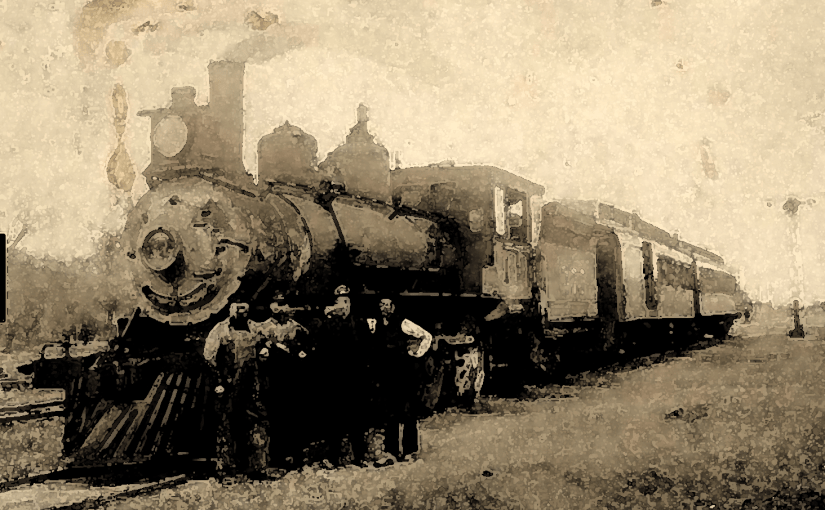
“Go West”


LOCATION: Big Spring, Texas
PERIOD: 1903
DRAMATIS PERSONAE: John Henry Hardin (1878-1949); “Henry Adams Hardin (1926-2015); John Farley Hardin (1927-2020)


Homer and Virgil Hardin were distant relatives of Louanne Bowden, on her mama’s grandma’s side.   They typified a certain mindset among the American pioneers: ruthless independence and no need for civilization. For a while, the kind of life they desired could still be found by leaving the settled towns and cities and going further west.


GO WEST
(F. D. Leone, Jr.)

John Henry Hardin was an engineer
Railroading for the T&P
He had a good wife and two ornery sons
This would’ve been about nineteen and aught-three

The Hardins come from North Carolina
Alabama, then Texas in eighteen-seventy-nine
They would move on about every ten years
Leaving progress: the lawyers and the bankers behind

And go west, hoping to stay free
Even if it meant a harder life
Go west, hanging on to liberty
Life ain’t worth living otherwise

Homer and Virgil were John Henry’s sons
They were dyed-in-the-wool true Hardins, them two
Stuck there in Big Spring, standing at the tracks
Staring and waiting for the coal train to blow through

Each had a nickel in his pocket
Earned that mornin’ from chopping two cords of wood
When they were younger they’d put ’em on the track
But they been saving their nickels to get out for good

And go west, hoping to stay free
Even if it meant a harder life
Go west, hanging on to liberty
Life ain’t worth living otherwise

© 2019 Frank David Leone, Jr./Highway 80 Music (ASCAP). The songs and stories on the Highway 80 Stories website are works of fiction. Names, characters, businesses, places, events, locales, and incidents are either the products of the author’s imagination or used in a fictitious manner. Any resemblance to actual persons, living or dead, or actual events is purely coincidental.

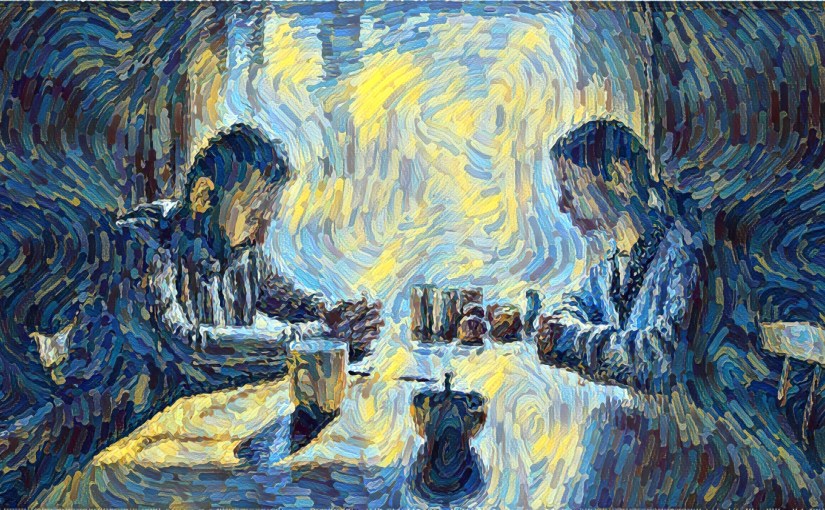
“Butterfly of Tyler”


LOCATION: Tyler, Texas
PERIOD: 1916-1986
DRAMATIS PERSONAE: Lillian Cobb (1894-1986); Walter Murphy (1889-1966); Peter Cobb Murphy (1917-1999); Helen Haynes Murphy (1947)


In the early decades of the twentieth century, upper class Southern families, in many ways, still lived by a code of behavior that reflected antebellum values.  Young men and women socialized at the frequent balls and dinners held at the large homes among the wealthy Southern families. Lillian Cobb was often the prettiest girl there and enjoyed the attention of most of the eligible young men, who would crowd around her, filling her dance card. She was described by some as a butterfly, flitting from partner to partner.

A vestige of what was a 19th century value system, fathers controlled whom their daughters saw socially and ultimately married.  It was unusual for a daughter in her early twenties, or more likely eighteen or nineteen, to defy her father in her choice for a husband.  Lillian Cobb’s father was no different, and she was a product of a culture which strictly prohibited her from choosing a romantic partner from outside her family’s social strata or someone whose reputation had been seriously tarnished.

In the 1910s and 1920s, prior to the Great Depression, this society was peopled by men who did not inherit their wealth but had grown rich in industry or one of the professions, doctor or lawyer.  This was especially true for East Texas towns such as Tyler, where much of the new wealth came from oil and gas production. But there were still the old money families, and these two classes, the newly rich and the old guard, made up one upper social class.

In the case of Lillian Cobb, she fell in love with the irresponsible but dashing son of a Texas family whose roots went deep, back before statehood.

William MacLachlan was the second oldest son of Andrew MacLachlan, patriarch of an old family whose money derived from huge land holdings and cattle.  Andrew had never allowed drilling on any of his land, considering it a blight on the landscape.  Cattle were living things, warm bodies which you raised from birth and fed and took care of for several years.

Andrew’s son William, Willy his friends called him, was a Romantic youth, whose mind was filled with the poetry of John Keats and Robert Browning, and ideas about manhood coming out of novels of Walter Scott.  He had aspirations to write, himself, and filled composition books with his poetry.  A couple of times Willy bound these poems into folios, adding some ink and watercolor drawings, which he then gave to Lillian as his form of courtship.

Willy had dropped out the University of Texas, living off his family without any clear direction for earning his own way, or plans for the future other than bumming around Europe.  Willy was known to drink copious amounts of whiskey, something else which would not endear him to any of the Tyler aristocracy.

William MacLachlan was just the kind of boy Randolph Cobb, Lillian’s father, would never approve of for his daughter. And he did every thing in his power to thwart any ideas of marriage between his daughter and Willy MacLachlan.

By contrast Walter Murphy was in his final year at University of Texas law school, with a promising future assured.  Lillian might have been in love with the dreamy Willy, but her father knew to whom he was going place his daughter’s hand in marriage.

Lillian Cobb (1894-1986) married Walter Murphy (1889-1966) in 1916, gave birth to Peter Cobb Murphy (1917-1999). Peter C. Murphy was father to Helen Haynes Murphy (1947), Louann Bowden’s mother.


BUTTERFLY OF TYLER
(F. D. Leone, Jr.)

There had been a round of parties
For Lillian Cobb’s upcoming wedding day
She spent the night before crying in her room
That 1916 Saturday in May

A great-aunt on her daddy’s side
Sat with her, they talked the night away
“I’ll tell your father to call this wedding off”
“You mustn’t do that; it’s too late.”

The butterfly of Tyler
Flitting on her careless wings
Young men would crowd beside her
A vision fading into a dream

Any other girl would have been thrilled
Walter Murphy was the catch of the year
But he was not who Lillian had set her eye
Her father refused the one she held dear

So she cried for the good times that would be no more
For the names that had filled her dance card
For all the twilight parties and the one
Who lives still in her heart

The butterfly of Tyler
Flitting on her careless wings
Young men would crowd beside her
A vision fading into a dream

© 2020 Frank David Leone, Jr./Highway 80 Music (ASCAP). The songs and stories on the Highway 80 Stories website are works of fiction. Names, characters, businesses, places, events, locales, and incidents are either the products of the author’s imagination or used in a fictitious manner. Any resemblance to actual persons, living or dead, or actual events is purely coincidental.

“I Didn’t Know What Else To Do”


LOCATION: Texas
PERIOD: 1856-1888
DRAMATIS PERSONAE: Jedadiah Phelps (1856-1888?); Nellie Phelps (1855-1922)


Jed Phelps was the younger brother of Nellie Phelps, the grandmother of Earl Bowden’s maternal grandmother.  Earl Bowden was Louanne Bowden’s father, which makes Jed Phelps her great-great-great-granduncle.

By the time Jed was six he’d lost his older brother Burch and his mother.  Ten years later his father died leaving his sister and him alone on the family farm in Tennessee.  Nellie married Robert Dorsey the son of a wealthy Texas rancher when she was 17, in 1873.  Dorsey brought Nellie and Jed with him back to his family’s Texas ranch, which was rather large.  Dorsey land stretched between what would become the future cities of Monahans and Abilene.

Abilene was established by cattlemen such as Charles Dorsey, Bob’s father, as a stock shipping point on the Texas and Pacific Railway in 1881. Monahans grew up around a deep water well dug a few years later when the railroad surveyors discovered that the lack of water for the laying crew and their animals would slow down construction of the rail.  Monahans’ digging of a water well produced an abundance of good water and the town would thrive.

Jed was a disgruntled young man, at sixteen he didn’t much like being bossed around by Bob Dorsey.  Having an active imagination Jed dreamed of joining the Texas Rangers whose fame of heroic deeds fighting the Indians and Mexicans he’d heard all about in the bunkhouse.  And so, that’s what he did as soon as he turned nineteen.

But by then the Indians had been run off and the Mexicans no longer posed much of a threat.  Mainly the Rangers were a mercenary band supporting the ranchers whose barbed wire fences were an obstacle for the old cattle drovers accustomed to driving their herds north unobstructed.

There had been a fence war raging between the cattlemen taking large herds across Texas to places like Kansas City and the ranchers who tried to preserve the integrity of their ranches.  This conflict eventually petered out when the railroad was completed since it made no sense to drive the herds north when they could much easier be loaded onto a train.

Disenchanted with this life, in 1888 Jed decided to return to Tennessee and the family  farm to see what was there.  More disappointment awaited him, and so he rode off again, never to be heard from again (see song “A Rusted Plow“).


I DIDN’T KNOW WHAT ELSE TO DO
(F. D. Leone, Jr.)

Got the lantern, walked out to the barn
Raised the axe, split a log in two
Much as I hated splitin’ wood
I didn’t know what else to do
 
Wasn’t that long ago that Pa could lift
Hunderd pound sack under each arm
He looked tiny now under all those quilts
Still, Nellie couldn’t keep him warm
 
Was about six when we lost Burch
Can’t hardly see his face at all
Ma went to bed and never got back up
Now ten years later, looks like it’s Pa
 
The torn wood smelled green and sour
I started feelin’ pretty loose and relaxed
I’m sixteen and figure it’ll fall to me
Even if he got better Pa won’t ever be back
 
I looked up, Nellie was on the porch
Asked her, “How’s he?” She said, “Pa’s dead.”
We buried Pa next to Ma and Burch
I found a field stone and set it at th’ head
 
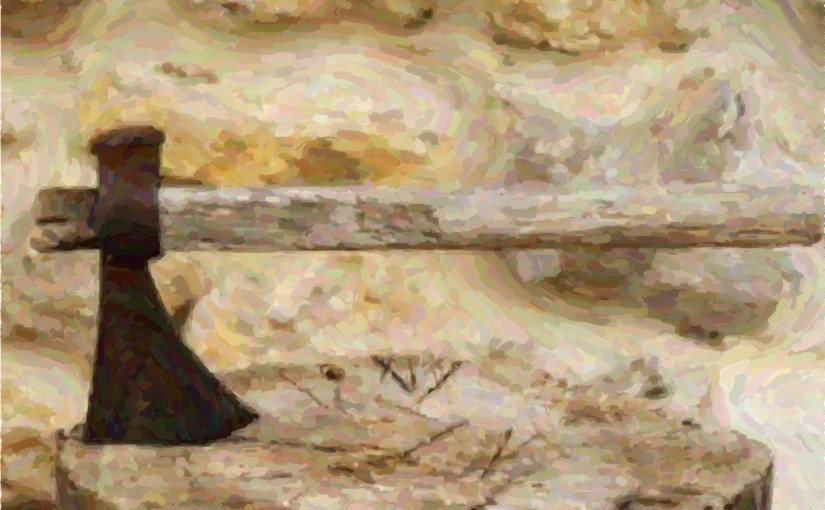
I swung the axe it stuck in the wood
Raised it again split that log in two
We had plenty wood already in the shed
I didn’t know what else to do

© 2018 Frank David Leone, Jr./Highway 80 Music (ASCAP). The songs and stories on the Highway 80 Stories website are works of fiction. Names, characters, businesses, places, events, locales, and incidents are either the products of the author’s imagination or used in a fictitious manner. Any resemblance to actual persons, living or dead, or actual events is purely coincidental.
“A Rusted Plow”


LOCATION: Texas
PERIOD: 1872-1888
DRAMATIS PERSONAE: Jethro “Jed” Phelps (1856-1888, 32); Nellie Phelps (1855-1922, 67); William Phelps (1834-1872); Martha Massey (1835-1862)


Jed Phelps describes life after his Pa died: His sister Nellie marries a Texas rancher who brings them all to his ranch and puts sixteen year old Jed to work. However, after a few years Jed doesn’t take to ranchin’. He’d heard heroic stories about the Texas Rangers and joins up. When that isn’t all he dreamed it’d be, he decides to go back to their farm in Tennessee only to find something less than he expected.

His family never jnew what happened to Jed, whether he died, or just never came home or even contacted them.


A RUSTED PLOW
(F. D. Leone, Jr.)

After Pa died Nellie married Bob Dorsey
Brought us to Texas to the biggest ranch I seen
Had me punchin’ cows and breakin’ horses
So I joined the Rangers when I turned nineteen
I’d heard about the Indian Wars
But by then the Kiowa were off the plains
We were so good they don’t need us no more
‘Cept to chase off a few fence cuttin’ gangs

Things ain’t how I want to remember
The truth ain’ what I want to hear
I gotta leave the past behind, it’s better
Than seein’ what’s waitin’ for me there

1888 I went back to Tennessee
Wondered how the ol’ homestead looked now
Rode for a week and what greeted me
Was a crow sittin’ on a rusted plow
I found the block where I split wood
The barn was all but fallin’ down
Squattin’ on my heels, chewin’ a cheroot
Thinkin’ how Pa had been so proud

Things ain’t how I want to remember
The truth ain’ what I want to hear
I gotta leave the past behind, it’s better
Than seein’ what’s waitin’ for me there

Went around back, found those graves
Cleaned them up straightened the stones
A part of me kinda wished we had stayed
But I can’t get back what’s long gone
Spose I got what I came for
It’s sure all that’s here to be found
I’ll ride away come back no more
Not for any crow sittin’ on a rusted plow
I’ll ride away come back no more
Not for no crow sittin’ on a rusted plow

© 2018 Frank David Leone, Jr./Highway 80 Music (ASCAP). The songs and stories on the Highway 80 Stories website are works of fiction. Names, characters, businesses, places, events, locales, and incidents are either the products of the author’s imagination or used in a fictitious manner. Any resemblance to actual persons, living or dead, or actual events is purely coincidental.
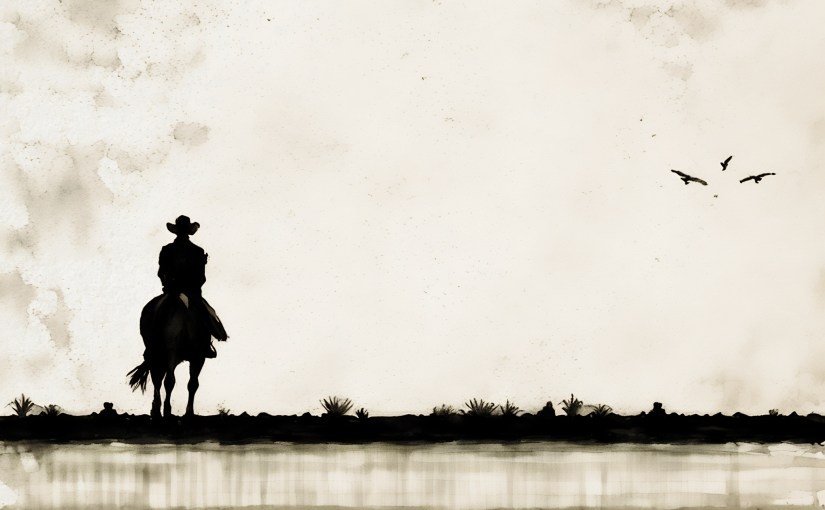
“Oil City”


Charles Taylor McLemore (1921-2001), Jacob “Jake” Tyler McLemore’s (1959) father, talks about growing up in his hometown of Oil City, Louisiana. During the first decades of the 20th century oil was discovered in Texas and Louisiana and until the Depression forced the speculation to pause, fortunes were made and lost. Oil City and the McLemore family were a small part of that history.

Jacob “Mac” McLemore (1879-1977) made and lost more money than any of the McLemore men. When he was fifteen he heard about the 1894 oil strike in East Texas. He started at the bottom working any job he could get, eventually learning enough to strike out on his own.

Jacob Mac McLemore never knew his father, who had been an outlaw-gunslinger who died a few months before he was born.  Sam Summers McLemore (1852-1878) never even knew the 16-year old whore, Sally McCune, he was living with was pregnant when he went out in the street to face a younger and what turned out to be faster boy.  Jacob was raised by Sally, who eventually was able to quit the life and lived out her days running a boarding house in Fort Worth.   There’s some who say it was more than a boarding house, but others deny those rumors.

Indians found oil seeping from the soils of Texas long before the first Europeans arrived. They told explorers that the fluid had medicinal values. The first record of Europeans using crude oil, however, was for the caulking of boats in 1543 by survivors of the DeSoto expedition near Sabine Pass.

Melrose, in Nacogdoches County, was the site in 1866 of the first drilled well to produce oil in Texas. Other oil was found in crudely dug wells in Bexar County in 1889 and in Hardin County in 1893. But it was not until June 9, 1894, that Texas had a major discovery. This occurred in the drilling of a water well for the city of Corsicana. Oil caused that well to be abandoned, but a company formed in 1895 drilled several producing oil wells.

Jacob Mac was 15 when the Corsicana oil came in, and for the next sixty years he chased strikes all over Texas and Louisiana. He might make some money here, then invest it somewhere else only to see his investment evaporate in the dusty Texas wind.

Jacob was married and divorced four times, the last near the end of his life and the one which really broke him. Of the four marriages, only the first produced any children, one boy, Lee Allen (1903-1989), and a girl, Aurelia.  Lee Allen was Jake McLemore’s grandfather.

If you were to ask those who knew him, what they would tell you about Jacob Mac McLemore was that, first and foremost, he was a decent man whose word was his bond. No one ever knew him to brag or lie and that he never made a deal that he did not keep, and usually made his partners money.

He died at the age of 98, dying peacefully in his sleep in an Odessa, Texas hospital room with his great-grandson, Jake, by his side. You might say that Jacob Mac lived an interesting life, but despite not enjoying consistent good luck he was always in good humor and very good company.


OIL CITY
(F. D. Leone, Jr.)

Oil City is my home
Ain’ pretty but I belong
Grey and gritty, right or wrong
Oil City is my home

Aught-five oil came from the ground
Oil City was a wildcat town
Wooden sidewalks and hitching posts
Boom towns ain’ got no ghosts

Aught-six grandpa McLemore
Had a little money but wanted more
Oil City was where grandpa came
Gamblin’ on the big oil game

Oil City is my home
Ain’ pretty but I belong
Grey and gritty, right or wrong
Oil City is my home
Oil City is my home …

Few years pass and the fever died
Were other towns, other strikes
1917 it almost burned down
The whores all left town

Dad went to work at J.M Guffey
We stayed in Oil City
Grandpa went broke in the Depression
Kept chasin’ oil, died in Odessa

© 2018 Frank David Leone, Jr./Highway 80 Music (ASCAP). The songs and stories on the Highway 80 Stories website are works of fiction. Names, characters, businesses, places, events, locales, and incidents are either the products of the author’s imagination or used in a fictitious manner. Any resemblance to actual persons, living or dead, or actual events is purely coincidental.
“My Pocketknife”


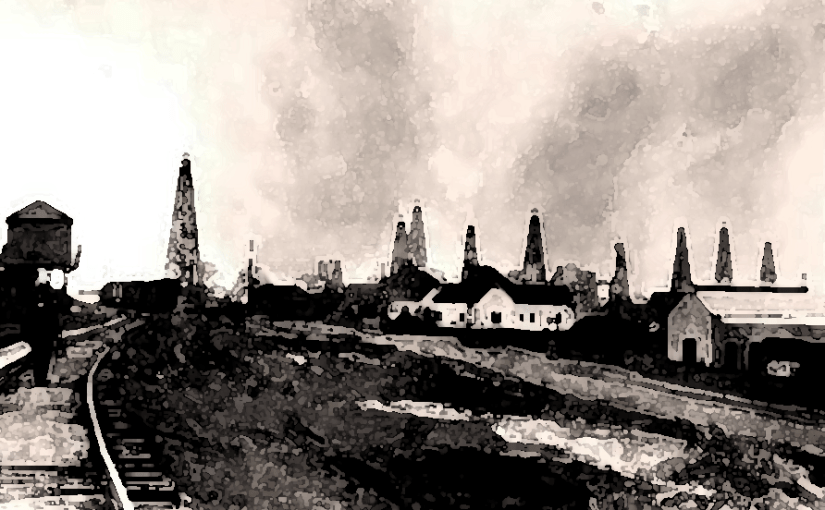
It took a couple of years longer than in other towns, but The Great Depression finally hit Oil City, Louisiana in 1932. The price of oil plummeted and work ground to a stop. They capped the wells and hauled the rigs away, to wait for better times. In 1934, out of all other options, Lee Allen McLemore and his thirteen year old son Charlie hit the road looking for work, and like many others head west to California.

Jake McLemore’s father was Charles Taylor “Charlie” McLemore.

Charlie grew up during the depression, traveling with his father, Lee Allen, on trains, with other hobos, with the putative goal of finding work. When the crash hit the oil industry, it took longer than for most other industries, but eventually the bottom fell out of the oil business in 1932. The wells were capped and the rigs hauled away, leaving the men who had depended upon the work stranded in small oil patch towns with no other opportunities for work. Many of them joined the large numbers of itinerant men riding the rails. Some looked for work but many had given up and made do as best they could.

But when we think of hobos riding in boxcars we don’t usually think of children doing the same thing. But when families had no money, little food and nothing on the horizon, they simply sent their children away to fend for themselves, as best they could.

“At the height of the Depression, as many as a million teenagers traveled the rails looking for work and community, moving in vagabond packs and living in hobo jungles, finding both charity and brutality in the broken-back cities of America. They crowded the cars and hid down in the tenders where the coal and water were stored; they squeezed between cars and clung atop their bucking roofs. In 1932, about 75 percent of the nearly six hundred thousand transients on the Southern Pacific line through Texas, New Mexico, and Arizona were under the age of twenty-five.”

“Fathers, and sometimes sons, stayed in the network of “jungles” along the route, tucked amid the timber and hidden from view. Each camp had its own division of labor—one person went into town to find a potato for soup while another brought salt or an extra spoon. Pots and pans hung from tree branches; crude shelters were made from cardboard or tin scrap and sometimes built up in the trees. Pocketknives were like gold in the jungles. Blades were “hired out” in exchange for soap or a bowl of stew. In a pinch, a knife could be traded for a pair of shoes or sold for cash. Men cooked possums and jackrabbits caught in snares along the brush lines and traded their hides for food.” (Mealer, Bryan. The Kings of Big Spring: God, Oil, and One Family’s Search for the American Dream. 2018.)

This was the kind of life Charlie McLemore lived during his childhood.

Charlie and his father worked picking cotton in California for a few weeks and also fruit when they could. They managed to work just enough to feed themselves, as well as, put a little aside. Eventually they got back to Oil City just as things were starting to come back.

By the time World War II started, and a need for oil exploded, Charlie was in his late teens. His father got work immediately at a refinery and from then on, the Lee McLemore family did okay.

Charlie went into the oil business as well, but oil was not the only resource product that supported the Oil City economy. Natural gas was even more abundant and Charlie got a job at United Gas Corporation, headquartered in Shreveport, Louisiana, and moved his family there in 1960 a year after Jake was born.

Charlie worked at United Gas and survived the hostile takeover by Pennzoil in 1968, and became part of the management of Pennzoil United, Inc. He did pretty well, well enough to send his son Jake to Vanderbilt University in Nashville.

Retiring at the age of 70 in 1991, Charlie lived long enough to see Jake get married and have children. Charles Taylor McLemore died in 2001 at the age of 80 from a heart attack a few months before 9/11, and several years before his grandson Lee’s death in 2004 in Iraq.

Despite surviving the Great Depression by riding the rails with his father, he was among the generation that experienced the economic boom after WWII. Charlie McLemore saw nothing in his lifetime that undermined his faith in the American Dream. A dream he lived out to the fullest.


MY POCKETKNIFE
(F. D. Leone, Jr.)

Charlie and his father crawl up the embankment
Hidden by the bend they crouch and wait
The train’ll have to slow down maybe just enough
With any luck they’ll grab that freight

Charlie and his father left Oil City at dawn
Somethin’ called The Depression had arrived
Work was for the takin’ out in California
Pickin’ cotton under sunny skies

Long as I have my pocketknife
I’ll be alright, be alright
I can make it through the coldest night
Long as I have my pocketknife

Charlie and his father join a migrant army
Ride the rails with tramps an’ hoboes
Tent camps were jungles, danger everywhere
Do your best to hang on to your coat

Charlie and his father dodge a railroad bull
Hidin’ in the tender ’til he’s gone
A man was crumpled in the corner, frozen overnight
It’s a damp and cold L.A. dawn

Long as I have my pocketknife
I’ll be alright, be alright
I can make it through the coldest night
Long as I have my pocketknife

© 2018 Frank David Leone, Jr./Highway 80 Music (ASCAP). The songs and stories on the Highway 80 Stories website are works of fiction. Names, characters, businesses, places, events, locales, and incidents are either the products of the author’s imagination or used in a fictitious manner. Any resemblance to actual persons, living or dead, or actual events is purely coincidental.

“Levi, Ruby, and Cole”


LOCATION: Northwest Louisiana
PERIOD: 1860s
DRAMATIS PERSONAE: Levi Motts (1843-1864); Ruby Robison (1845-1933 ); Coleman Broussard (1842-1910)


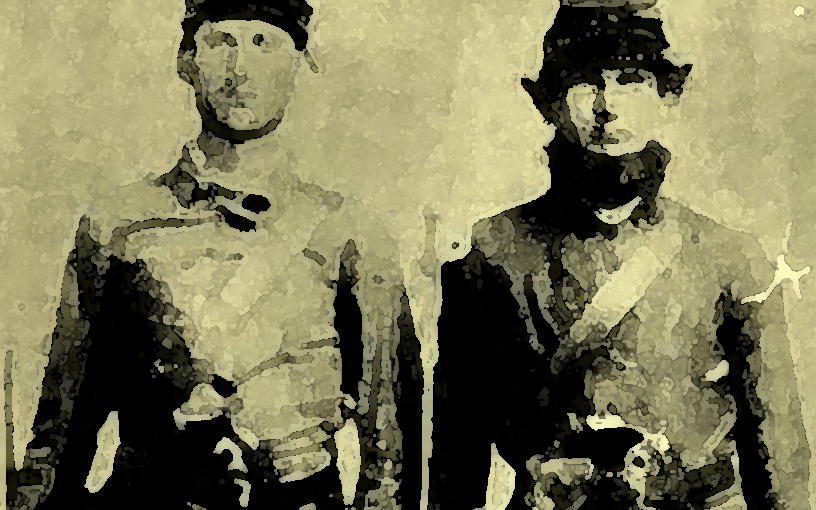
Levi Motts and Coleman Broussard were cousins, and each one loved Ruby Robison and she loved them both, as well. Levi and Cole were Confederates, and fought at Mansfield. But Levi died that afternoon, leaving Ruby and Cole to carry on together.


LEVI, RUBY, AND COLE
(F. D. Leone, Jr.)

Cole was strong and steady
Straight as a rail
Levi was born ready
Always raisin’ hell
Ruby loved Levi all the way
But Cole was who she chose
Levi might grow up some day
But, who knows

Ruby knew Cole loved her
But Levi charmed her heart
Cole was down to earth
Levi sparkled like a star

The War broke this trio up
Only one came back home
Ruby had two loves
Levi and Cole

Cole knew he and Ruby
Would never have
The kind of magic love
She and Levi had
Just taking care of her
For Cole, it was enough
He ain’ the apple of her youth
But theirs was also love

Ruby knew Cole loved her
But Levi charmed her heart
Cole was down to earth
Levi sparkled like a star

© 2018 Frank David Leone, Jr./Highway 80 Music (ASCAP). The songs and stories on the Highway 80 Stories website are works of fiction. Names, characters, businesses, places, events, locales, and incidents are either the products of the author’s imagination or used in a fictitious manner. Any resemblance to actual persons, living or dead, or actual events is purely coincidental.
“Between Here and Gone”


LOCATION: Macon, Georgia
PERIOD: January, 2010
DRAMATIS PERSONAE: Pearl Boone Robison (1973)


Pearl Robison comes from a fractured family line going back before the Civil War, and her life has carved a jagged line as well. She is related through her father, Jason Jones Robison (1946- ) to Ruby Robison (1843-1933), who was the sister of Marcus Walsh Robison (1836-1897) Pearl’s great-great-great-grandfather. Ruby Robison was a young prostitute in Shreveport who gave birth to a Civil War soldier’s child, the first Pearl Robison (see songs, “Fannin Street” and “Levi Motts is My Name“).

In 1973 Pearl Robison was born in Conyers, Georgia but we first meet Pearl when she is managing a dollar store in Macon. One January day in 2010, sitting in her car before opening up, she decides to leave town and head west on U.S. 80.


BETWEEN HERE AND GONE
(F. D. Leone, Jr.)

No one dreams of bein’ manager at Dollar Town
But life happens, there’s worse around
A stick of spearmint’ll hide whiskey on her breath
Might as well open up she’s out of cigarettes

Snowed eight inches overnight the air is crystal clear
They’ll be buying extra bread and eggs and beer
Just sittin’ and thinkin’ in her car out there alone
She’s stranded between here and gone

She could just drive away free as the breeze
Start over somewhere, just leave
Don’t matter no more what’s right or wrong
She’s stranded between here and gone

Checking her makeup she sees a new grey hair
She don’ know that woman who returns her stare
The day’s first shopper pulls in the parking lot
She still has time for one more shot

There’s nothing in this town for her to stay
She used to find little things that kept that thought away
Like goin’ to the Blue Bonnet for a lemon custard cone
She’s stranded between here and gone

She could just drive away free as the breeze
Start over somewhere, just leave
Don’t matter no more what’s right or wrong
She’s stranded between here and gone

© 2017 Frank David Leone, Jr./Highway 80 Music (ASCAP). The songs and stories on the Highway 80 Stories website are works of fiction. Names, characters, businesses, places, events, locales, and incidents are either the products of the author’s imagination or used in a fictitious manner. Any resemblance to actual persons, living or dead, or actual events is purely coincidental.

“Levi Motts Is My Name”


LOCATION: Northwest Louisiana
PERIOD: 1864
DRAMATIS PERSONAE: Levi Motts (1843-1864); Coleman Broussard (1842-1910); Ruby Robison (1845-1933); Pearl Robison (1864-1944)


Mustering out of Monroe, Louisiana Levi and his cousin Coleman Broussard joined up with in Colonel Henry Gray’s brigade, the Louisiana Gray’s. It did not take them long to find their way to the burgeoning red light district of Shreveport. There Levi met and took up with one of the young sporting girls there, Ruby Robison. Cole was also smitten and Ruby seeing Levi for what he was, a rake and leaky vessel for her to place her future, encouraged Cole in his romantic dreams. They were a inseparable trio, the two kinsmen and the beautiful and fragile young whore hedging her bets, so to speak.

Despite Coleman’s obvious romantic aspirations, Ruby couldn’t deny her stronger feelings for Levi. Defying the conventions of the time she and Levi made plans for marriage as soon as the war was over. However, the Louisiana Grays were called up to confront the Union troops already marching towards Louisiana after conquering Vicksburg. Gray’s brigade is one of the units in Gen. Robert Taylor’s army tasked with stopping the Trans-Mississippi Campaign of Nathaniel Bank’s invading force at Mansfield.

While the Battle of Mansfield was a Confederate victory, Levi Motts was one of only about a hundred Southern men who died there on April 8, 1864. When he went into battle, Levi knew that Ruby was pregnant with their child. This child, a girl Ruby named Pearl, is born in late December of 1864. Because of her illegitimate status Pearl chose to use the name Robison for most of her life.


LEVI MOTTS IS MY NAME
(F. D. Leone, Jr.)

Levi Motts is my name
Come from Northwest Louisiana
I joined up with Colonel Gray
He said be ready to march today
Don’t know when I’ll be back again
If this war will ever end

Ruby Robison is my gal
Keeps a room down in the bottoms
We talked of gettin’ out of there
Make a new life anywhere
Don’t know when I’ll be back again
If this war will ever end

Ruby wrote me a letter
We were waitin’ outside Mansfield
Wrote there’s a baby on the way
We fought the Yankees April Eighth
Don’t know when I’ll be back again
If this war will ever end

Levi Motts is my name
Come from Northwest Louisiana
Lead ball went through my neck
That afternoon I bled to death
Don’t know when I’ll be back again
If this war will ever end

© 2017 Frank David Leone, Jr./Highway 80 Music (ASCAP). The songs and stories on the Highway 80 Stories website are works of fiction. Names, characters, businesses, places, events, locales, and incidents are either the products of the author’s imagination or used in a fictitious manner. Any resemblance to actual persons, living or dead, or actual events is purely coincidental.

“Pearl and Jake”


LOCATION: Shreveport, Louisiana; Fort Worth, Texas
PERIOD: January, 2010-May, 2015
DRAMATIS PERSONAE: Pearl Boone Robison (1973); Jacob “Jake” Tyler McLemore (1959).


In 1973 Pearl Robison was born in Conyers, Georgia but we first meet Pearl when she is managing a dollar store in Macon. One January day in 2010, sitting in her car before opening up, she decides to leave town and head west on U.S. 80 (see song, “Between Here and Gone“).

She ends up in Shreveport, Louisiana, when she stops at an all night diner and Jake McLemore enters her life. They live together for five years before Pearl’s wanderlust overtakes her again and she leaves, this time heading for Fort Worth (see song, “Pearl + Jake“). She does not know at the time that she is pregnant, but when she discovers this fact, she waits almost two years before deciding it is best to let Jake know he is a father (see song “Terrell”)

She gives birth in 2015 to a baby girl whom she names Sadie Jo Robison, after her parents, Jason Jones Robison and Sadie Boone. Pearl and Jake get married in 2018 and raise Sadie Jo together.


PEARL AND JAKE
(F. D. Leone, Jr.)

Snowed all day in Macon when Pearl left for the last time
Al’bam, Mizsippy, Luziana; Georgia felt far enough behind
Creosote, cottonseed, Shree’port – hit her like a cinder block
Lights of an all-nite diner; Pearl coasted to a stop

Jake behind the counter, white apron little paper hat
Slid some coffee before her, quiet as an alley cat
Pearl pulled a pint from somewhere, tipped it over her cup
Jake lit a cigarette; the sun came up

Lovin’ her is what he meant to do
Even if it broke his heart in two
He played life like a game of horseshoes
Ah, but, lovin’ her was what he meant to do

Jake bought this diner after selling McLemore’s
Pearl was stranded in Macon managing a dollar store
They met on Jewella Avenue both lookin’ for a new start
Jake gave her some food and every one of his scars

Lovin’ her is what he meant to do
Even if it broke his heart in two
He played life like a game of horseshoes
Ah, but, lovin’ her was what he meant to do

Jake didn’t want to come home stinkin’ of cigarettes, beer and perfume
Five years passed by as he walked from room to empty room
Pearl was runnin’ away that first day he met her
She’d been leavin’ ever since, Jake finally found a way to let her

© 2018 Frank David Leone, Jr./Highway 80 Music (ASCAP). The songs and stories on the Highway 80 Stories website are works of fiction. Names, characters, businesses, places, events, locales, and incidents are either the products of the author’s imagination or used in a fictitious manner. Any resemblance to actual persons, living or dead, or actual events is purely coincidental.